
• In The Shop
  • Build
  • Restore
  • Electrify

Category: Plans

  • D’Anna

    D’Anna

    D’Anna

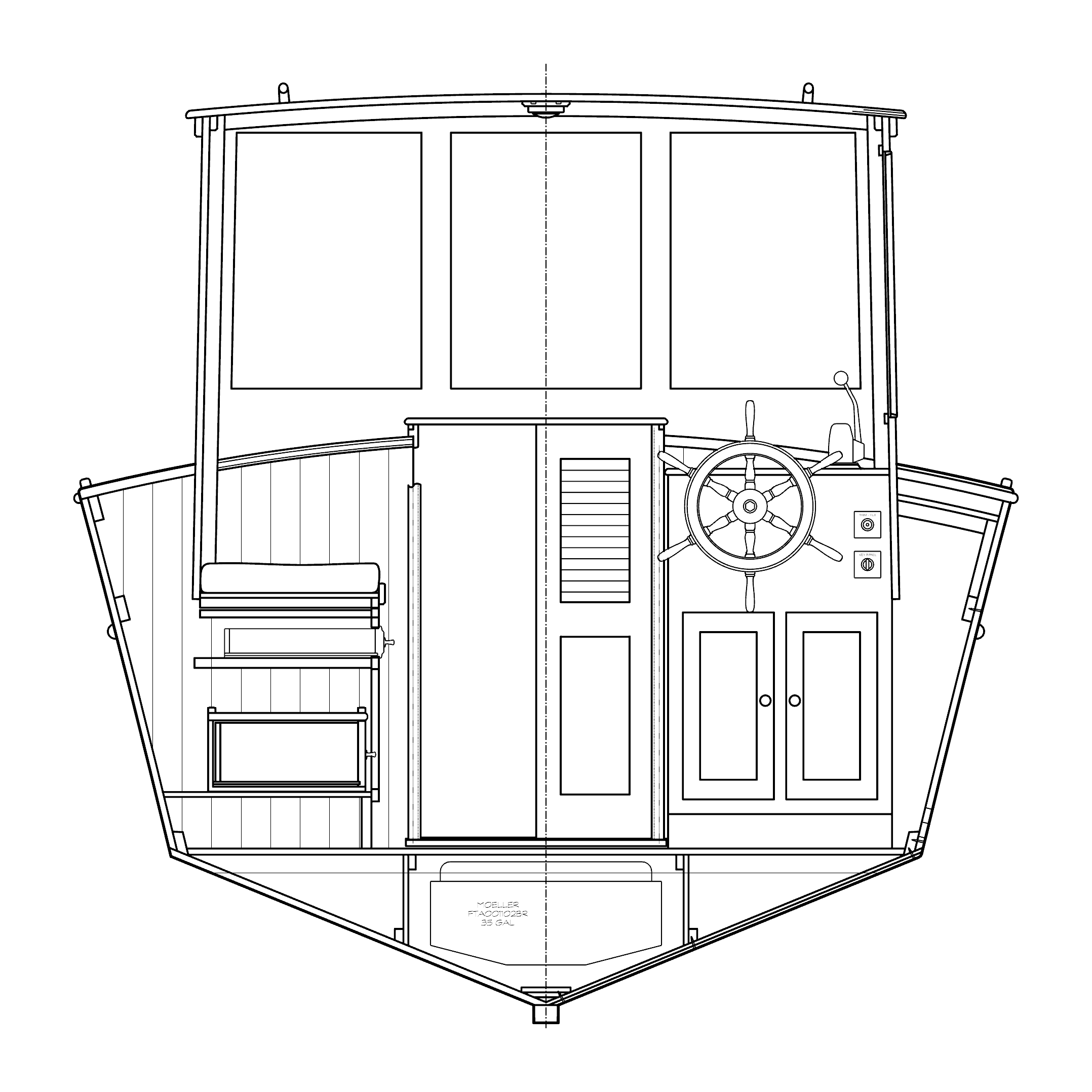
    Beals Island lobster boat

    An evolution of the 29′ Beals Island lobster boat DIANA

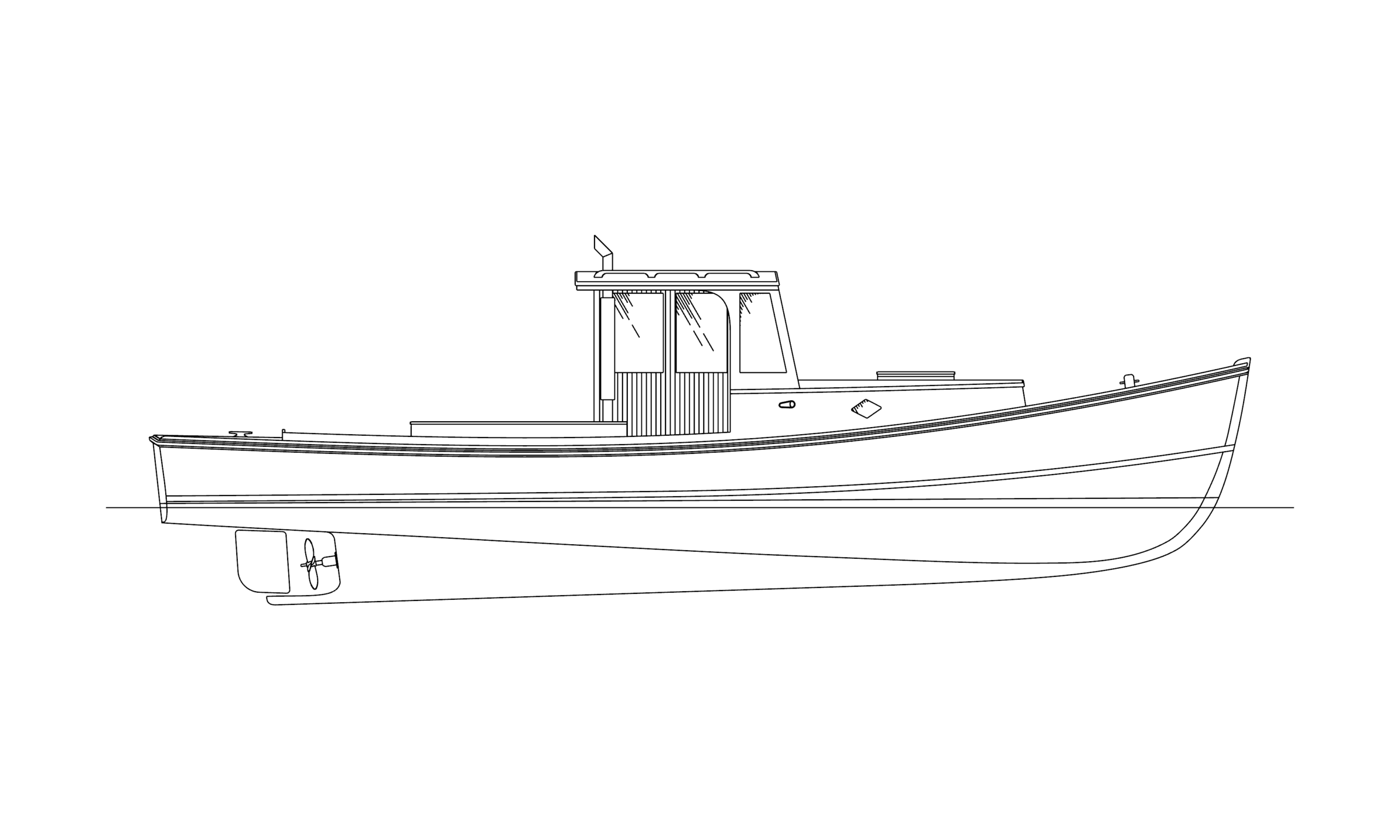
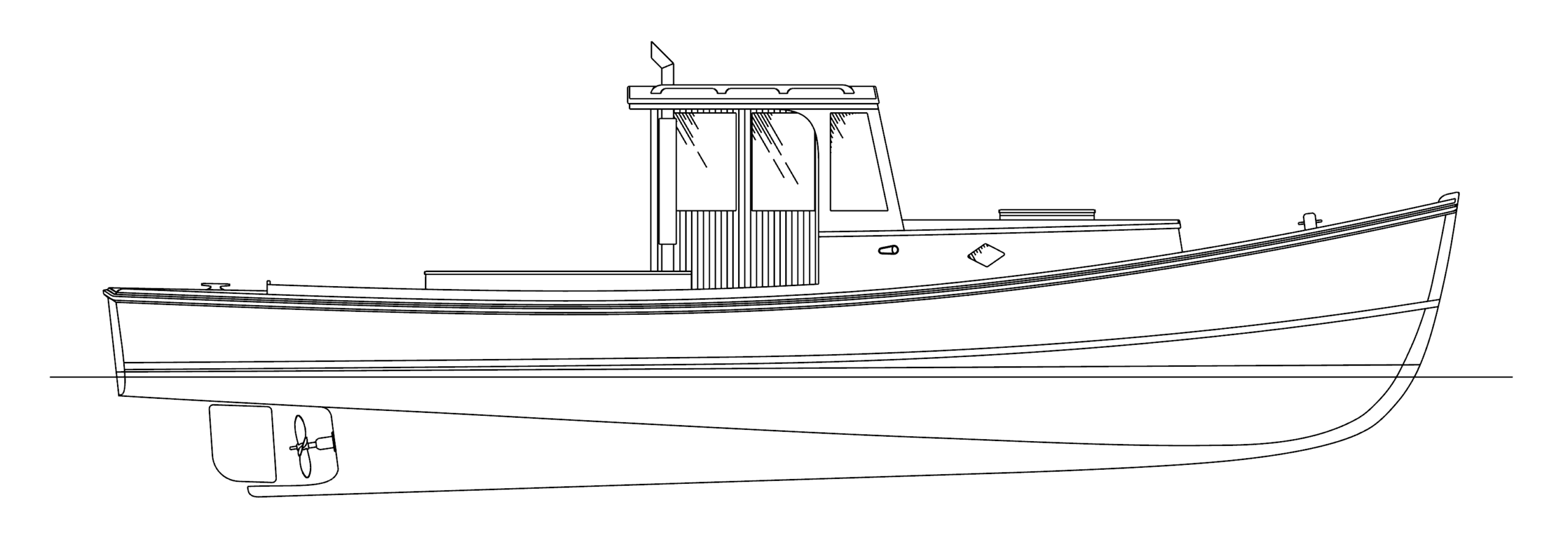
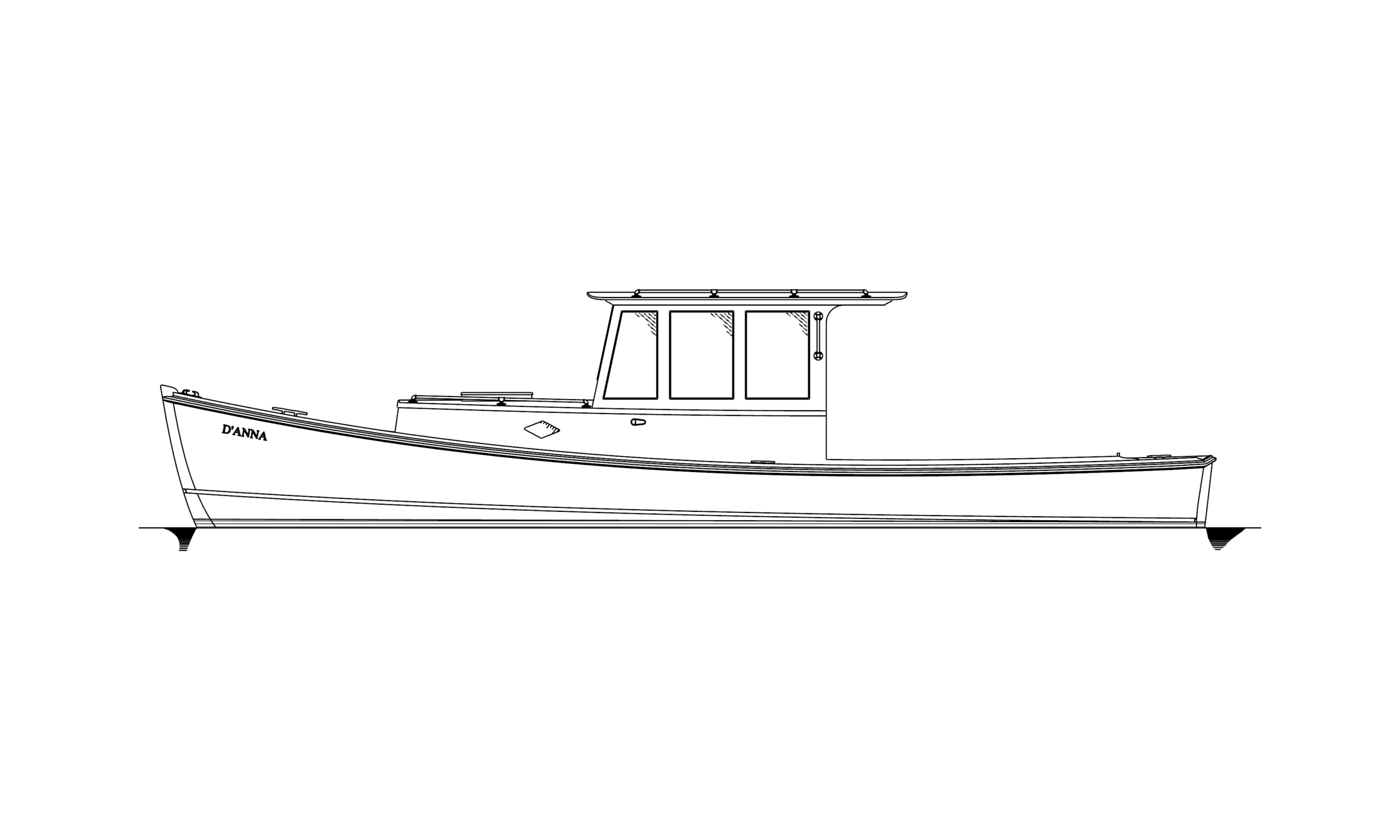
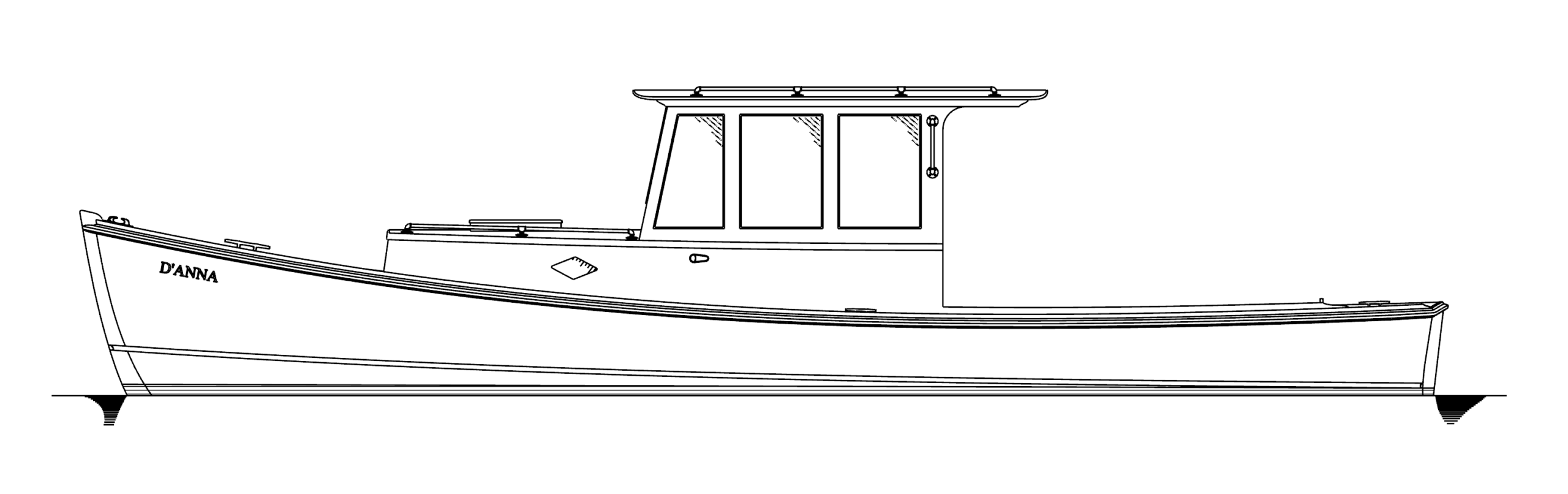
    D’Anna is an evolution of the Beals Island lobster boat, DIANA, which we restored in 2002. On re-launching, that boat was christened DIANA after the wife of her long time owner, Beals Island fisherman, historian and raconteur Avery Kelley. This modified design is named after Avery and Diana’s daughter, D’Anna.

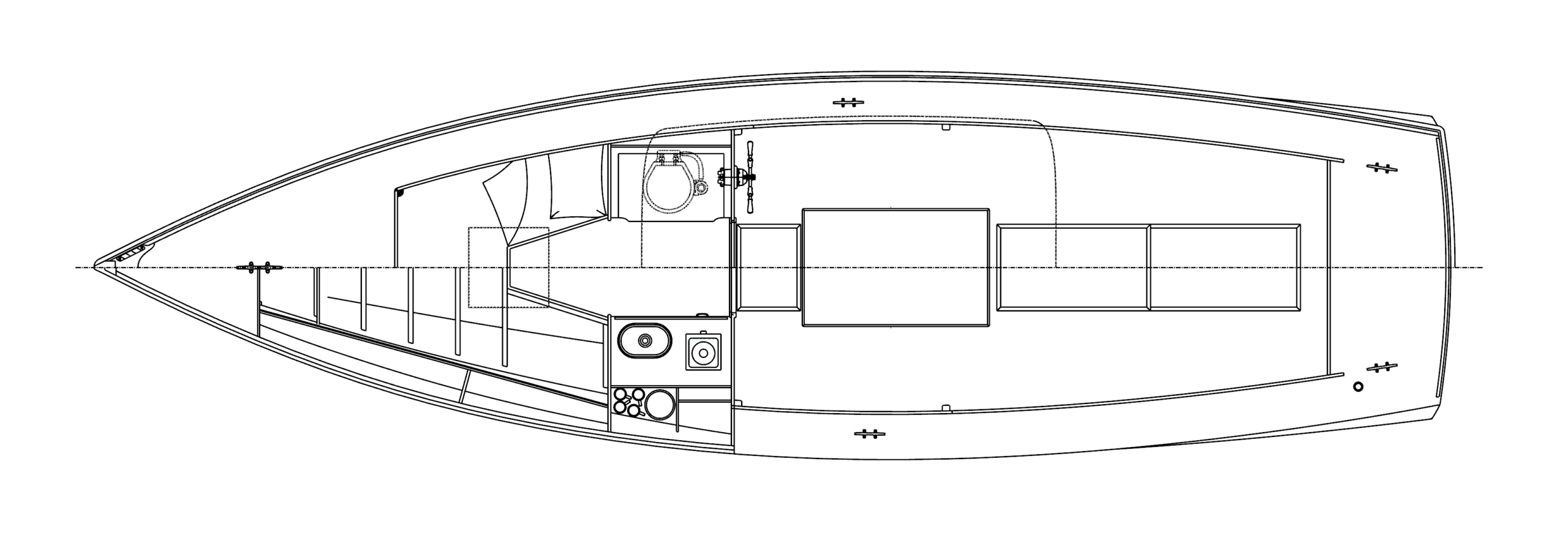
    Maine lobstermen like to have their engines fairly far forward in the boat, in order to make more room in the cockpit for working their traps. Typically, they do not carry much fuel, often topping up when they deliver their catch at the end of each day. This means that a true lobster boat hull is designed to carry its displacement relatively far forward. D’Anna’s lines have been modified to move her center of buoyancy slightly aft, to allow her engine to be mounted further aft and permit a somewhat larger fuel tank under the aft deck.

    Other modifications include a slight increase in length to 30′ and a beam increase to 8′ 6″, the legal trailering limit without permit. At this beam she is proportionately wider than her mother, but still narrow by today’s standards, allowing for easier powering above theoretical hull speed. The freeboard has also been raised slightly, and the transom is proportionately wider. The extra size allows a self bailing cockpit. In spite of her extra size, D’Anna is slightly lighter than her mother, due to her glued construction. A speed of 14 knots is available with her 75hp inboard diesel.

    While Diana’s plans were for traditional plank-on-frame, these plans show cold-molded construction. However, there is no reason why either boat cannot be built by either method. Please contact me if you are interested in alternative construction.

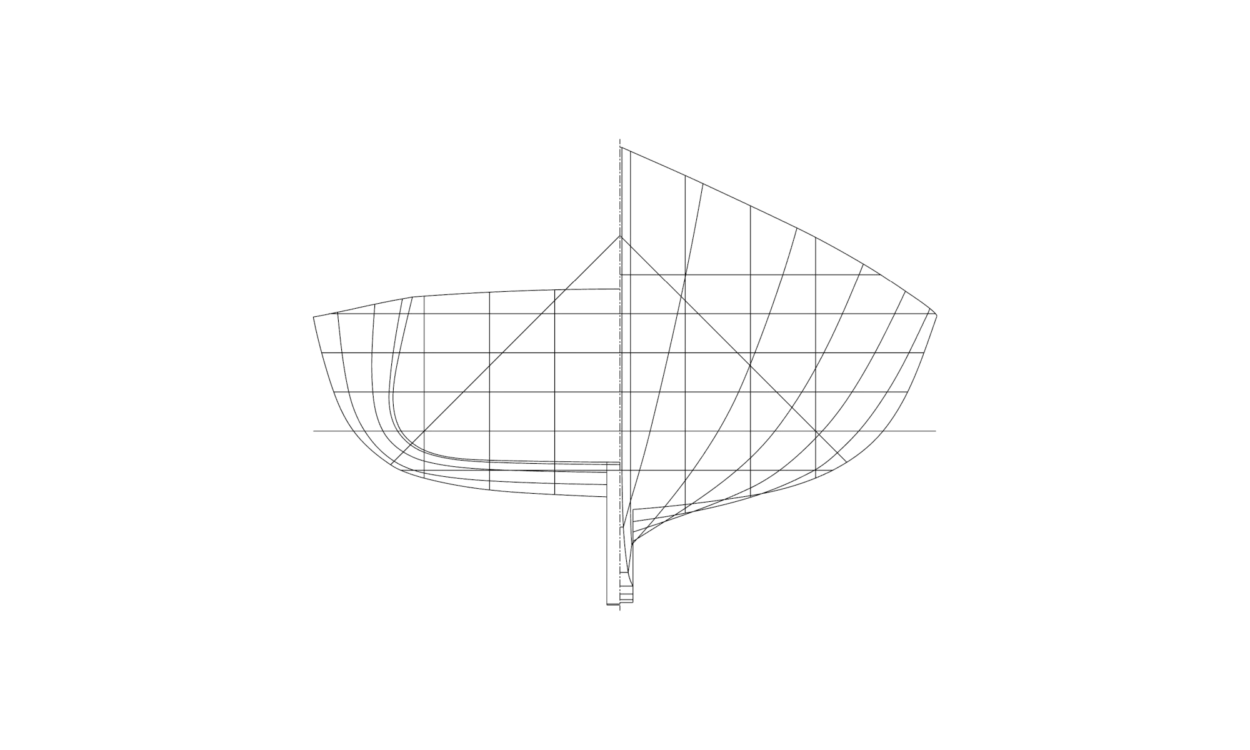
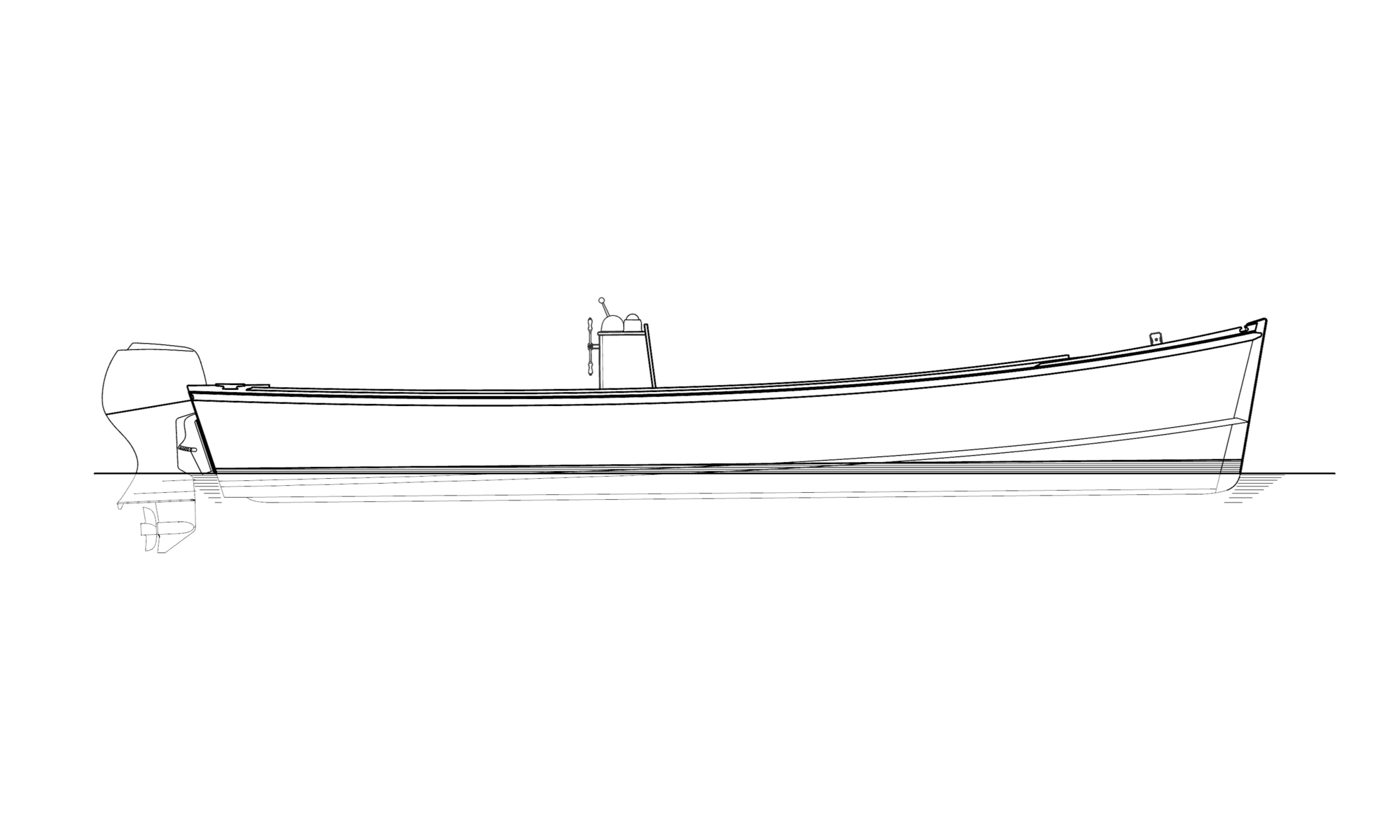
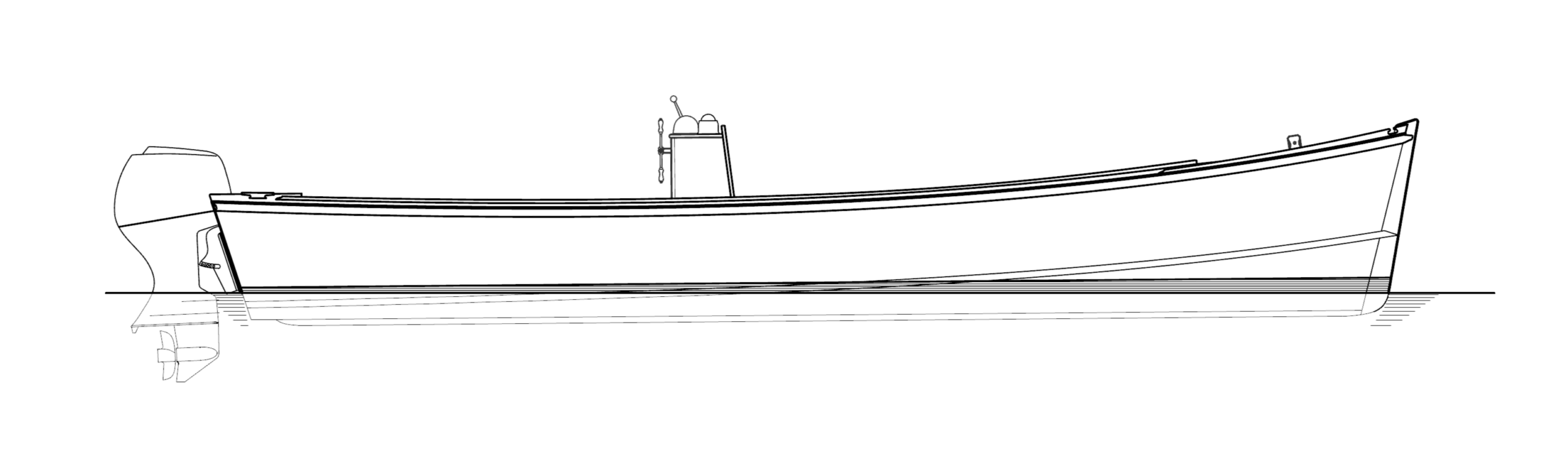
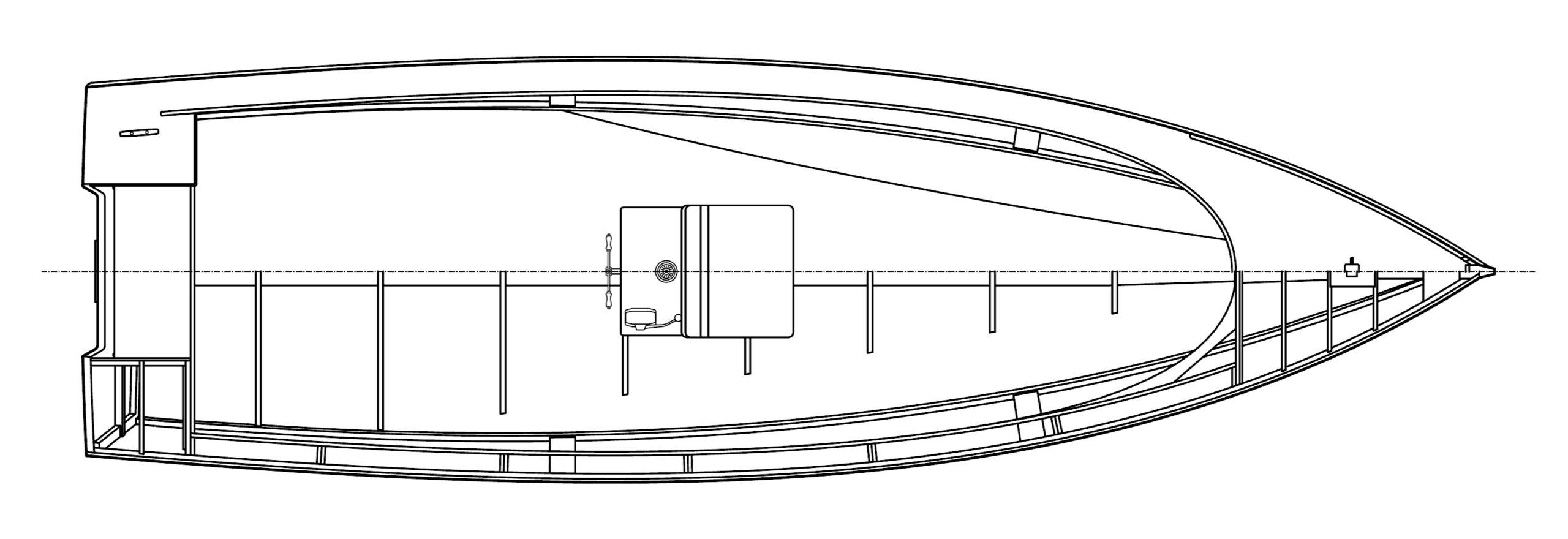
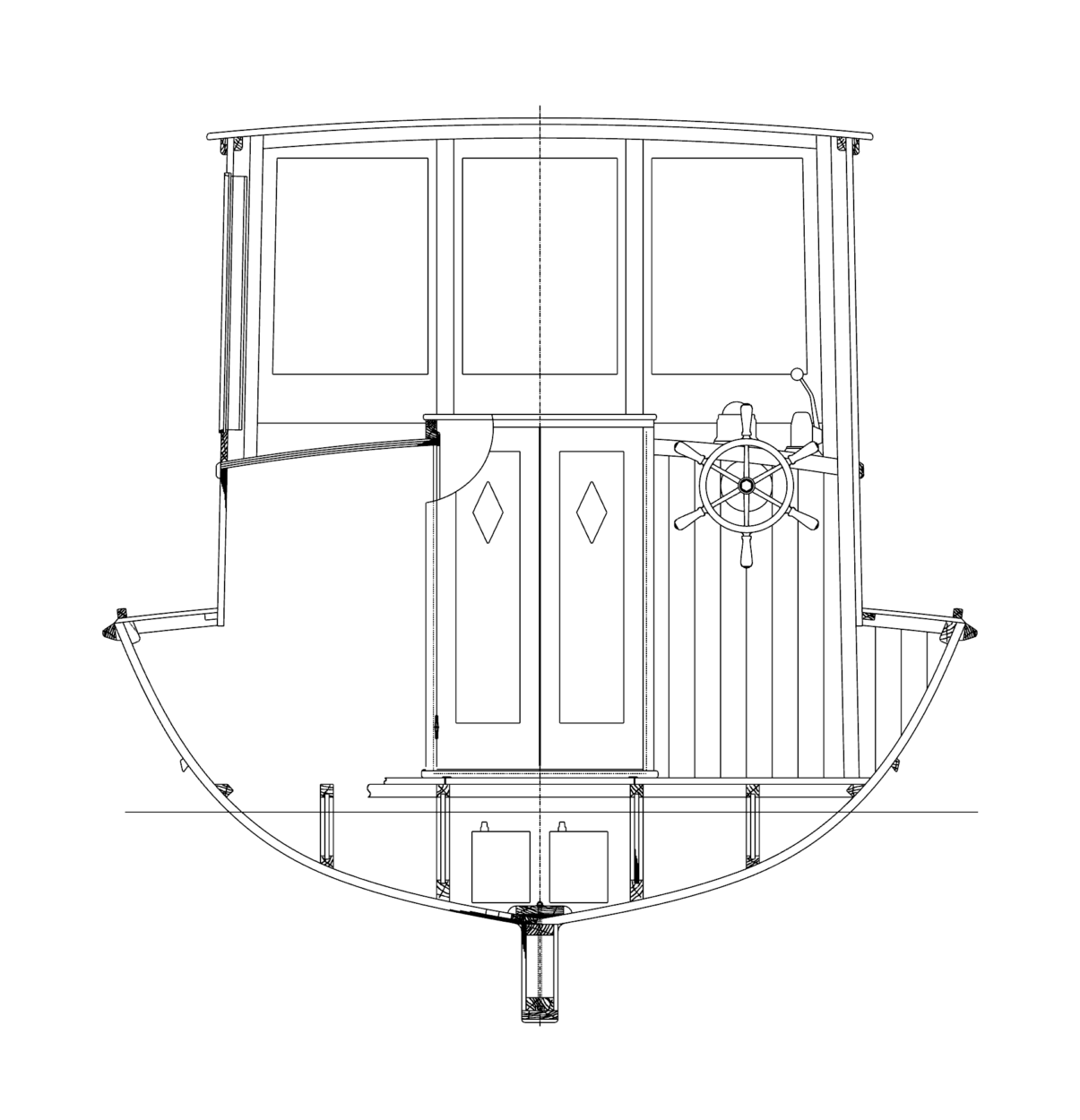
    The full plans consist of four sheets: Lines Plan, Outboard Profile & Deck Plan, Inboard Profile & Framing Plan, and Construction Sections & Details. Also included is a CD with hull offsets, construction and finished photos of a similar boat, and other various and possibly helpful information.


    STUDY PLANS: Click here to download free study plans.

    TO PURCHASE PLANS: Plans include 4 sheets. To order online using Paypal’s ordering system (which accepts credit cards and eChecks), please select one of the following buttons:

    U.S. orders. $200 + $20 shipping = $220
    International orders, including Canada. $200 + $80 shipping = $280
    You can see your Paypal Cart at any time by clicking the button below:

    You can also order plans by sending a check or money order to Hylan & Brown Boatbuilders, 10 Frank Day Ln, Brooklin, ME 04616.

    FAQ: Many questions are answered in Frequently Asked Questions. Please check there first.
    Particulars

    LOA30′
    LWL28′ 9″
    Beam8′ 6″
    Draft2′ 6″
    Disp.6300 lbs
    Speedup to 14 kts with 75 hp
    TrailerableYes, with an appropriate towing rig
    Hull typeDowneast skeg-type lobster boat
    ConstructionCold-molded wood
    Suitable forSomewhat protected waters
    Skill neededAdvanced
    Lofting requiredHull lines are computer-faired; CNC mold files available at extra cost and with restrictions
    Level of detailAbove average
  • Coquina

    Coquina

    Coquina

    N.G. Herreshoff

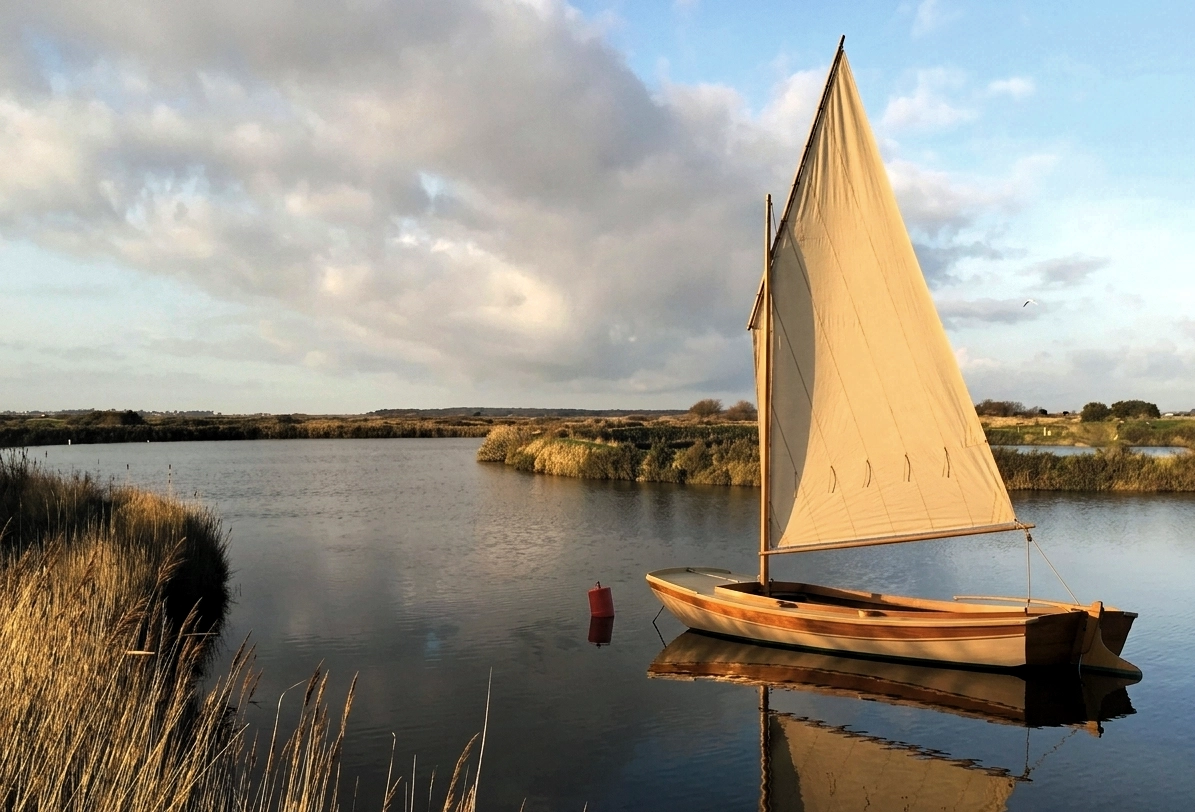
    Both glued lapstrake plywood and traditional cedar over oak construction.

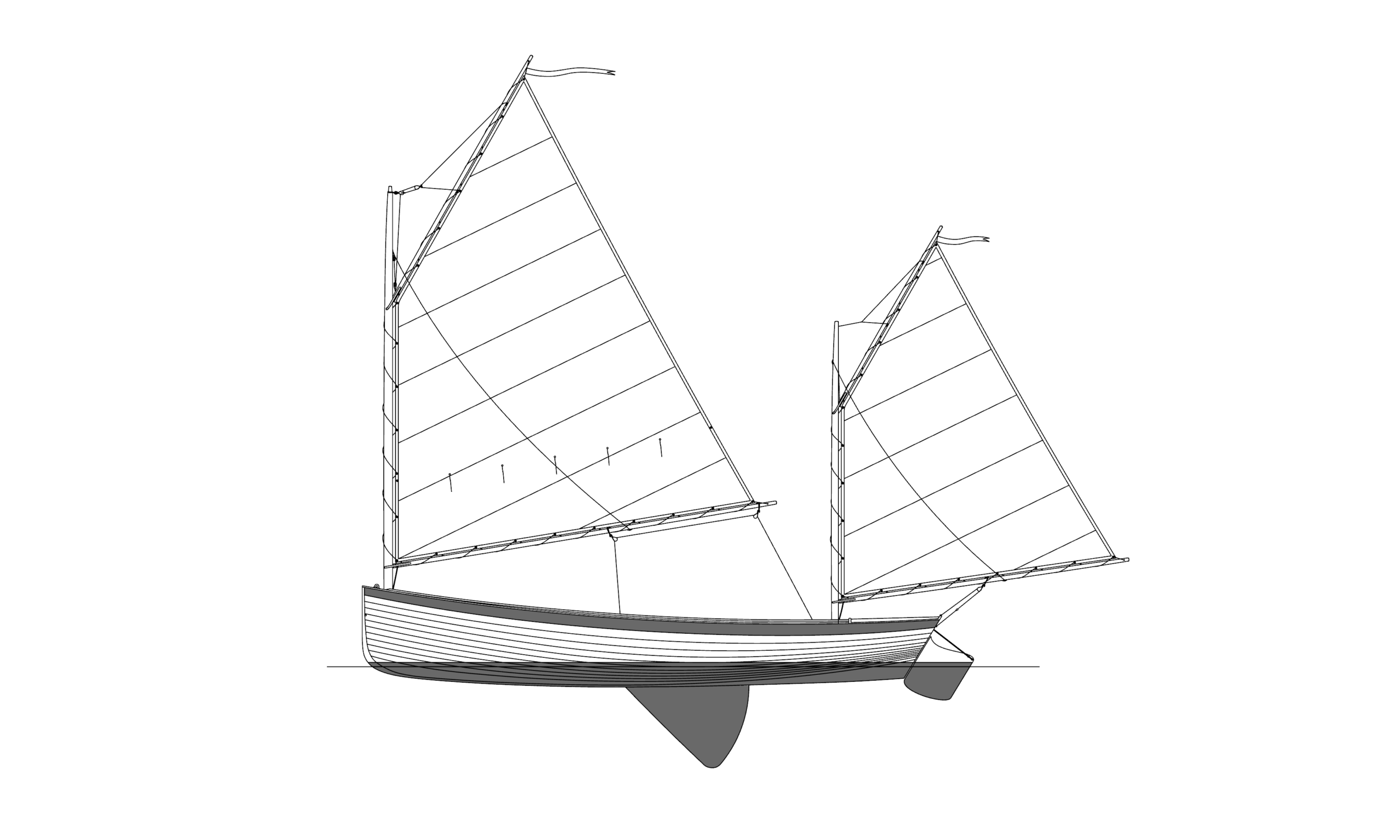
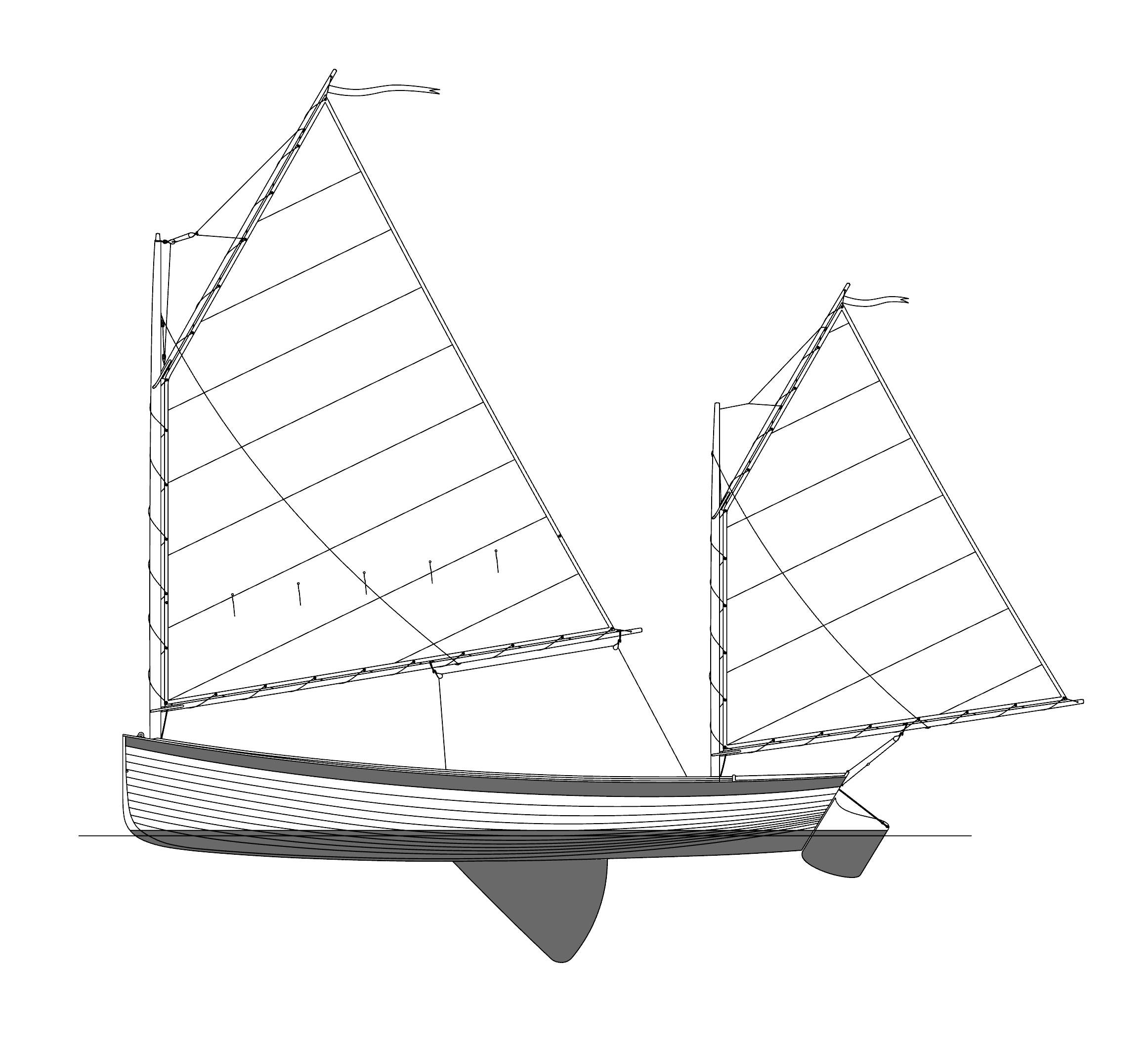
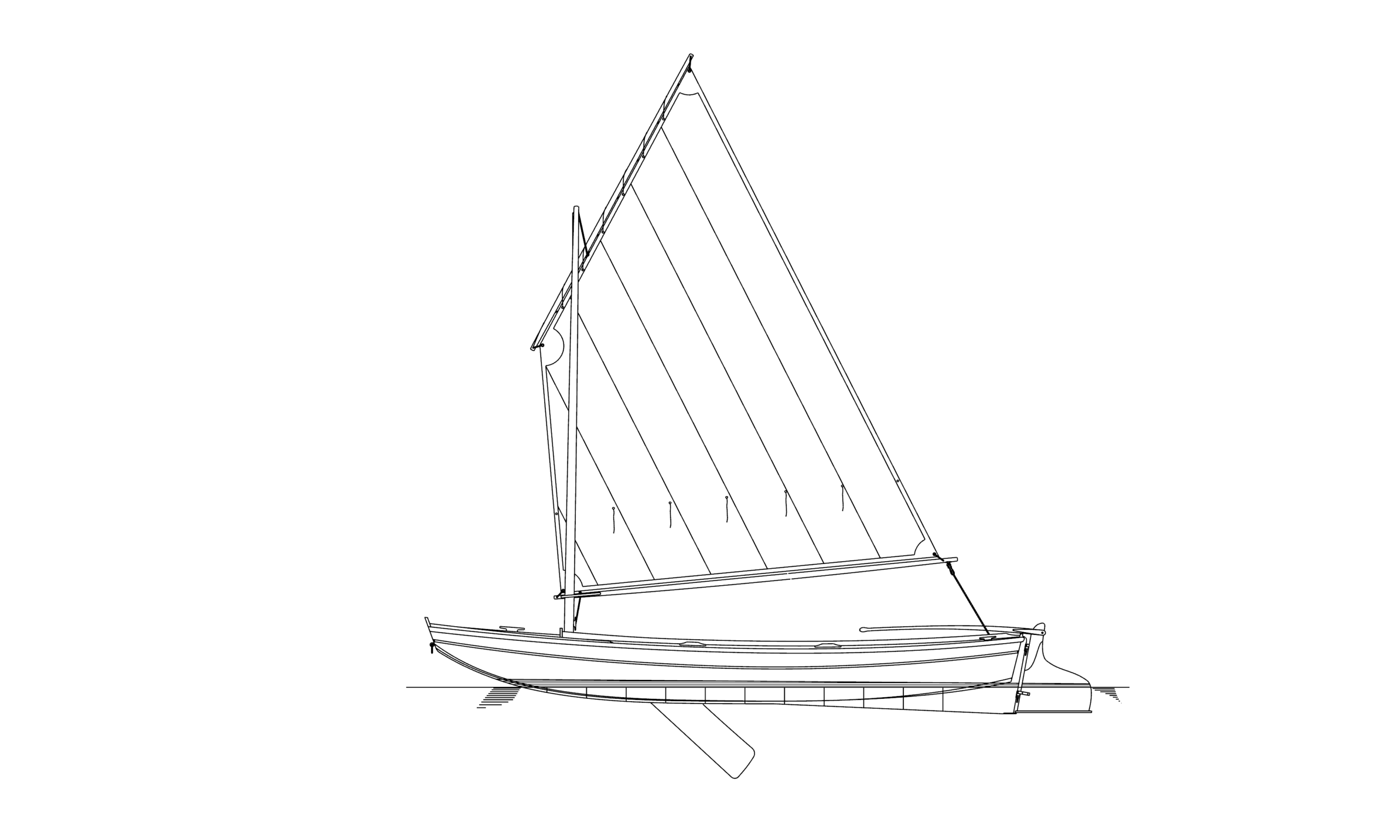
    Under license from the MIT’s Hart Nautical Collections, Doug Hylan and Maynard Bray have collaborated to produce a highly detailed builder’s package for both amateur and professional builders, as well as students of Herreshoff’s work. Nathanael Herreshoff designed Coquina for his own use in the winter of 1889, and used her for may years, perhaps longer that any other of his personal yachts. Herreshoff wrote in some detail of Coquina in his later life: “I sailed quite often, both summer and winter.” Surely such a boat, used so much and remembered so fondly by a man of Herreshoff’s means and experience, must have applications for today’s sailors.

    Plans are fully detailed, and consist of 11 sheets including Herreshoff’s original construction drawing.

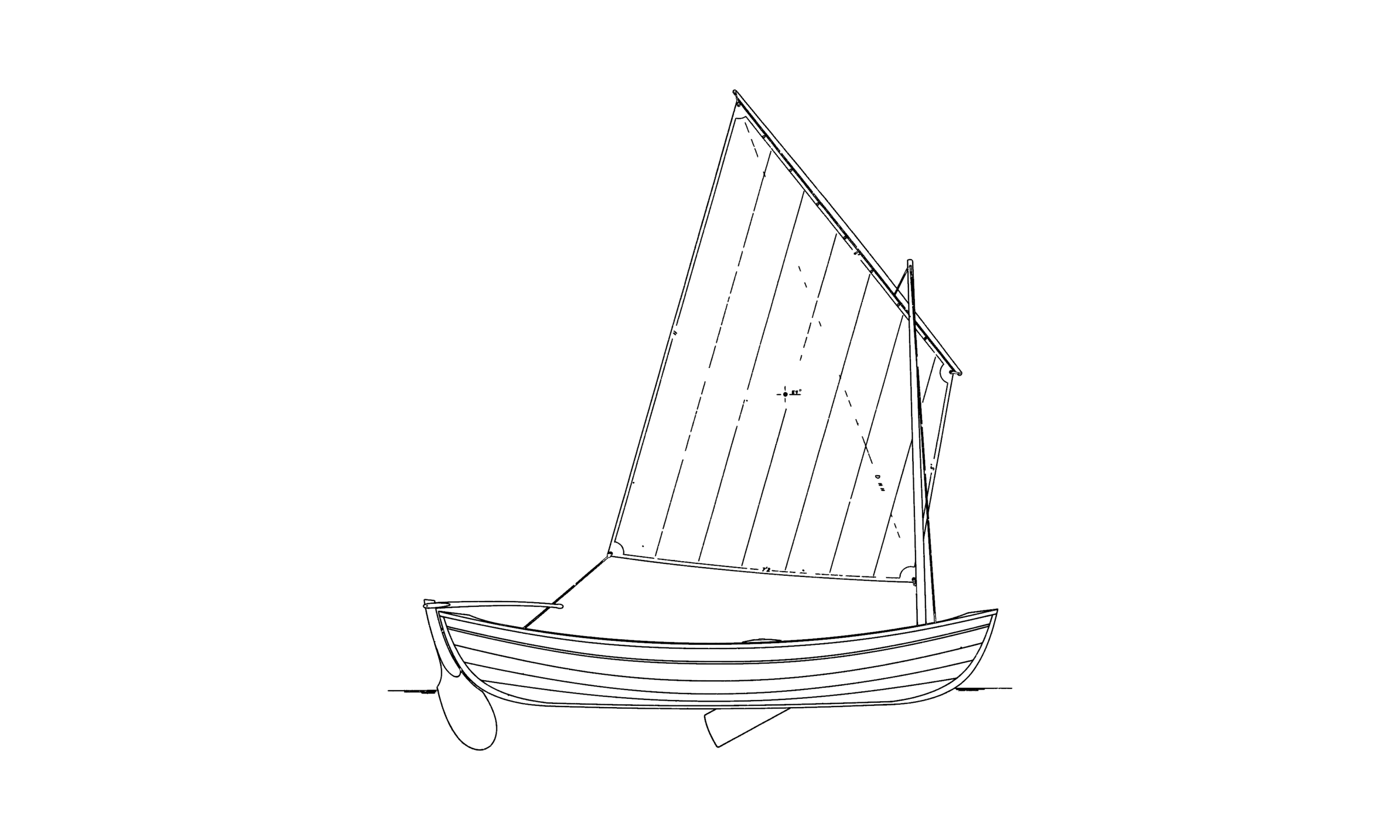
    Other sheets include sail plan, lines plan, original construction, glued lapstrake plywood construction, spars & rigging plan, building jig, and four sheets of full sized patterns and plank layouts.

    COMPACT DISC – also available, a CD containing over 500 photos of both traditional and glued lapstrake plywood construction, covering every aspect of building, rigging and sailing these wonderful boats.


    STUDY PLANS: Click here to download free study plans.

    TO PURCHASE PLANS: Plans include 11 sheets. A photo CD is also available. To order online using Paypal’s ordering system (which accepts credit cards and eChecks), please select one of the following buttons:

    U.S. orders, plans only. $200 + $20 shipping = $220
    International orders, including Canada, plans only. $200 + $80 shipping = $280
    U.S. orders, plans + CD. $250 + $20 shipping = $270
    International orders, including Canada, plans + CD. $250 + $80 shipping = $330
    U.S. orders, CD only. $50 + $6 shipping = $56
    International orders, including Canada, CD only. $50 + $15 shipping = $65
    You can see your Paypal Cart at any time by clicking the button below:

    You can also order plans by sending a check or money order to Hylan & Brown Boatbuilders, 10 Frank Day Ln, Brooklin, ME 04616.

    FAQ: Many questions are answered in Frequently Asked Questions. Please check there first. There are also some Coquina-specific FAQs at the bottom of this page.
    Particulars

    LOA16′ 8″
    Beam5′ 1″
    Draft8″ / 3′
    Weight450 lbs, with rig
    TrailerableYes
    Hull typeRound-bottom lapstrake
    ConstructionGlued lapstrake plywood or traditional cedar over oak
    Suitable forSomewhat protected waters
    Skill neededSkilled amateur
    Lofting requiredNo
    Level of detailVery detailed

    OTHER REFERENCES:

    Herreshoff of Bristol, Bray & Pinheiro, pp. 50, 51, 126, 146.
    “Getting to Know COQUINA” by Maynard Bray, WoodenBoat Magazine, No. 187, p. 76.

    Coquina FAQs (click to open)

    Do you take Credit Cards? How can I pay for my plans?

    As if August 1, 2007, you can now use the PayPal ordering system to pay for most plans. PayPal accepts Visa / MC / AmEx / Discover / eCheck / PayPal. Or you can send a check or money order to: COQUINA, 53 BENJAMIN RIVER DR., BROOKLIN, ME, 04616. We do not wait for personal checks to clear, usually shipping your order within a day or two.

    Do you ship plans outside of the US?

    Yes, we will ship plans anywhere. International postage rate are $50.00 for plans and $8.00 for a CD.

    Before I buy, where can I get more information on Coquina?

    The best source for general information is Maynard Bray’s article in WoodenBoat, number 187. Another good reference is Michael Hanyi’s article in the Nov/Dec 2001 issue of the British magazine Watercraft.

    I have some woodworking experience but have never built a boat before.
    Do you think I can build Coquina?

    This is a very difficult question to answer. We have seen beautiful boats that have come from the hands of inexperienced builders. And we have seen not-so-nice boats from builders with considerable experience. Given enough time, almost anyone can build a boat that will float and sail or row. We have gone to great lengths to put together a plans package that is as detailed as possible, in order to leave as few questions as possible for inexperienced builders. We have found that this is the best way to insure success in a project like this.

    Should I build a simpler boat first before building Coquina?

    If you have no boat building or woodworking experience, this may not be a bad idea. If it is a very simple boat, like Joel White’s fine Nutshell pram or Shellback dinghy, you may find that the skills acquired in building it will so speed up your Coquina project that you will have two boats for nearly the same time commitment as one. And once you start building boats, you are likely to want to keep it up.

    Can I count on you for help in building my Coquina?

    We want your Coquina project to have the best possible outcome, but unfortunately, if we answered every question that came our way, we would never get anything else done. You might consider asking someone to work with you on your project. This person may have more experience than you, and two heads are usually better than one. On our CD, we will provide a more extensive FAQ section addressing builder’s questions, as well as a list of applicable books and sources for maternials. Old WoodBoat Magazines are a great source of information – check out their on-line index. Finally, the WoodenBoat Forum at WoodenBoat.com can be a source of helpful (and sometimes not so helpful) information. If you need to contact me, e-mail me through this web site and include your phone number and best time to call.

    What are the pros & cons of traditional construction?

    Traditional plank on frame construction is the real thing – just what Herreshoff himself used. Some builders enjoy working in real wood and avoiding epoxy. A higher level of skill is required for traditional construction – joints are more complicated, steam bending is required, and better fits are required.

    What are the pros & cons of glued lapstrake construction?

    Glued lapstrake plywood boats are immune to drying out and the problems associated with the natural shrinking and swelling cycle of wood. They don’t leak, and are much better able to withstand life on a trailer. Their maintenance is slightly lower and the skills required to build them are less fussy.

    I love Coquina, but do not have the time or interest to build my own.
    How much does it cost to have one built for me?

    At Hylan & Brown – Boatbuilders the current price for a completed Coquina is around $29,000.00. Consult with other builders for their prices.

    How may hours are involve in building Coquina?

    Our first boat took us about 250 hours to complete the hull, about 850 man hours for the total project. This was for an experienced builder.

    How much are materials likely to cost to build Coquina?

    For the boats we built, the materials came to about $3200.00. We enjoy some wholesale and quantity discounts, but not to a great extent on a boat of this type.

  • Chesapeake Crab Skiff

    Chesapeake Crab Skiff

    Chesapeake Crab Skiff

    A fast and stable boat that can carry a real load.

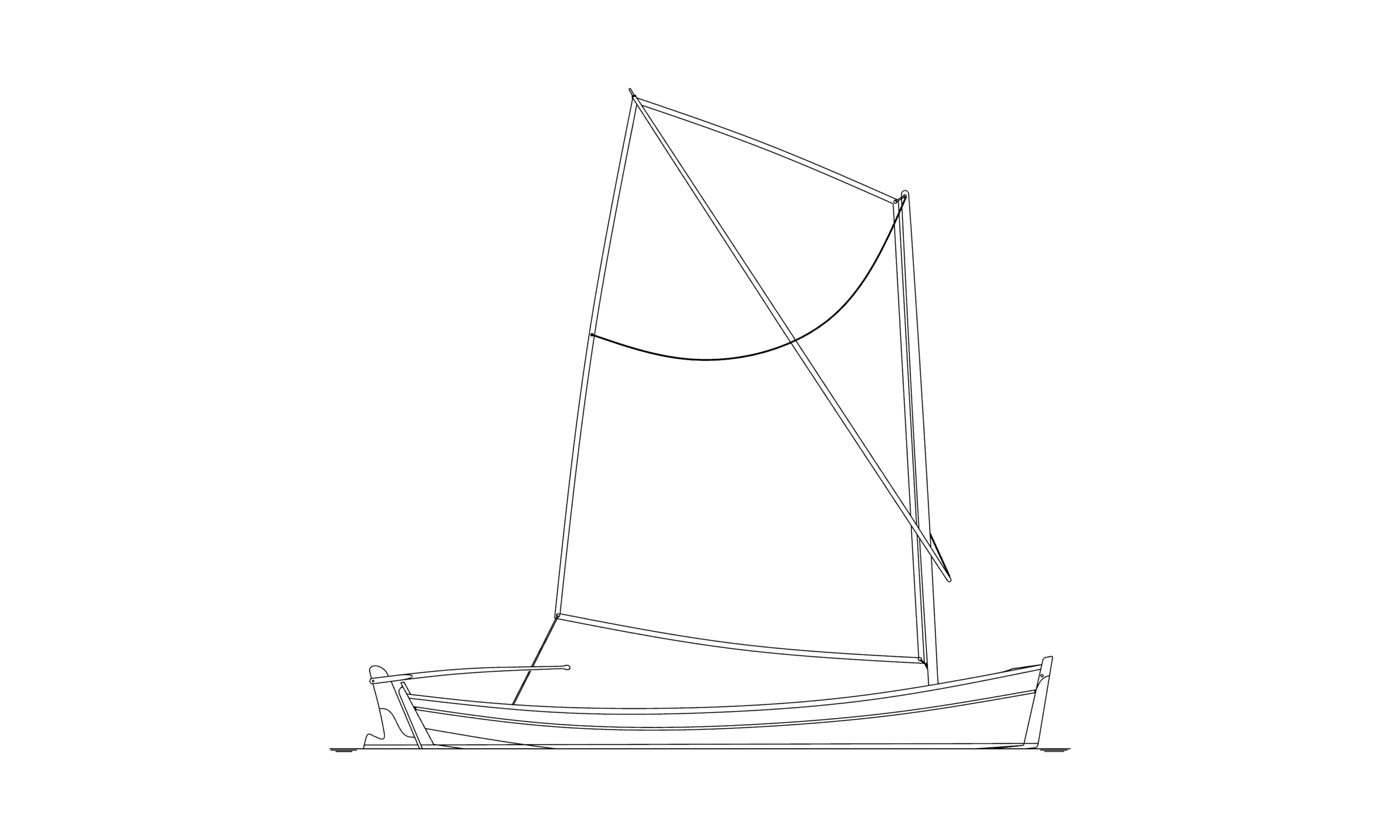
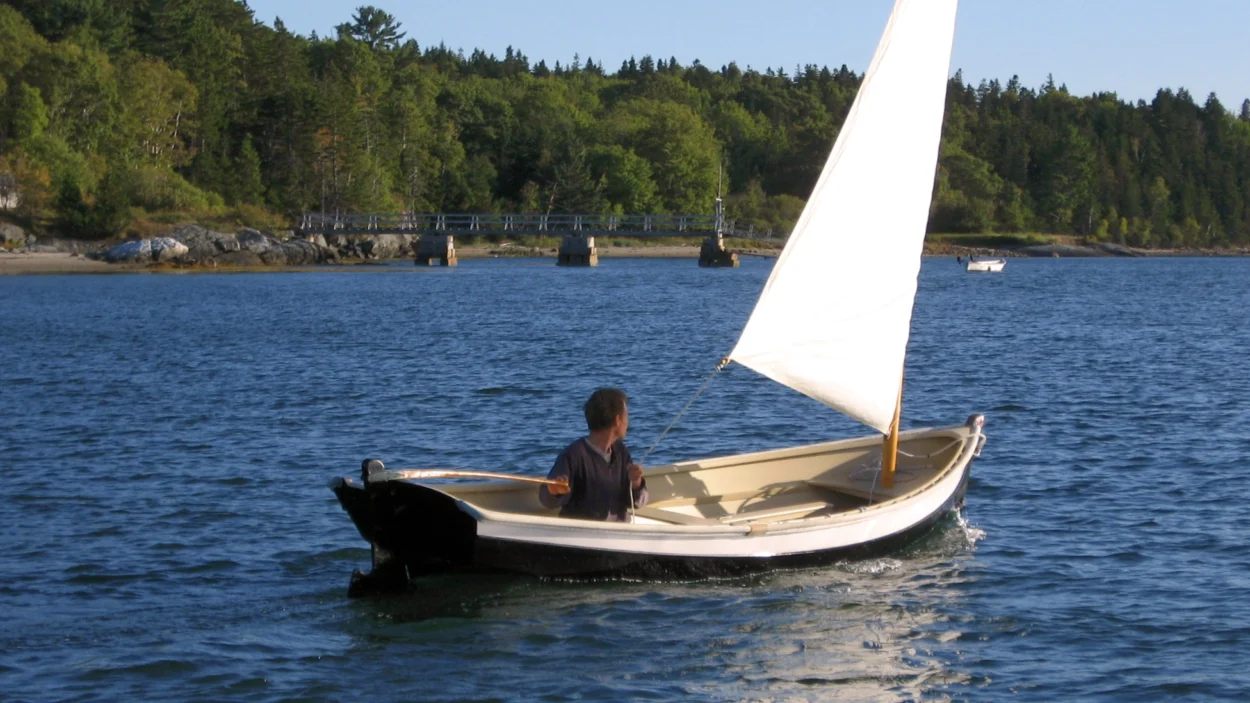
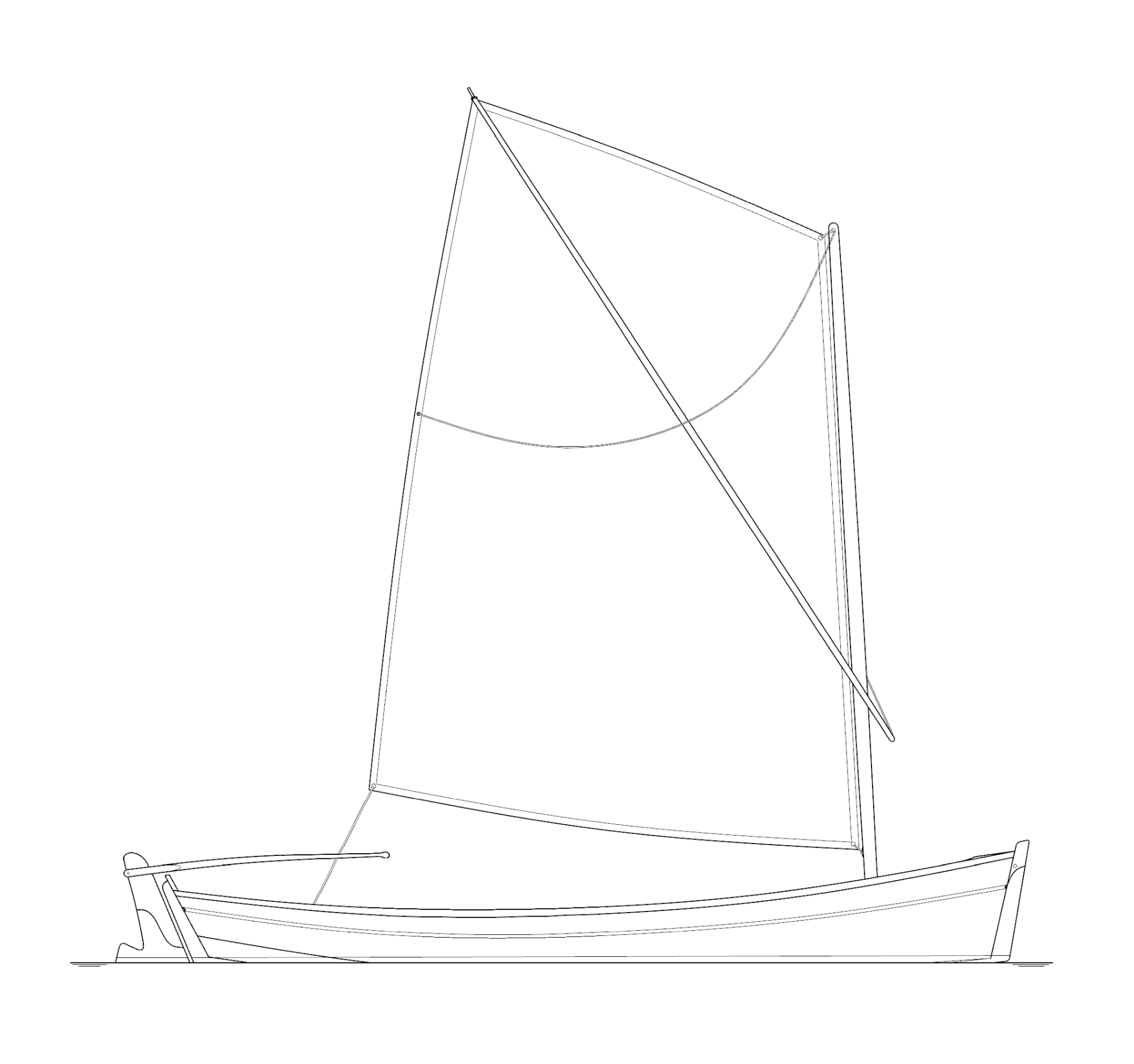
    Based on traditional crabbing skiff documentation by Howard Chapelle, this has proven to be a fast and stable boat that can carry a real load. While primarily a sailing skiff, she is reasonably handy under oars and easily driven with a tiny outboard. She also displays good manners when towed.

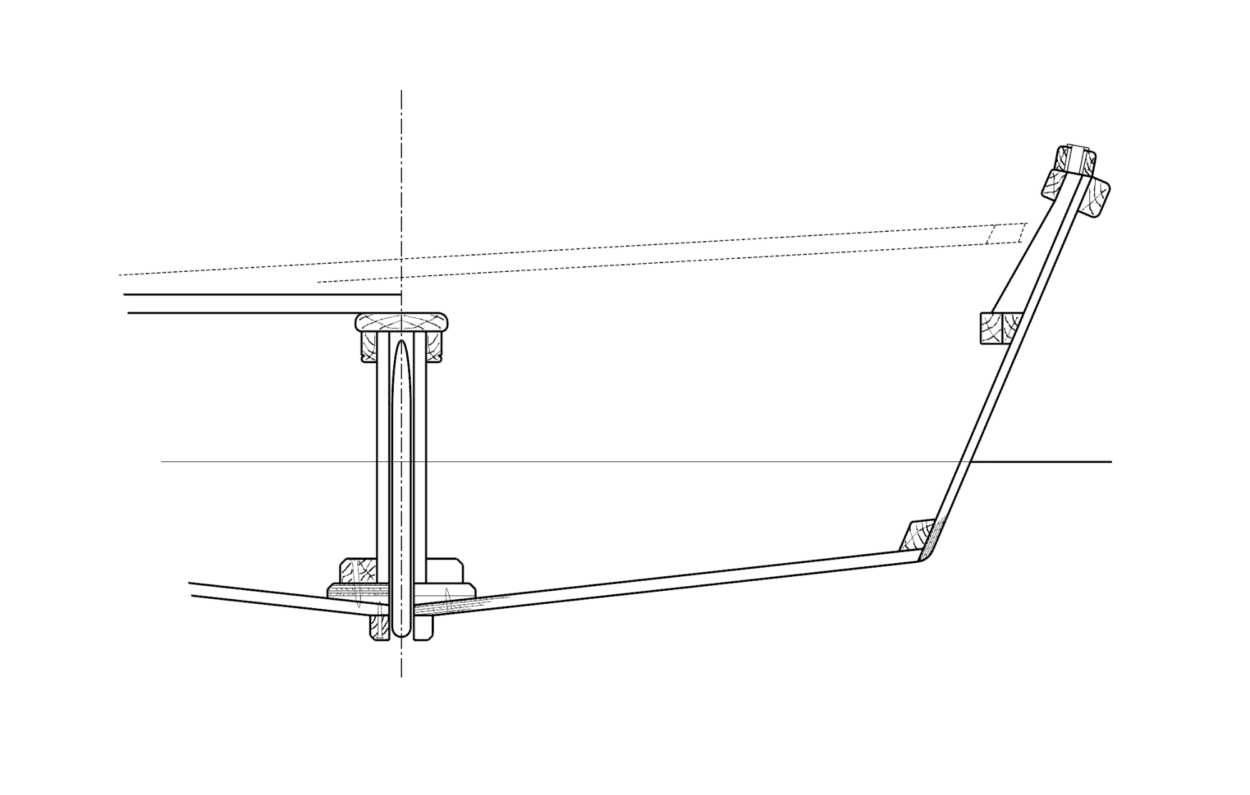
    As Mike O’Brien said in his WoodenBoat design review, “Doug Hylan has drawn a striking skiff that looks sharp in any company.” Plans are on four sheets: Lines and offsets, construction, leg o’ mutton sail plan and sprit sail plan.

    Traditional detailing is combined with easy maintenance and simple plywood construction.

    Crab Skiff prototype under sail

    STUDY PLANS: Click here to download free study plans.

    TO PURCHASE PLANS: Plans include 7 sheets: Lines, Construction, Sprit Rig, Leg-o-Mutton Rig, Setup Jig, full-size patterns. To order online using Paypal’s ordering system (which accepts credit cards and eChecks), please select one of the following buttons:

    U.S. orders. $150 + $20 shipping = $170
    International orders, including Canada. $150 + $80 shipping = $230
    You can see your Paypal Cart at any time by clicking the button below:

    You can also order plans by sending a check or money order to Hylan & Brown Boatbuilders, 10 Frank Day Ln, Brooklin, ME 04616.

    FAQ: Many questions are answered in Frequently Asked Questions. Please check there first.
    Particulars

    LOA15′ 4”
    Beam4′ 8″
    Draft10″ / 2′ 5″
    Weightapprox. 250 lbs
    Speedup to 6 kts
    TrailerableYes
    Hull typeDeadrise
    ConstructionPlywood
    Suitable forSomewhat protected waters
    Skill neededBeginner to intermediate
    Lofting requiredNo, full-size patterns included
    Level of detailAbove average

    OTHER REFERENCES – Design review by Mike O’Brien, WoodenBoat #157:74

  • Diana

    Diana

    Diana

    Beals Island lobster boat

    Inspired by the reconstruction of a 1950’s boat.

    DIANA was built by Alvin Beal in the early 1950s on Beals Island, Maine. She incorporates the handsome low sheer and skeg construction that were a hallmark of that area.

    In 2002, a new owner asked Hylan & Brown to rebuilt DIANA for use as a picnic boat for his Downeast summer home. The boats lines were lifted and her original construction documented. A new house and shelter were designed and the original propulsion system was re-configured.

    These plans will be of interest to students of Maine lobster boat design, as well as potential builders. Most early lobster boats were built from builders models, and little documentation exists. Plans consist of four sheets: lines & offsets, outboard profile, inboard profile and construction sections.

    In 2010 we launched a cold-molded version of DIANA called BRENDA KAY. We also offer stock plans for a 30′ cold-molded evolution of DIANA called D’ANNA.


    STUDY PLANS: Click here to download free study plans.

    TO PURCHASE PLANS: Plans include 4 sheets. To order online using Paypal’s ordering system (which accepts credit cards and eChecks), please select one of the following buttons:

    U.S. orders. $120 + $20 shipping = $140
    International orders, including Canada. $120 + $80 shipping = $200
    You can see your Paypal Cart at any time by clicking the button below:

    You can also order plans by sending a check or money order to Hylan & Brown Boatbuilders, 10 Frank Day Ln, Brooklin, ME 04616.

    FAQ: Many questions are answered in Frequently Asked Questions. Please check there first.

    Particulars

    LOA28′ 8”
    LWL27′ 6″
    Beam8′ 1″
    Draft2′ 3″
    Disp.6500 lbs
    Speedup to 18 kts
    Trailerablewith difficulty
    Hull typeDowneast skeg-type lobster boat
    ConstructionCarvel planking over steam bent frames
    Suitable forSomewhat protected waters
    Skill neededAdvanced
    Lofting requiredYes
    Level of detailAverage
  • Swan Point Garvey

    Swan Point Garvey

    Swan Point Garvey

    Working garveys of various sizes were once ubiquitous along the 90 miles of back bays behind the barrier islands on the New Jersey coast, used for tonging, clamming and fishing in the bays, gunning in the expansive marshes and bringing farm produce down river to market. In American Small Sailing Craft, Howard Chapelle goes into great length on the myriad variations of this hull type. Easy to build and burdensome, these boats gave an economical means of transport in sheltered waters all along the American East Coast. Proportions, size, and rig varied depending on locale, but construction was always simple and robust.

    The Swan Point Garvey is designed for glued plywood construction, so it will be much lighter than the traditional boats, and will be happy living on a trailer. She can be rowed, sculled, poled, sailed or fitted with a tiny outboard (preferably electric). If you enjoy camp cruising, there is good sleeping space for two with the amidships thwart “slipped”. Just like its forebears, this will be a simple boat to build – well within the abilities of a weekend boatbuilder or a parent/child team.

    Longtime Barnegat Bay sailor Russ Manheimer commissioned the design for this little sailing garvey, writing: “Even not-so-pretty boats such as our humble New Jersey garvey deserve consideration for a new design for home builders using modern glued ply methods.” Russ’s input was invaluable in developing this design. He aspires to foster a comeback of the type, with a boat that “would work well along the quiet water and creeks still to be found on our bay and elsewhere.”


    STUDY PLANS: Click here to download free study plans.

    TO PURCHASE PLANS: Plans include 7 sheets: Lines & Sail Plan, Construction, Building Jig, Details, and 3 sheets of full-size patterns. To order online using Paypal’s ordering system (which accepts credit cards and eChecks), please select one of the following buttons:

    U.S. orders. $220 + $20 shipping = $220
    International orders, including Canada. $200 + $80 shipping = $280
    You can see your Paypal Cart at any time by clicking the button below:

    You can also order plans by sending a check or money order to Hylan & Brown Boatbuilders, 10 Frank Day Ln, Brooklin, ME 04616.

    FAQ: Many questions are answered in Frequently Asked Questions. Please check there first.

    Particulars

    LOA15”
    Beam4′ 8″
    Draft8″ / 2′ 6″
    Weightapprox. 300 lbs
    Power2-3 hp max
    Speedup to 5 kts
    TrailerableYes
    Hull typeGarvey
    ConstructionPlywood
    Suitable forSomewhat protected waters
    Skill neededBeginner
    Lofting requiredNo, full-size patterns included
    Level of detailAbove average

    OTHER REFERENCES: Design review by Mike O’Brien, WoodenBoat #299.

  • Beach Pea

    Beach Pea

    Beach Pea

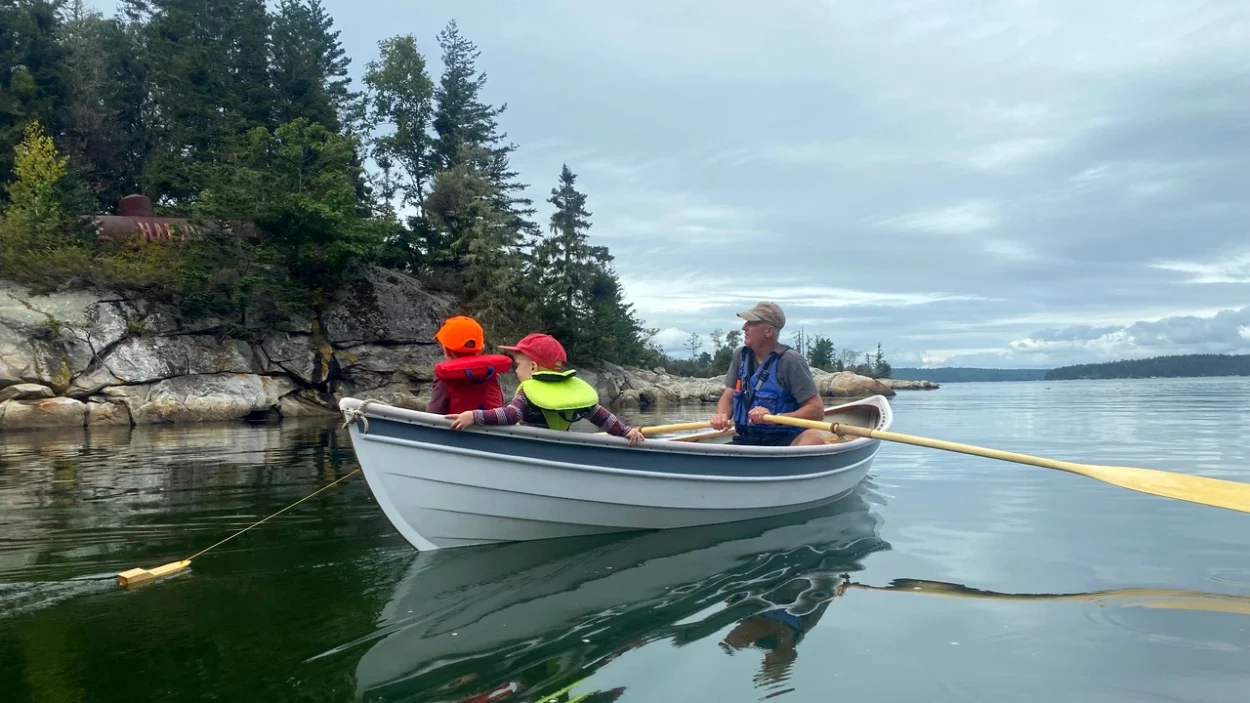
    Most boats produced as tenders today row so poorly that it is little wonder that their owners often turn to an outboard motor for help. But if you wish to forego the noise, expense and pollution of a motor, you may find that a peapod is the ultimate yacht tender.

    These are great little boats, seaworthy, stable, and easily rowed. Here is a pod that is a bit smaller than most, but she will still carry a big load and bring you through some lumpy water with confidence.

    Beach Pea uses modern glued lapstrake plywood construction, so she is lighter and easier to build than a traditionally-built boat. In addition, you won’t have to worry about her seams opening if your pod has been out of the water for a while. The clean interior will be easier to maintain, and a coat of paint will last longer on the stable plywood surface.

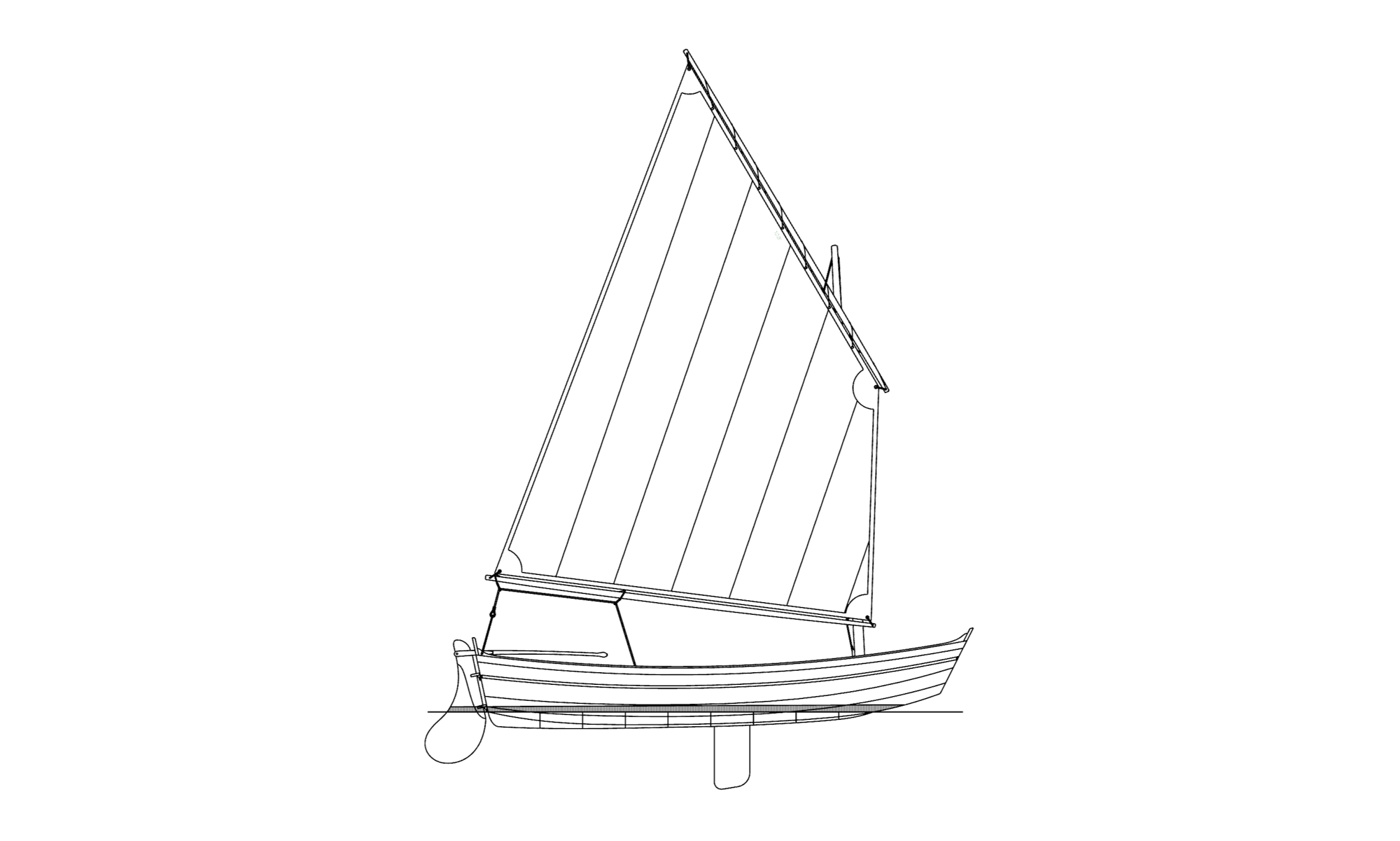
    Two sailing rigs are shown, an easy to strike lugsail, and the more traditional sprit rig. Doug Hylan drew Beach Pea’s plans with the beginning builder in mind. The plans are well-detailed and full-size patterns eliminate the need for lofting. Plans are on five sheets, including lines, construction, two sail plans and full size patterns for molds and stems. A 22 page “how to build” booklet is included to help you along.

    The extended version of Beach Pea is 15 feet long with the same beam. Basically, the longer boat uses the same molds as the 13 footer, just spaced further apart. Also the stems are pulled out a bit to the same proportion. The plans include instructions for re-spacing the molds, a layout for the new stem shape, and an optional arrangement with side decks and flotation compartments in the ends. There is also a slightly bigger sail plan and rudder arrangement shown.


    13′ STUDY PLANS: Click here to order digital study plans from the WoodenBoat Store

    13′ KITS: Learn more about the Beach Pea 13 kit here. To order a kit, contact Hewes & Co.

    TO PURCHASE PLANS: Click here to order plans from the WoodenBoat Store


    EXTENDED 15′ VERSION: The plans for the extended 15′ version of Beach Pea are an add-on to the regular 13′ plans. Please thus order the plans for the 13′ version (see above) and the add-on plans below. To order online using Paypal’s ordering system (which accepts credit cards and eChecks), please select one of the following buttons:

    U.S. orders. $50 + $6 shipping = $56
    International orders, including Canada. $50 + $15 shipping = $65
    You can see your Paypal Cart at any time by clicking the button below:

    You can also order plans by sending a check or money order to Hylan & Brown Boatbuilders, 10 Frank Day Ln, Brooklin, ME 04616.

    FAQ: Many questions are answered in Frequently Asked Questions. Please check there first.


    15′ version (click to show)

    Particulars | 13′ version

    LOA13′
    Beam4′ 4″
    Draft3″ / 1′ 6″
    Weightapprox. 120 lbs
    PropulsionSail & oar
    TrailerableYes
    Hull typeRound bottom double ender
    ConstructionGlued lapstrake plywood
    Suitable forProtected waters
    Skill neededBeginner to intermediate
    Lofting requiredNo, full size patterns included
    Level of detailAbove average

    Particulars | 15′ version

    LOA15′
    Beam4′ 4″
    Draft3 1/2″ / 1′ 6″
    Weightapprox. 140 lbs
    PropulsionSail & oar
    TrailerableYes
    Hull typeRound bottom double ender
    ConstructionGlued lapstrake plywood
    Suitable forProtected waters
    Skill neededBeginner to intermediate
    Lofting requiredNo, full size patterns included
    Level of detailAbove average
    Photo: Elizabeth Root
  • Oonagh

    Oonagh

    Oonagh

    The anti-RIB

    In traditional boating circles, it is a long cherished tradition to rail against inflatables, and there are some good reasons. Because rowing them to good effect is not possible, inflatables almost invariably wind up with an outboard on the transom. Outboards produce several varieties of pollution – sound, air, water – and have a tendency to foster questionable skylarking by bored youngsters. And recently, mankind has discovered that burning petroleum might just have another big drawback as well.

    The new generation of rigid bottom inflatables, or RIBs have some additional vices. They abandon what used to be the most powerful argument for inflatables – that they can be deflated and stored aboard for longer passages. They feature deepish V-bottoms, which make rowing even more impossible, and only really show any advantage with the application of lots of petroleum. When you try to use that horsepower, a RIB will first plow itself into a deep trough, then jump up onto a plane with unnerving rapidity – they have no sweet spot between the two.

    My hunch is that the rush to RIBs is driven by the fact that we baby boomers (the flower children who were going to bring us to the age of Aquarius, remember?) are losing our balance, muscle mass, joint mobility (and a bunch of other functions too embarrassing to mention), and are happy to have a dinghy that is as stable as a church, can be driven like a bumper car, and gives us an airtight excuse for not rowing. Come on Flower Children, let’s take back the high road!

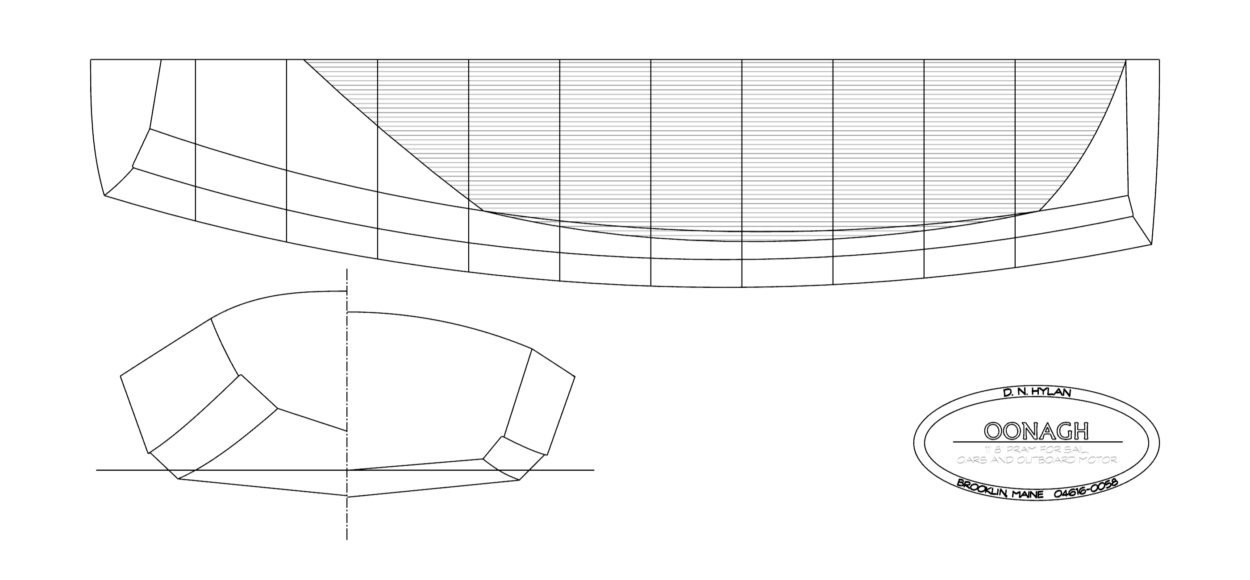
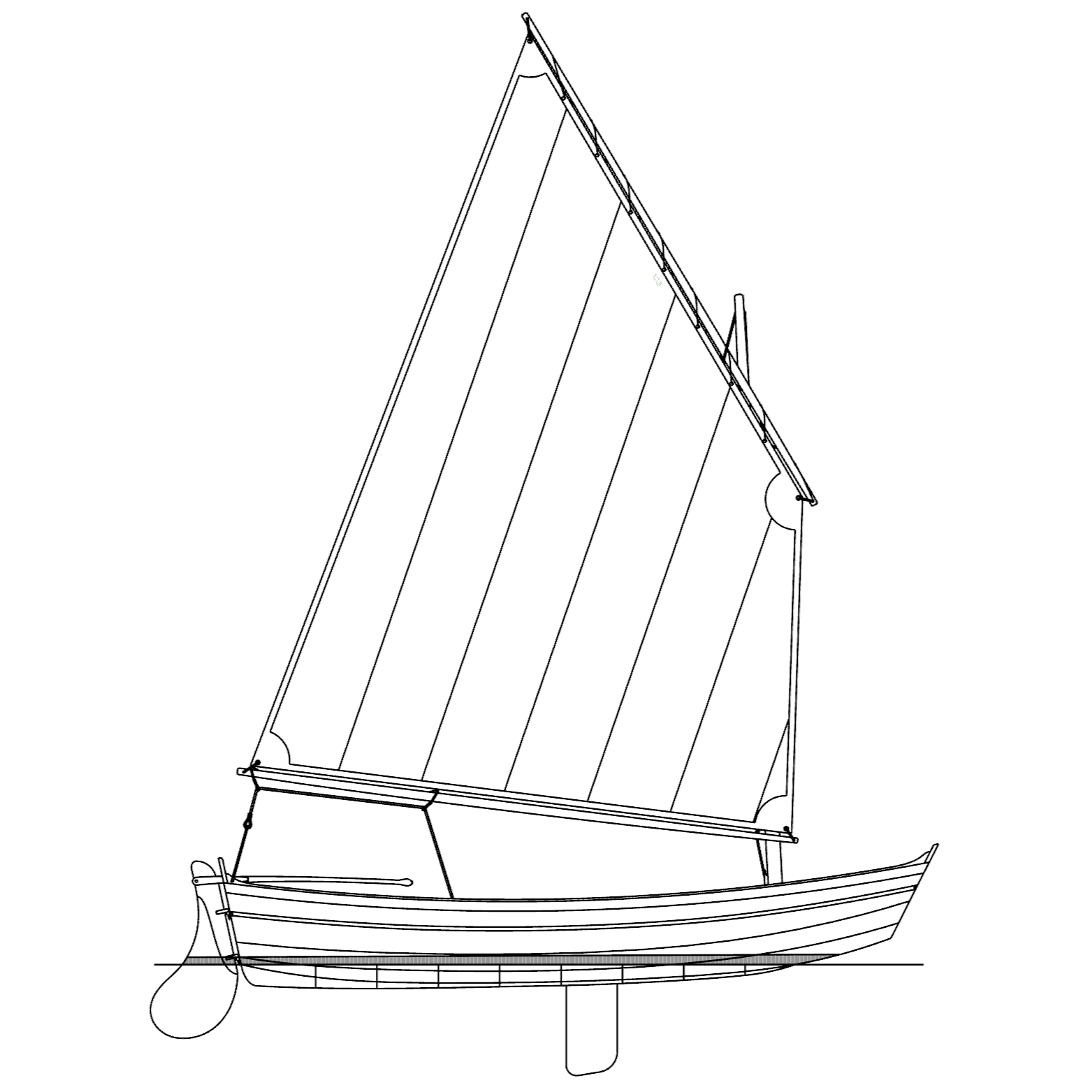
    Inflatable boats have some undeniable advantages. First and probably foremost is their tremendous stability. They also have wonderful built-in fendering – no worries about coming alongside your perfect topsides when things are a little lumpy. And when you get alongside, you can stand up on the inflated pontoons to get a boost for climbing aboard the mother ship. Oonagh is my attempt to combine some of the best qualities of inflatables with the advantages of a traditional dinghy, and put it into a package that is a little less hostile to the planet.

    To help protect your topsides, Oonagh’s plans show the over-sized cushioned gunwale guard more commonly used on docks. She will tow much more easily than an inflatable, and row four times as well. Within the same general size she will give much more interior room, and her passengers will be down in the boat rather than sitting up on the pontoons where soggy drawers are almost inevitable. And we don’t even need to mention sailing, do we? With a little care, your Oonagh can be passed on to your grandchildren.

    I know that many people are going to want to put a motor on Oonagh, so she is designed for it. The same tucked up transom that makes for decent rowing will preclude planing, so there is no point in putting anything more than 2 horsepower back there. In fact, one horsepower is as much as she can really use effectively. This begs the question – why not electric? Why not indeed! A small trolling motor will push her along nicely, and you will be able to carry on a private conversation while enjoying the scenery.

    Beyond use as a tender, Oonagh will make a fine boat for family sailing, fishing trips or just an evening row with the kids. Her simple construction and detailed plans will make for a good family construction project as well. I can guarantee that the experience of building, then using, a small boat will be a treasure that your kids will carry with them throughout life.

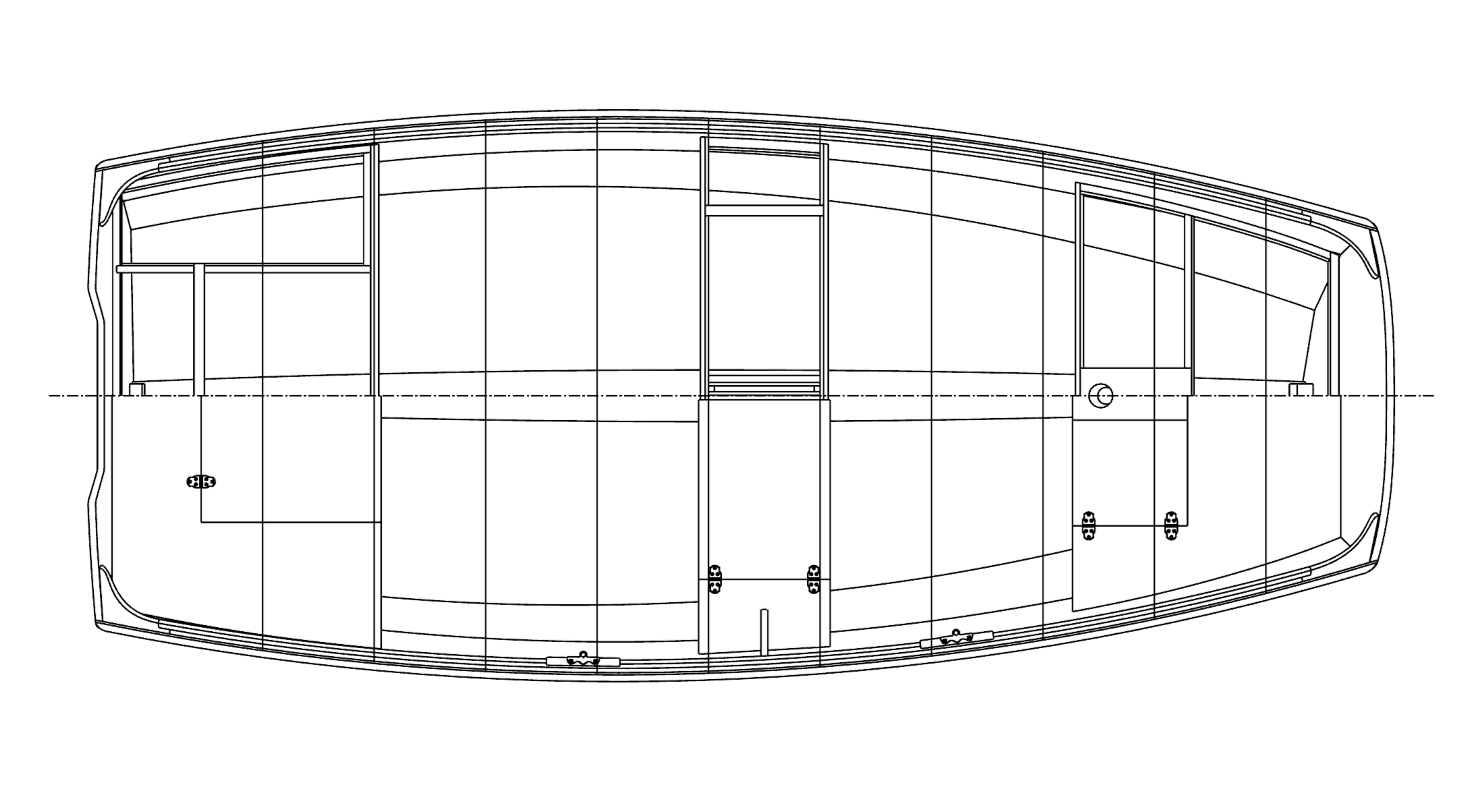
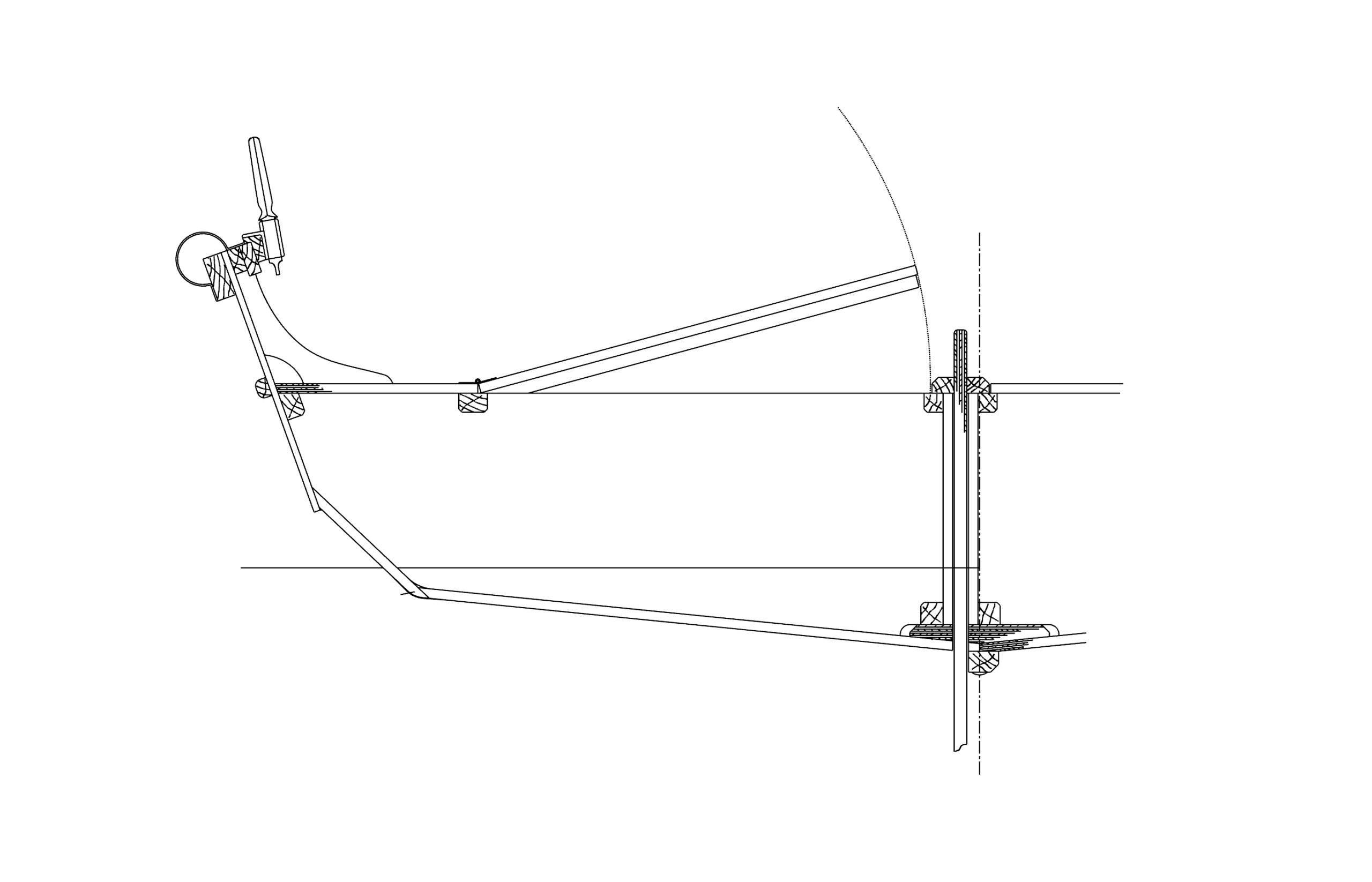
    Plans include seven sheets: Sail Plan, Lines & Construction Plan, Building Jig, Full Size Patterns, Plank Layout.


    TO PURCHASE PLANS: Oonagh plans, CNC kit, and a series of “how to build” videos are now available exclusively through OffCenterHarbor.com.

    Particulars

    LOA11′ 8″
    LWL9′
    Beam5′
    Draft5″ / 22″ board down
    Weightapprox. 170 lbs
    TrailerableYes
    Hull typeMultichine
    ConstructionGlued lapstrake plywood
    Suitable forSomewhat protected waters
    Skill neededBeginner
    Lofting requiredNo
    Level of detailAbove average
  • Ben Garveys

    Ben Garveys

    Ben Garveys

    Ben 15′ 9″ | Big Ben 19′

    Fine boatyard skiffs or small harbor ferries

    Here are a pair of boats that will feel right at home on the working waterfront. Both boats would make fine boatyard skiffs or small harbor ferries. Both would be fine for a little recreational fishing or getting around the lake on summer vacation.

    Garveys originated as shallow draft, burdensome, and very easily built boats for working the shallow bays and estuaries of the Jersey Shore. The advent of the internal combustion engine, and later, the outboard motor, ensured their survival since the hull form is actually much better suited to mechanical power than to the sailing rigs of the early boats.

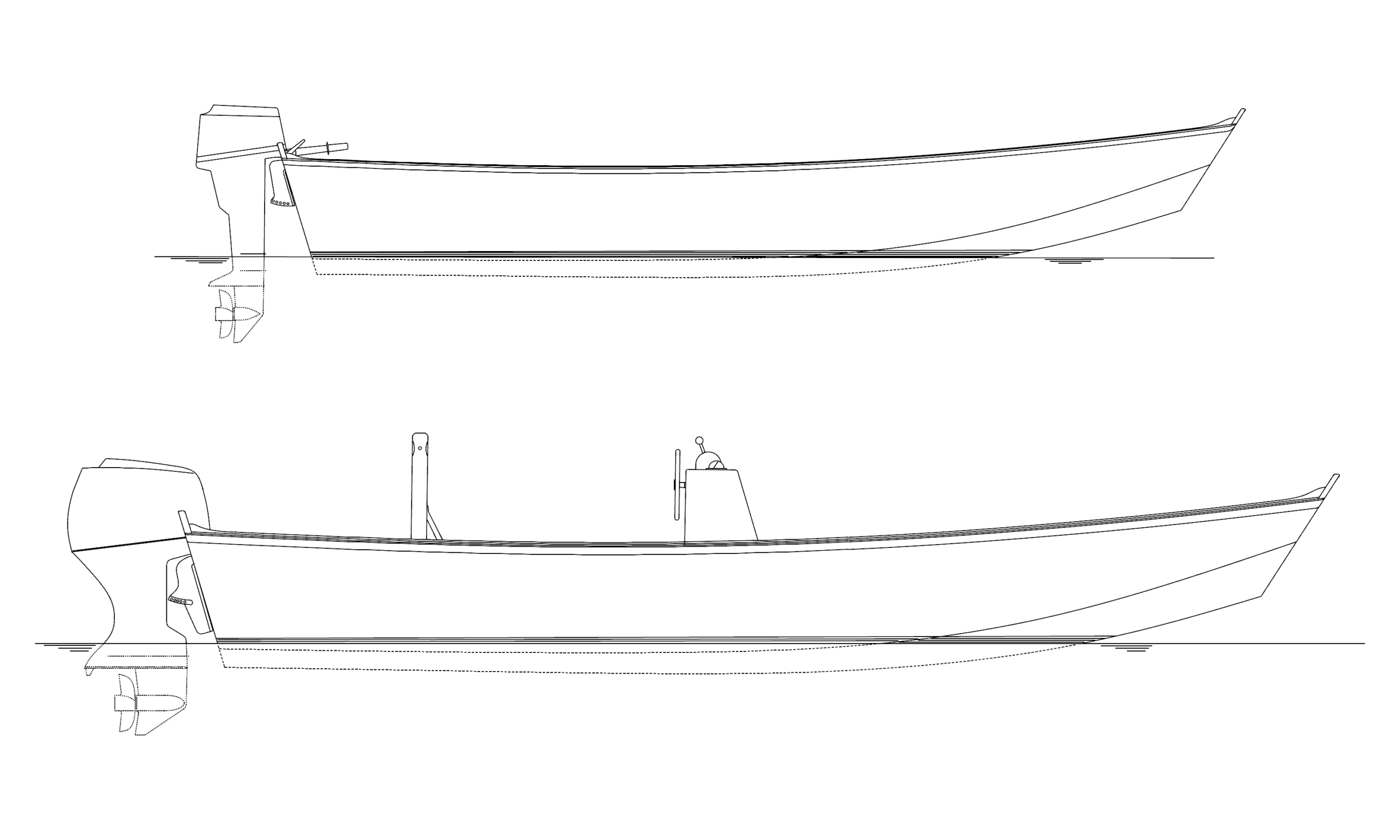
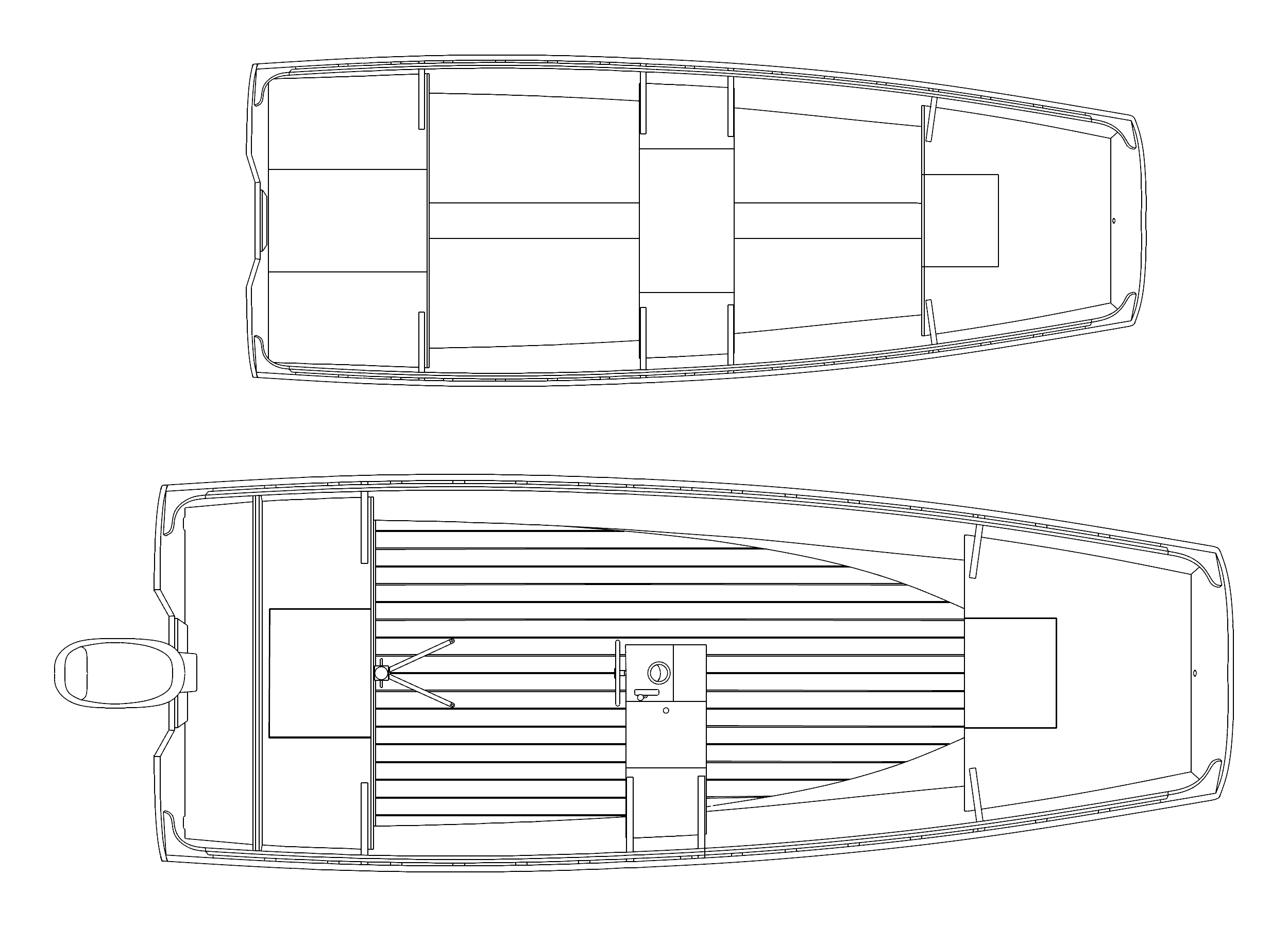
    Doug Hylan has refined the Ben garveys a bit from their original form. They show a strong sheer and more rake to the bow transom for good looks, the buttock lines aft have been straightened out for planing speeds, and the construction is updated to make use of plywood and epoxy adhesives. But they still display the same characteristics that made their forefathers popular: ease of construction, shallow draft, good stability, and great load capacity.

    The Ben garveys are built of plywood, upside down on a ladder frame over temporary molds. Lofting is required, but is extremely simple. The chines are easily made using epoxy fillets and fiberglass tape. Flotation compartments ensure that a swamped boat will float level and even support the motor head above the water.

    The plans are on five sheets (four for Big Ben) and include lines, construction, details, and building jig. Also included are instruction sheets which cover tools and materials, scarfing plywood, construction, and use.

    WB Plans: $75.00 each.


    Outboard profile of Ben garveys
    Plan view of Ben garveys

    Particulars

    LOA15′ 9″ | 19′
    LWL11′ 2″ | 14′ 1″
    Beam5′ 7″ | 6′ 11″
    Draft5″ | 7″
    Powerup to 40 hp | up to 80 hp
    Speedup to 35 kts
    TrailerableYes
    Hull typeV-bottom garveys
    ConstructionPlywood with epoxy/glass chines
    Suitable forSomewhat protected waters
    Skill neededBeginner to intermediate
    Lofting requiredYes, very simple
    Level of detailAbove average

    OTHER REFERENCES: Design review by Mike O’Brien, Boat Design Quarterly 9 (page 7).

  • Bowler

    Bowler

    Bowler

    Weekend Cruiser

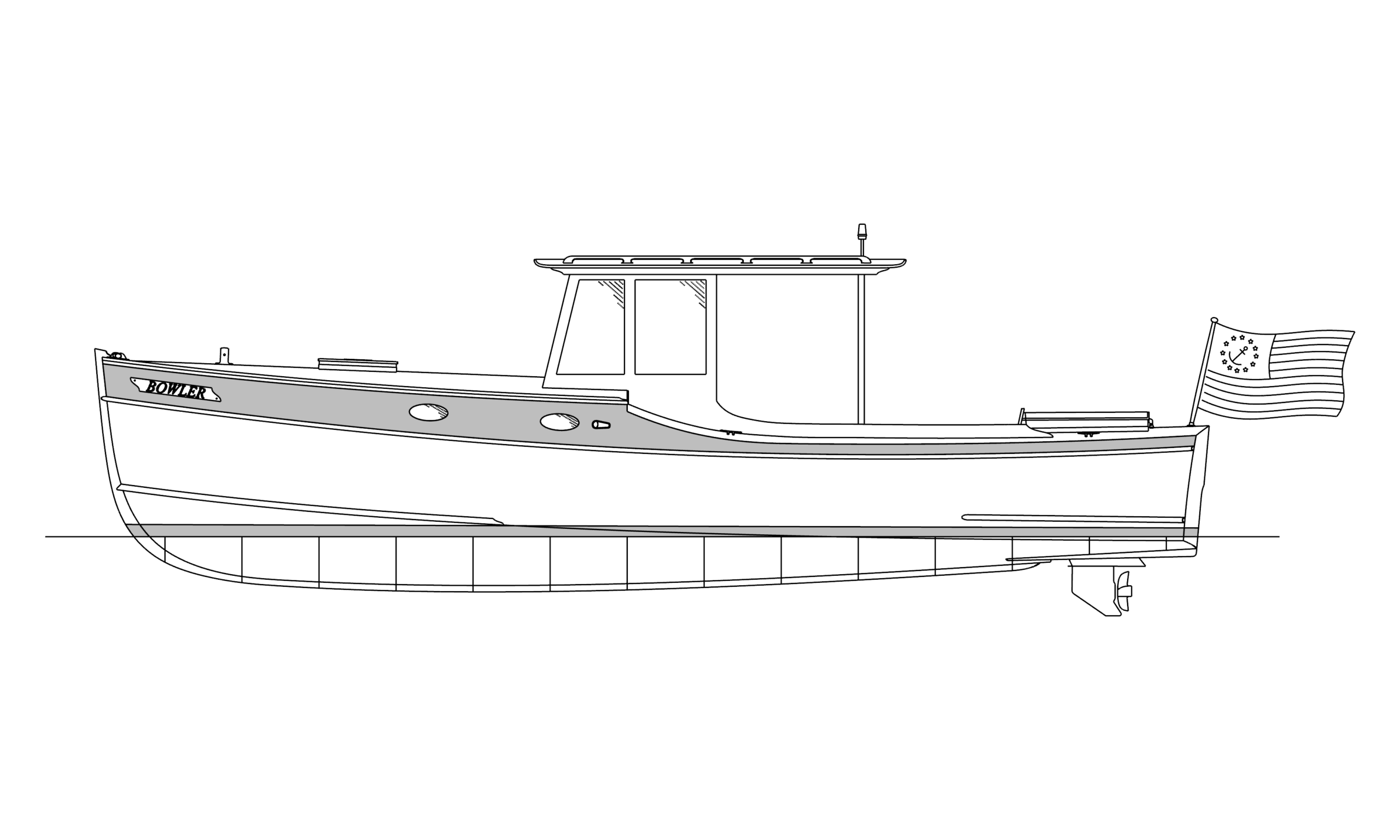
    Thank you for considering my plans for Bowler, a “cruising” version of my Top Hat launch. These boats are descended from Harry Bryan’s inspired Handy Billy design, which in turn can trace its origins back to William Hand’s V-bottom designs from the early 20th century. One hundred years later, Hand would still recognize these boats – handsome, sea kindly, efficient, and attractive to the home builder. We’ve incorporated some extra beam, modern construction, and today’s wonderfully quiet and clean-burning outboard motors.

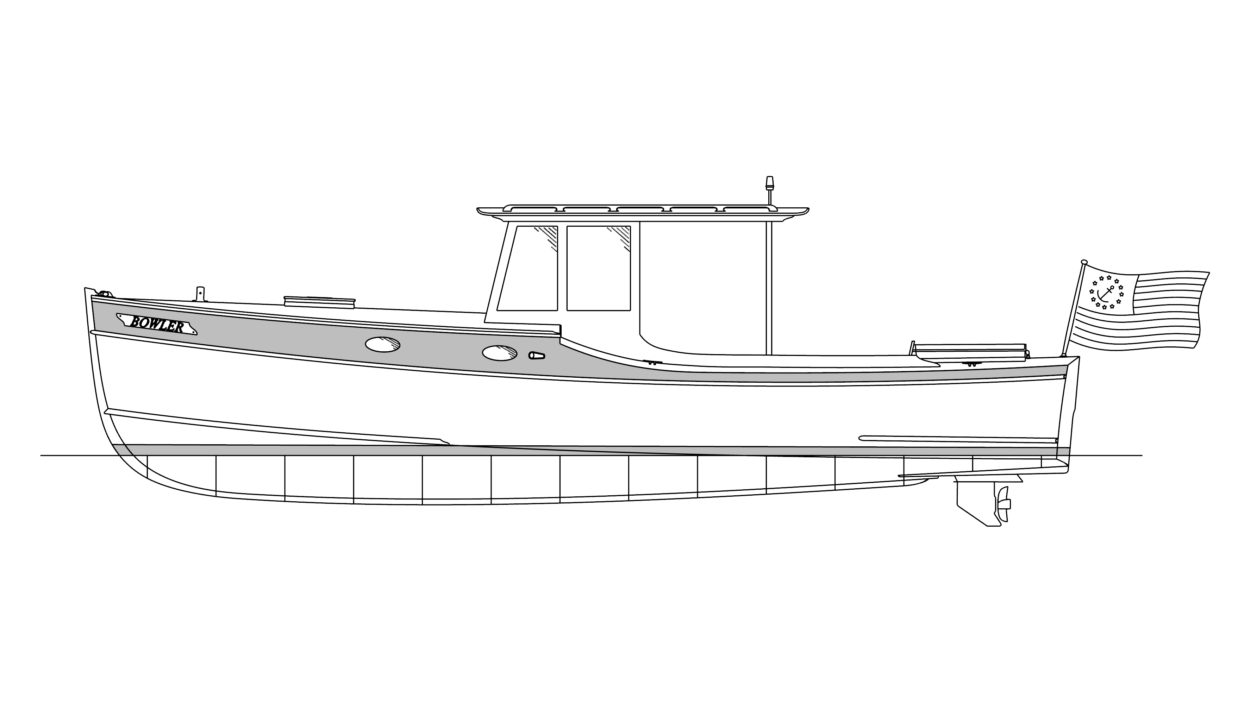
    Bowler uses modern glued wood construction. Her bottom is plywood and her curvaceous topsides are strip-planked. All is sheathed in Dynel/epoxy for a boat that stays good-looking with less maintenance. Her fine bow will handle a chop with ease, and her semi-displacement hull can be driven up to 17 knots with just 60 horsepower.

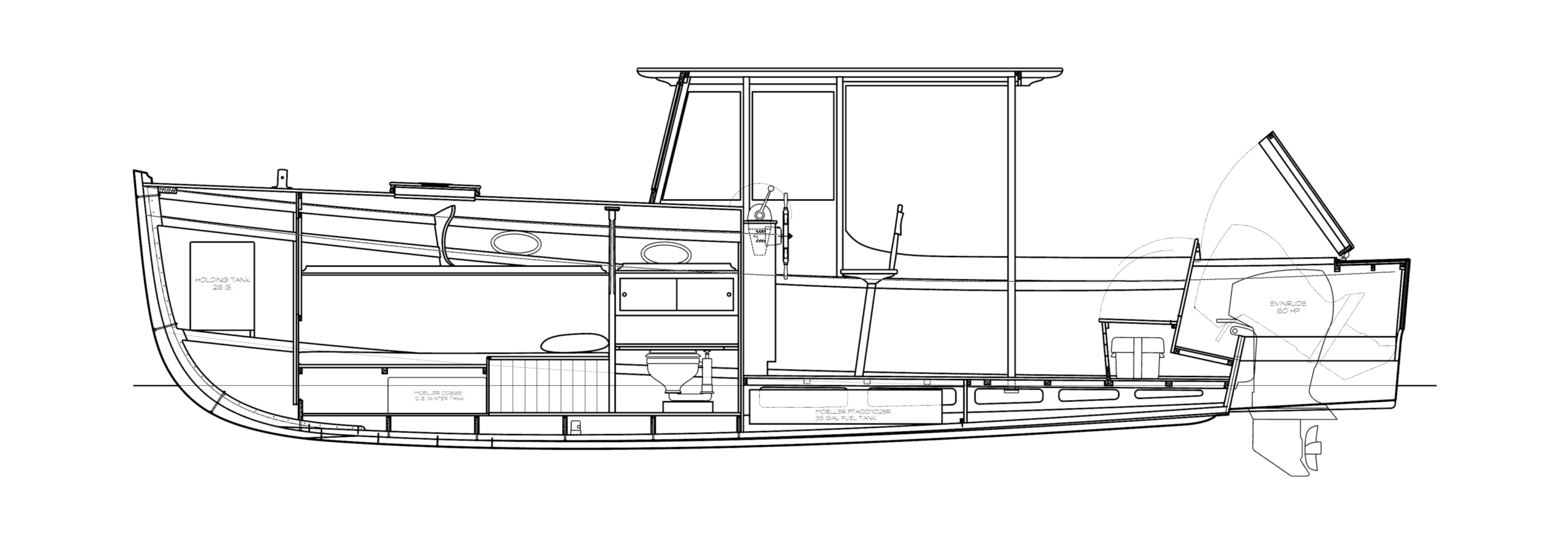
    Down below is a generous V-berth, followed by a toilet to starboard and a sink & counter to port. A step up brings you to the shelter, with 6′ 3″ of headroom. The helm station is to starboard, and to port is a “co-pilot” seat with storage under. A luxurious settee extends across the aft end of the cockpit, just forward of the motor well. Lots of storage back here as well.

    Bowler’s motor is in a covered well, which makes engine noise almost negligible. The plans are based on an Evinrude E-TEC 60 hp motor – if you want a different motor, you should plan to purchase it early, before the dimensions of the motor well are all glued in place. Please don’t call to ask me if a bigger motor can be installed. This type of hull is not appropriate for speeds over 20 knots.

    While most will consider Bowler a day boat, a weekend cruise is easily accommodated as long as simple eating is acceptable. A young and adventurous couple might head off for a week! With curtains around the shelter, even a pair of kids could be included in the fun.

    The plans consist of six sheets: Lines, Outboard Profile, Construction Plan, Construction Sections, Joiner Details, Lofted Offsets. Also included is a CD of construction photos and other helpful information.


    STUDY PLANS: Click here to download free study plans.

    KITS: Learn more about the Bowler kit here. To order a kit, contact Hewes & Co.

    TO PURCHASE PLANS: Plans include 6 sheets plus a USB stick with photos and other info. To order online using Paypal’s ordering system (which accepts credit cards and eChecks), please select one of the following buttons:

    U.S. orders. $325 + $20 shipping = $345
    International orders, including Canada. $325 + $80 shipping = $405
    You can see your Paypal Cart at any time by clicking the button below:

    You can also order plans by sending a check or money order to Hylan & Brown Boatbuilders, 10 Frank Day Ln, Brooklin, ME 04616.

    FAQ: Many questions are answered in Frequently Asked Questions. Please check there first.

    Particulars

    LOA26′ 6″
    LWL25′ 4″
    Beam8′ 2″
    Draft1′ 4″
    Disp.3680 lbs
    Powerup to 60 HP
    Speedup to 17 kts
    TrailerableYes
    Hull typeV-bottom semi-displacement
    ConstructionPlywood bottom & sheathed strip-planked topsides
    Suitable forSomewhat protected waters
    Skill neededIntermediate
    Lofting requiredNo, corrected offsets included, full-size patterns available
    Level of detailAbove average

    In the Press:

    “A Simple Change of Hat” WoodenBoat 253:58.

    “D.N. Hylan: Bagatelle” Maine Boats, Homes & Harbors #133.

  • Point Comfort 23

    Point Comfort 23

    Point Comfort 23

    This boat is a larger version of my popular Point Comfort 18, a traditional Chesapeake Bay workboat type reinterpreted for simpler and more modern construction. Like her smaller sister, this design is drawn to use plywood – in large pieces where possible (roughly three quarters of the boat’s hull), and in small pieces where necessary to get the Chesapeake deadrise bow form. Construction should prove relatively quick and straightforward.

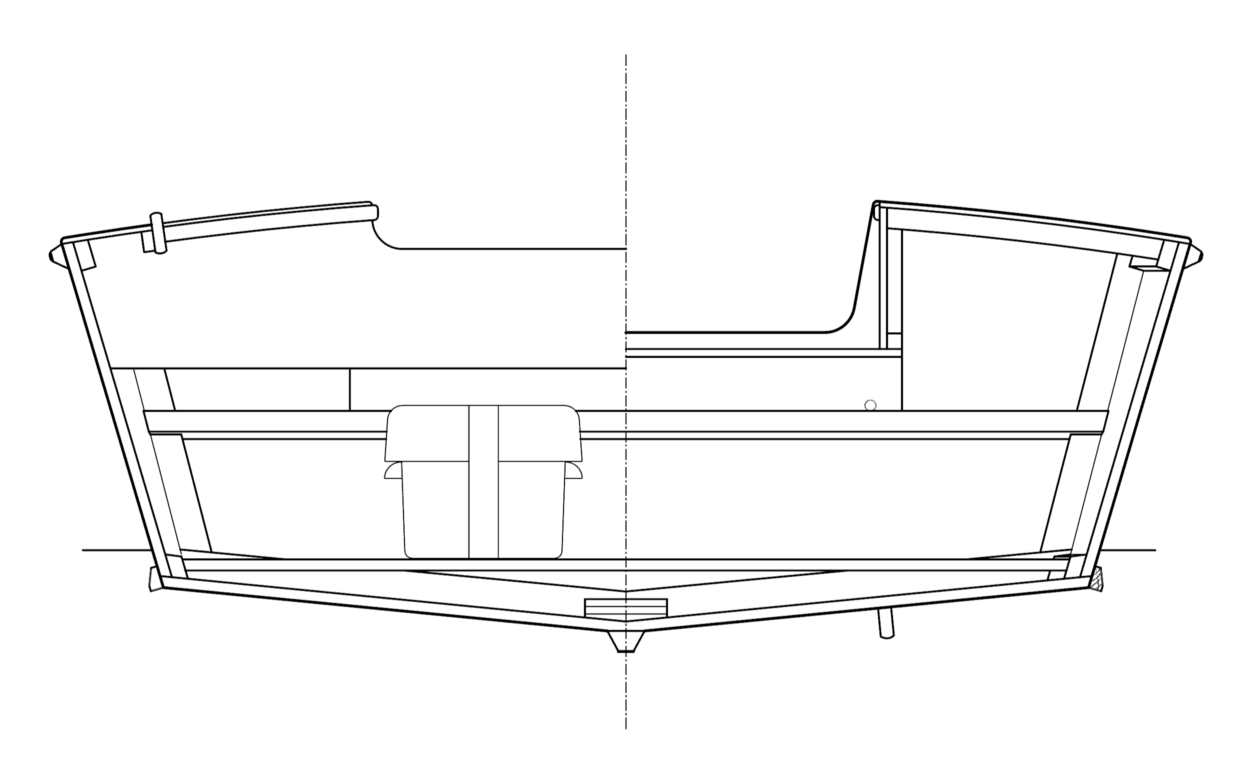
    The hull is built upside down over molds and a ladder frame. Heavy 3/4″ plywood is used for planking which allows a hull with little internal framing.

    This type has proven to make excellent use of low horsepower – in fact, big motors are not recommended. Fifty horsepower should give 20 knots, but this boat will carry a good load at rewarding speeds with as little as 25. Sixty horsepower should be viewed as the upper limit.

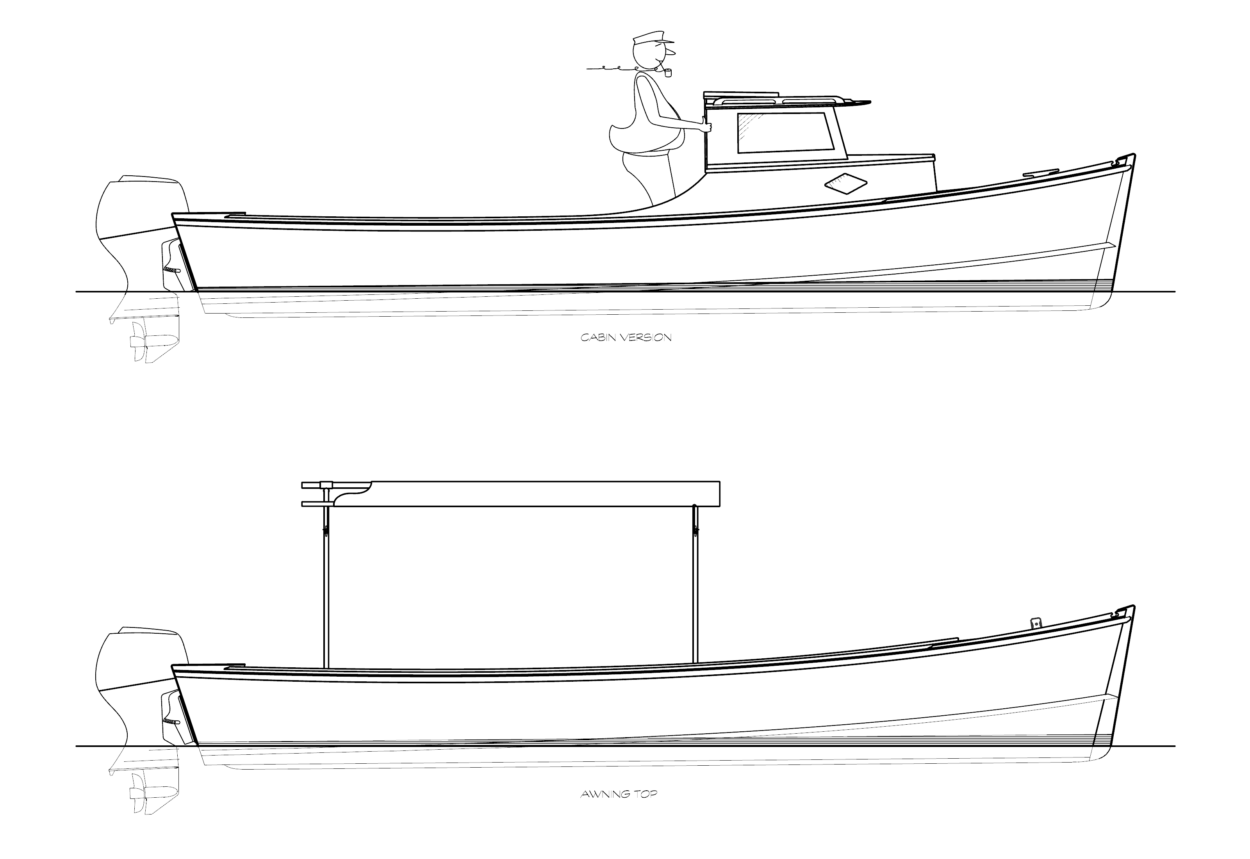
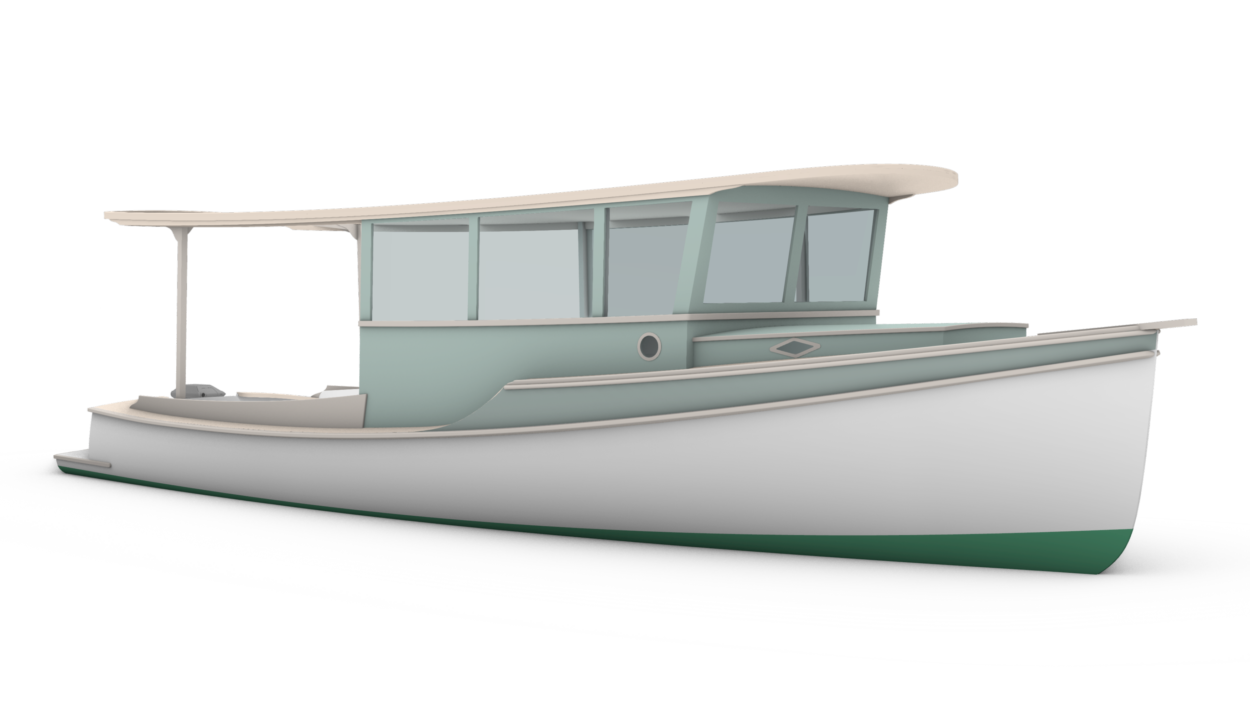
    Included are details for a cabin version and an awning top – the two could be combined for spartan cruising for those with sufficient pluck.

    The plans consist of eight sheets: Lines, Outboard Profile, Construction Plan, Optional Cabin configuration, Building Jig, and three sheets of full sized patterns.

    The Point Comfort skiffs give one of the best combinations of quick and easy building, soft riding, and fuel efficiency I have ever encountered. It will give a smooth ride in the kind of small chop that would knock your fillings loose in a flat bottomed skiff, and get a big load delivered in good time with a tiny fuel bill.


    STUDY PLANS: Click here to download free study plans.

    TO PURCHASE PLANS: Plans include 8 sheets plus full size patterns. To order online using Paypal’s ordering system (which accepts credit cards and eChecks), please select one of the following buttons:

    U.S. orders. $350 + $30 shipping = $380
    International orders, including Canada. $350 + $80 shipping = $430
    You can see your Paypal Cart at any time by clicking the button below:

    You can also order plans by sending a check or money order to Hylan & Brown Boatbuilders, 10 Frank Day Ln, Brooklin, ME 04616.

    FAQ: Many questions are answered in Frequently Asked Questions. Please check there first.

    Point Comfort 23 outboard profile
    Point Comfort 23 plan view

    Alternate layouts:

    Point Comfort 23 alternate layouts

    Particulars

    LOA23′ 1″
    LWL21′ 10″
    Beam6′ 10″
    Draft7″
    Disp.1500 lbs
    Power25 to 60 HP
    TrailerableYes
    Hull typeChesapeake deadrise skiff
    ConstructionPlywood
    Suitable forSomewhat protected waters
    Skill neededIntermediate
    Lofting requiredNo, full size patterns included
    Level of detailAbove average