Our expertise with both original designs and the development of plans from existing craft (often historically significant) can bring your ideas to life.
Hylan & Brown is a custom yacht design and construction company specializing in traditionally-inspired designs created with the highest standards of craftsmanship. Whether we are building a 13′ 100 lb peapod or a 43′ 12-ton power cruiser, we are committed to producing heirloom quality watercraft that indulge one’s senses and inspire rich experiences. We offer the rare opportunity to bring your custom yacht from vision, to design, to reality, all under one roof. Our design and construction portfolio includes numerous examples of unique new construction, accurate and sensitive restoration of historically significant vessels, and tastefully customized and updated versions of classic yachts.
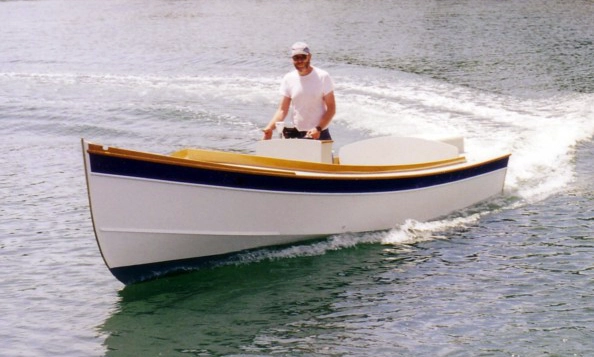
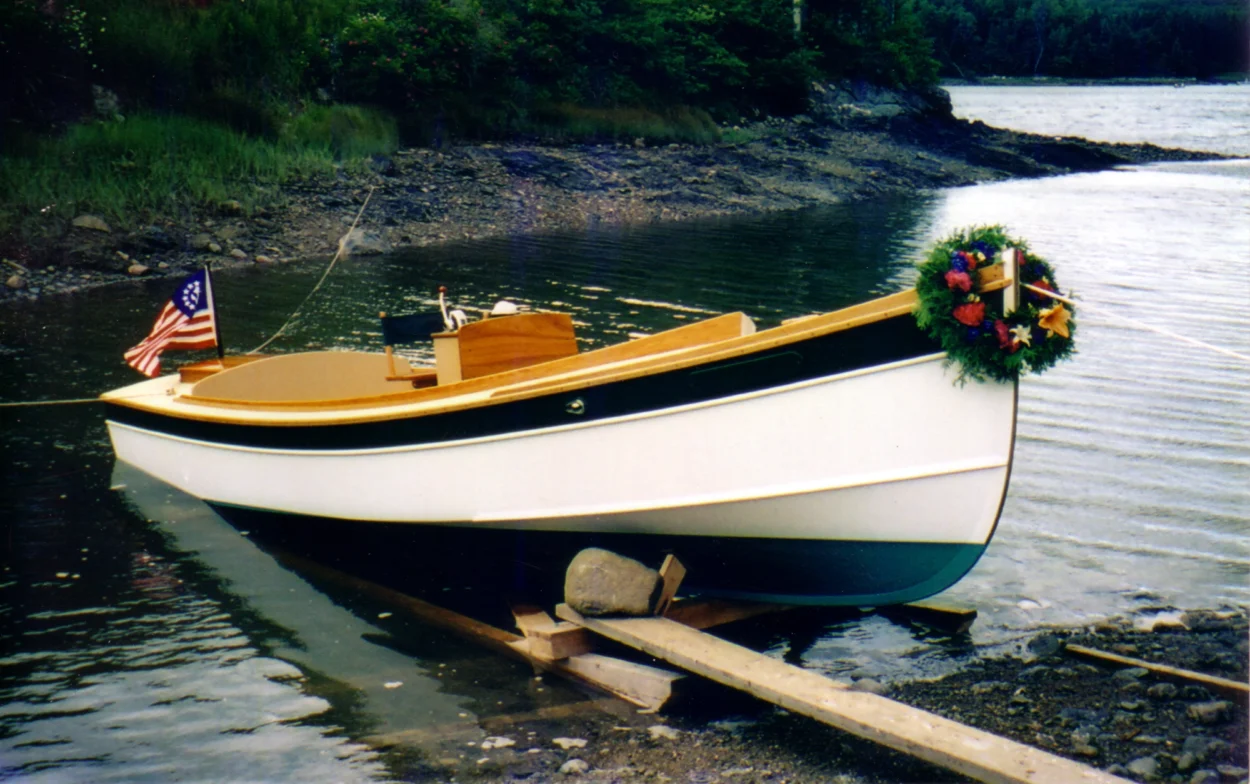
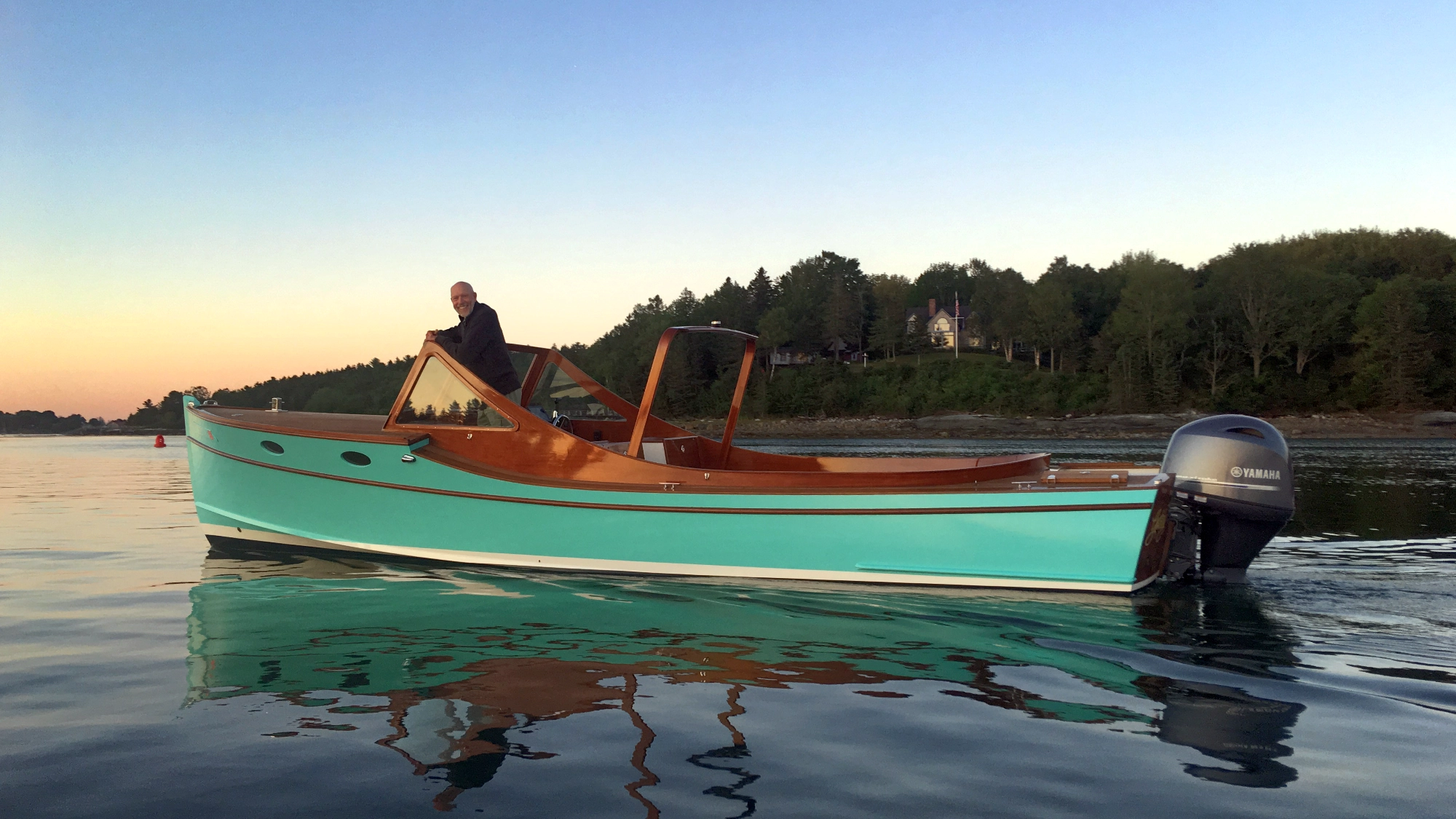
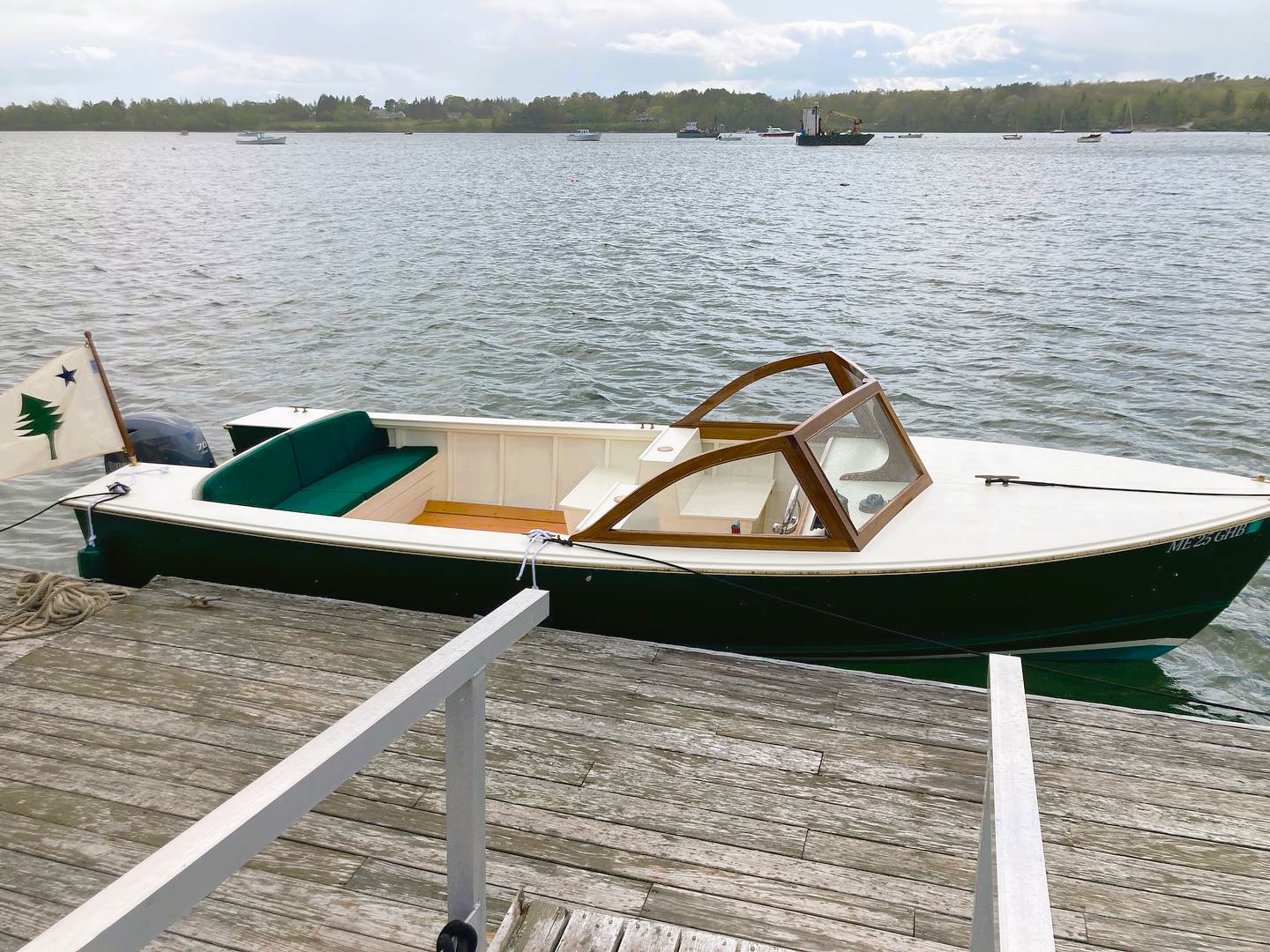
21′ Harry Bryan design, one plank-on-frame, three molded plywood
Designer Harry Bryan put together this excellent design by combining elements of William Hand’s seaworthy and easily driven V-bottom launches with modern four cycle outboard technology.
The result is a power boat that is fuel efficient, quiet, handsome and able.
We have built four of these boats, the first strictly to Harry’s design, and the later three modified to be built using marine plywood. For more information about this design, see Harry’s web site.
Sailors particularly like these boats as they combine many of the features they love about sailing.
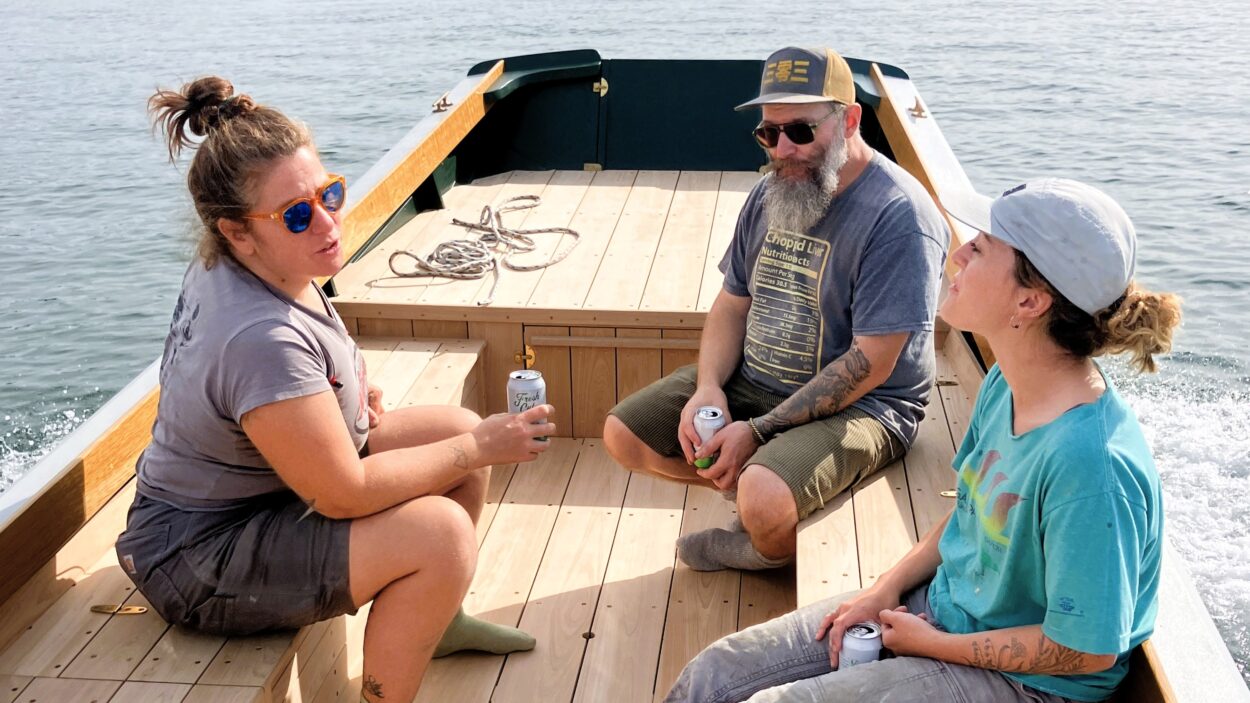
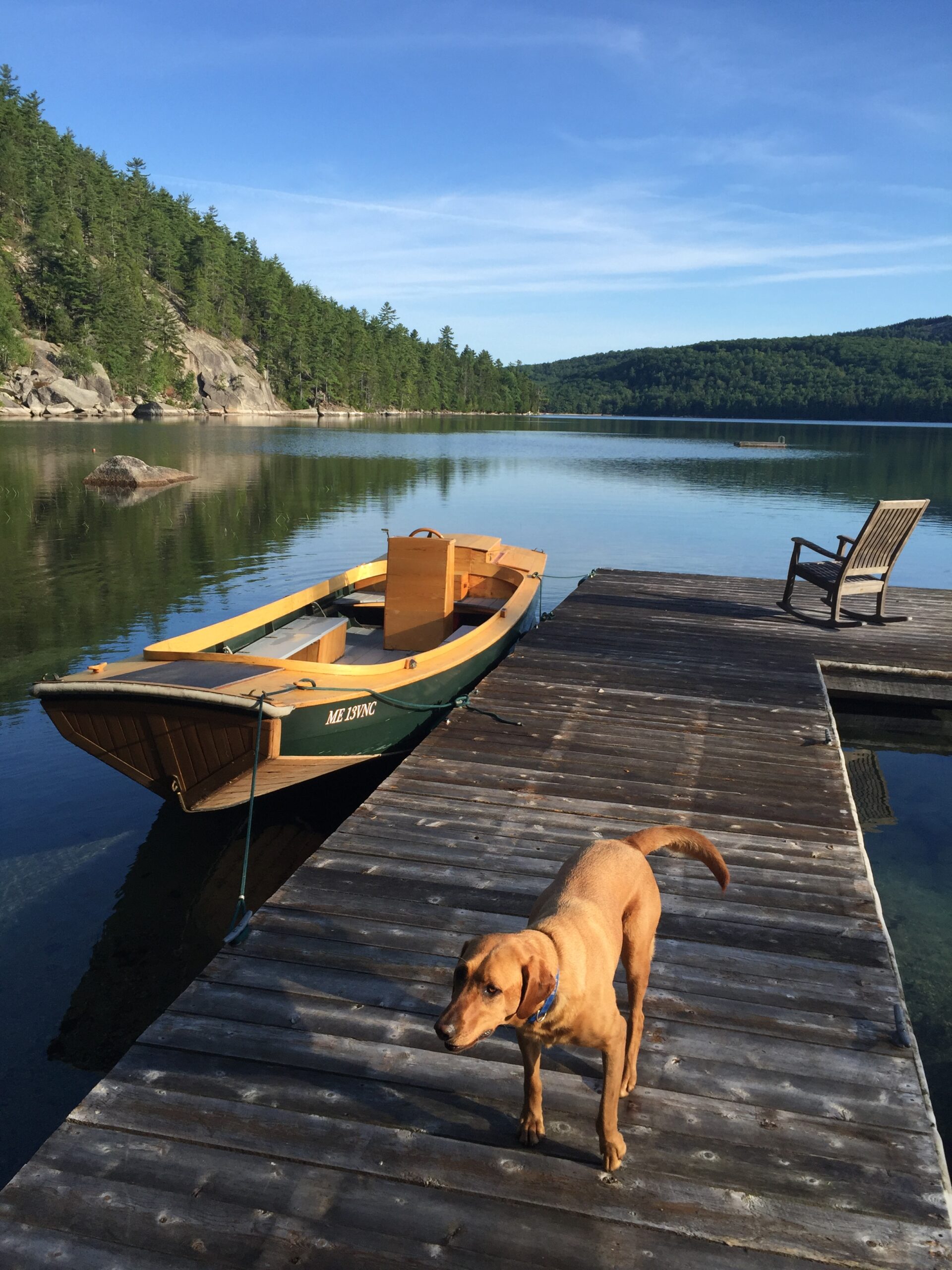
SARDINE’s owner enjoys his Harry Bryan-built garvey on a crystal clear pond in Downeast Maine. The beloved boat is the epicenter of cherished family gatherings throughout the summer. SARDINE has always been quiet with a 4-stroke Honda in an insulated motor well. But switching to electric propulsion has provided the new and remarkable experience of silent, emissions-free swimming, stargazing, and exploring on the pristine pond.
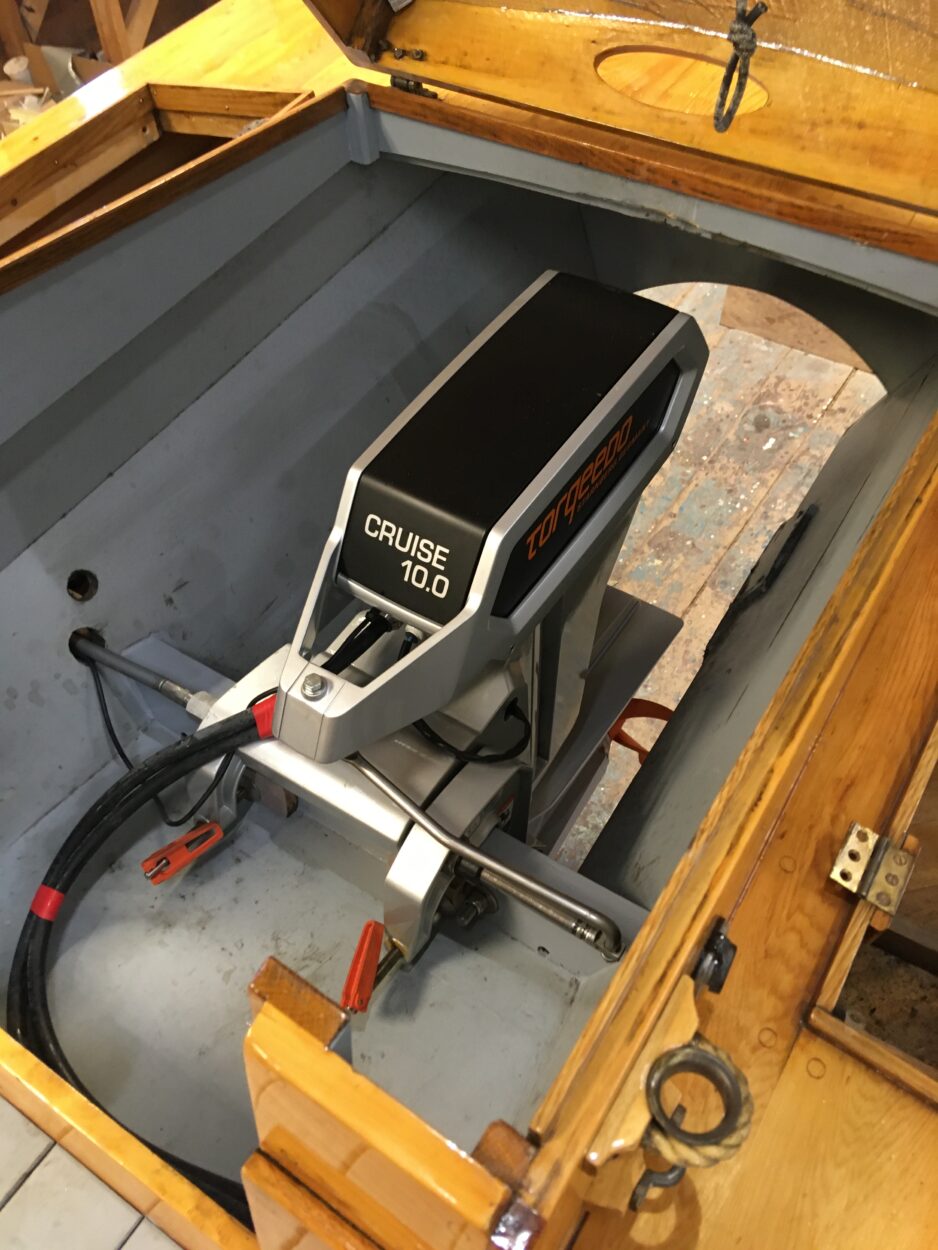
We installed a Torqeedo Cruise 10.0 with two 5 kW Torqeedo lithium batteries and a 240V fast charger. With her new electric system SARDINE was capable of better acceleration and slightly better top speed than with her 20 hp Honda.
A pond/ lake house like this has proven to be the perfect venue for the latest developments in “e-mobility on the water.” Working with a talented crew from Nate Holyoke Builders and master electrician Matt Davis, a 240V shore power post was built on the dock that is in keeping with the aesthetic of the cottage. After an excursion on the pond, SARDINE can plug in as easily as making off a dock line, and can charge her batteries from flat in 2 hours.
Photo / Video produced by Hemmings House Pictures Ltd., an impact film company.
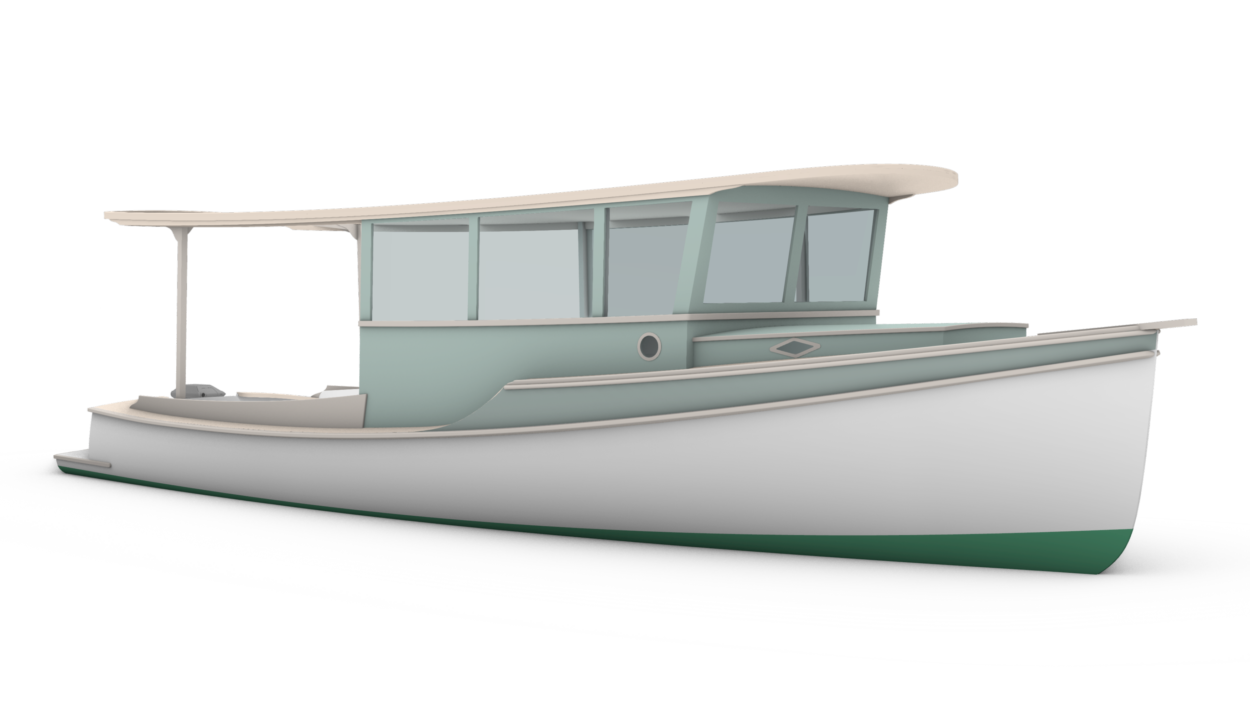
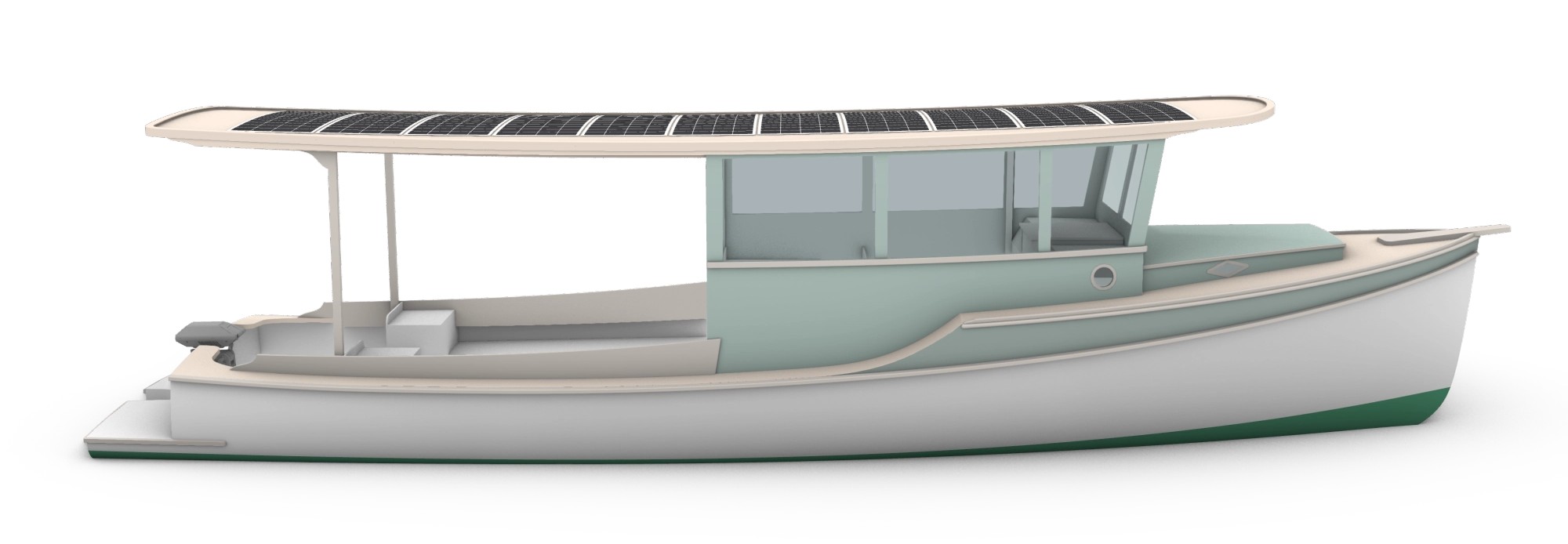
Early in 2024, we were approached by an experienced Australian boatman who had heard of our work with electric propulsion. He sent along a design brief that demonstrated that he knew boats and was familiar with the advantages and constraints that go with marine electric propulsion. We don’t often take design commissions for construction in other shops, but this one meshed perfectly with my interest in the possibilities for low impact, quiet cruising.
Historically, the development of power boats has always been about going faster. Cheap petroleum and advances in internal combustion fostered this trend, despite the fact that high speed boating is among our most energy intensive and polluting pursuits. Batteries still have a long way to go before they can pack the power density of a good sized fuel tank, but low speed boating can be very efficient indeed.
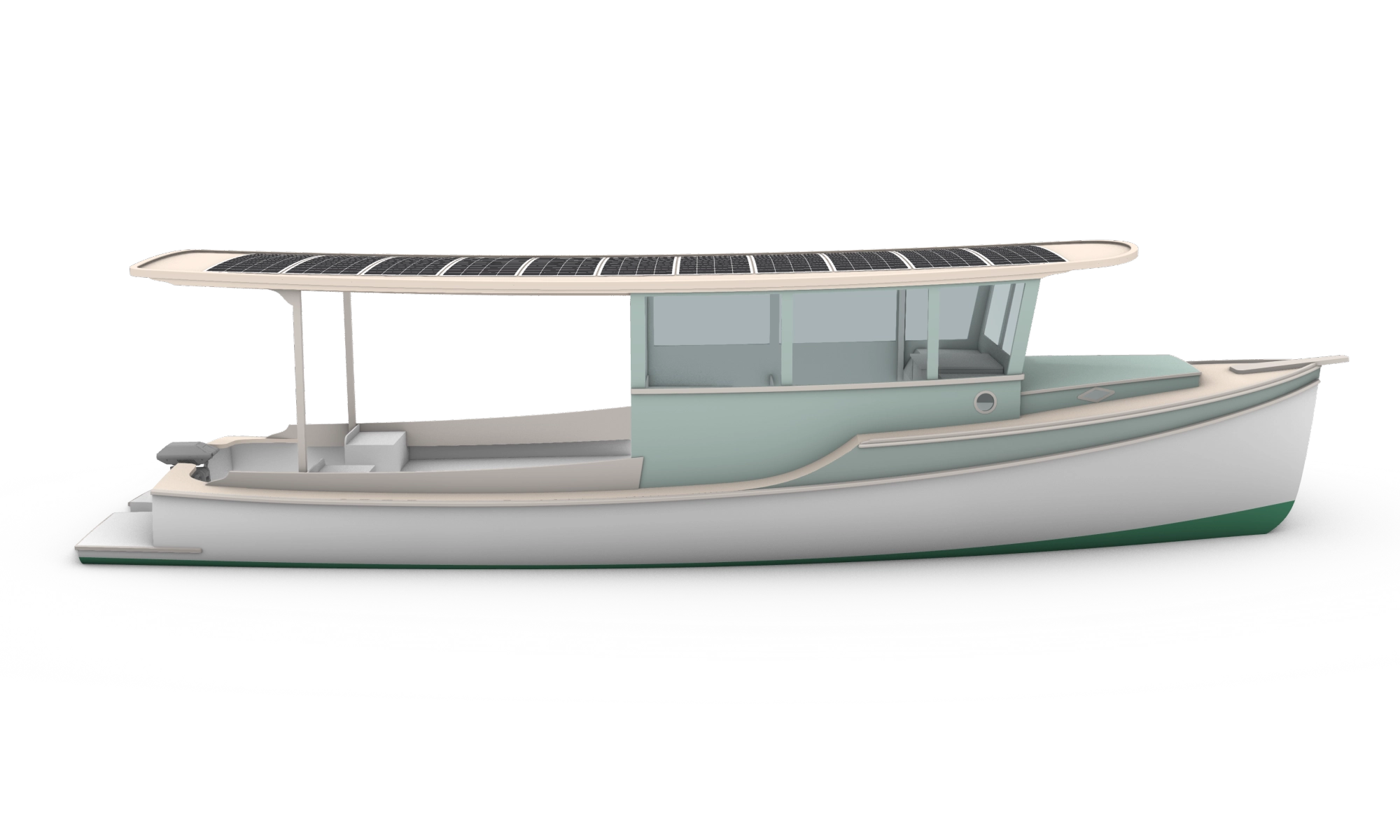
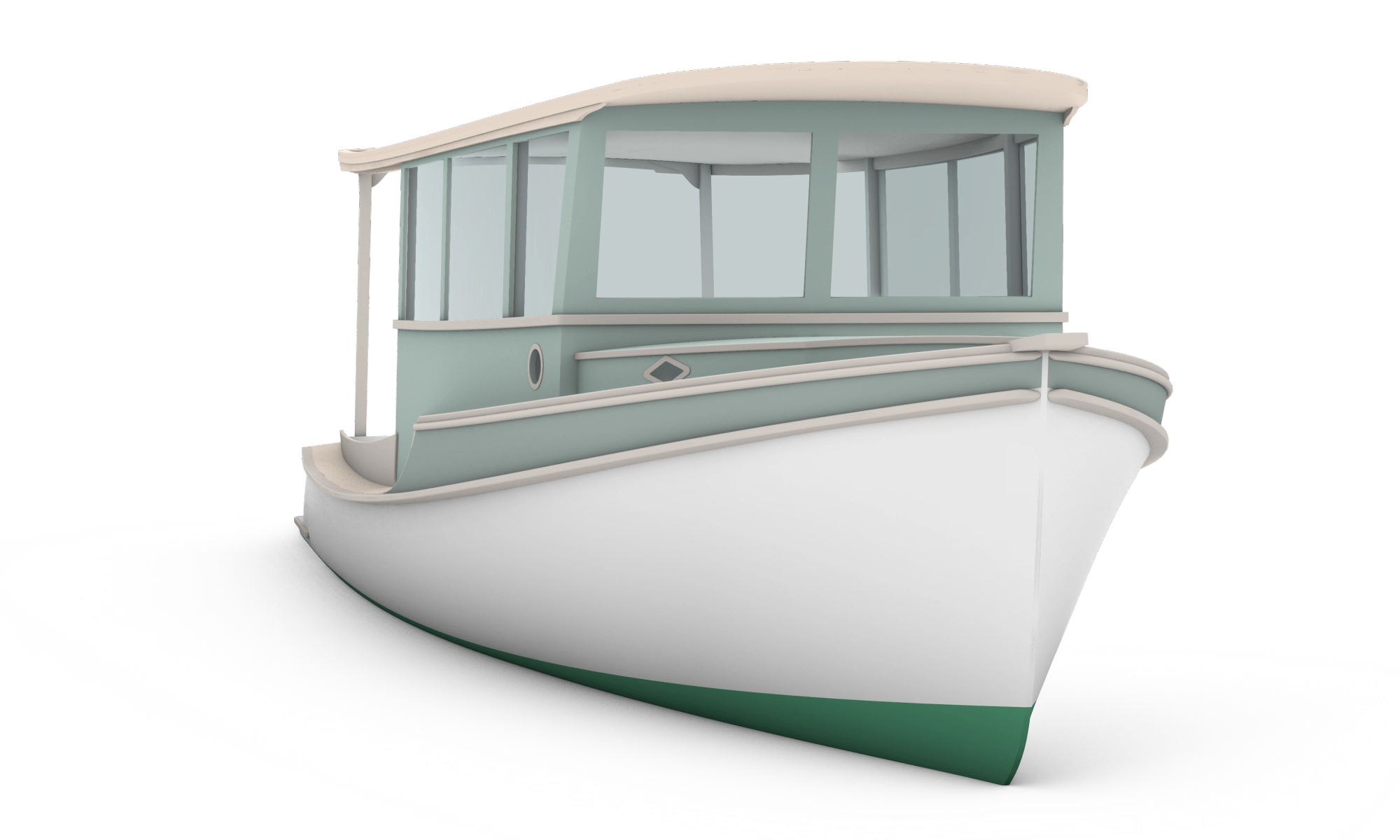
Hull shapes that are optimized for high speeds are inefficient at lower speeds — you have to go back almost 100 years for designs that are optimized for the upper hull speed range that is so wonderful for electric boating. Atlantic Canada’s Cape Island boats and Sam Crocker’s small fishing vessels were the mode for the hull shape for this design. A large solar canopy will allow true solar sailing on the sunny days around the summer solstice, extend battery range, and mean fewer stops for marina shore power. As batteries get lighter and cheaper, each of our new electric projects seems to include more of them.
The design brief for this boat called for a boat large enough for spartan cruising for one or two people, with a beam narrow enough to avoid extra permits on Australian roads, and light enough to be towed behind the owner’s vehicle. A large solar canopy and traditional styling were also called for. With these parameters set, the rest is just details! Construction will start in the winter of 2025, at Denman Marine in Tasmania.
At Hylan & Brown, we feel fortunate to have found a group of committed people who are interested in slowing down and enjoying the peace and quiet that comes with electric power boating. We enjoy the challenge of working with a variety of electric propulsion suppliers to figure out the best components to meet their needs and work hard to keep abreast of the best combination of new and reliable in this rapidly evolving technology.
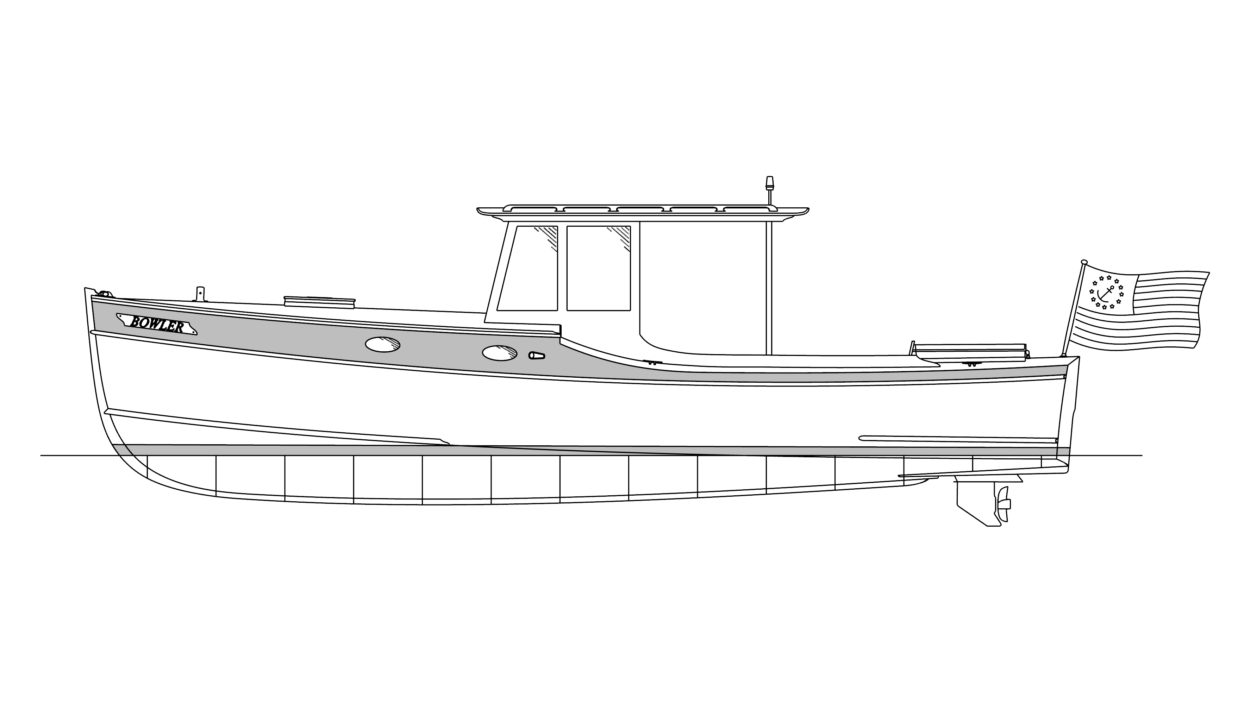
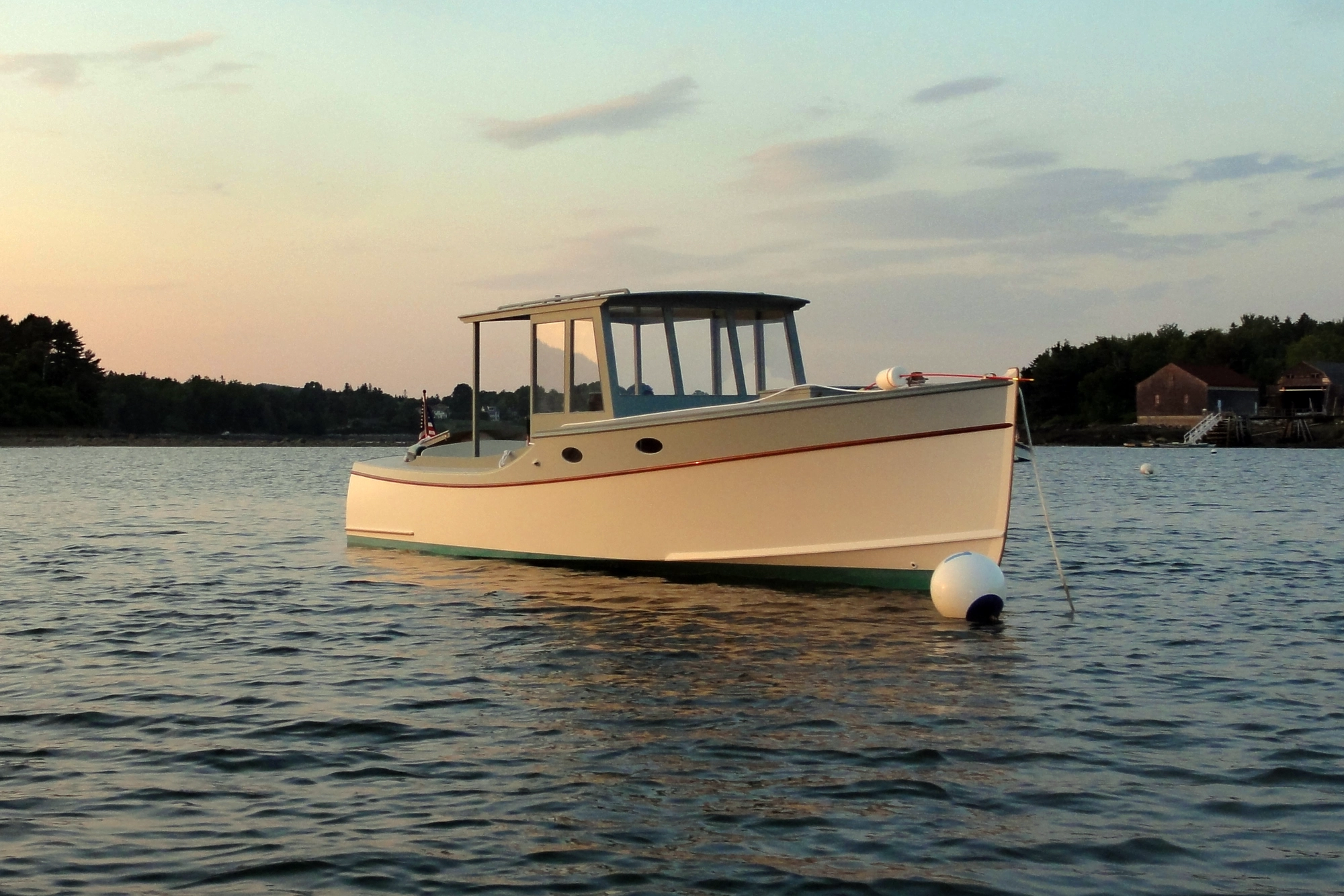
Shortly after we launched the prototype of Doug’s Top Hat design in 2002, he sketched another version along the same lines but with a higher topsides, a windshield and shelter top. The idea was to provide better protection from the elements and more accommodations space for short cruises.
Eleven years later a couple approached Doug about a small lobster boat design for day use and weekend cruises. On a whim he showed them his sketch and they were smitten.
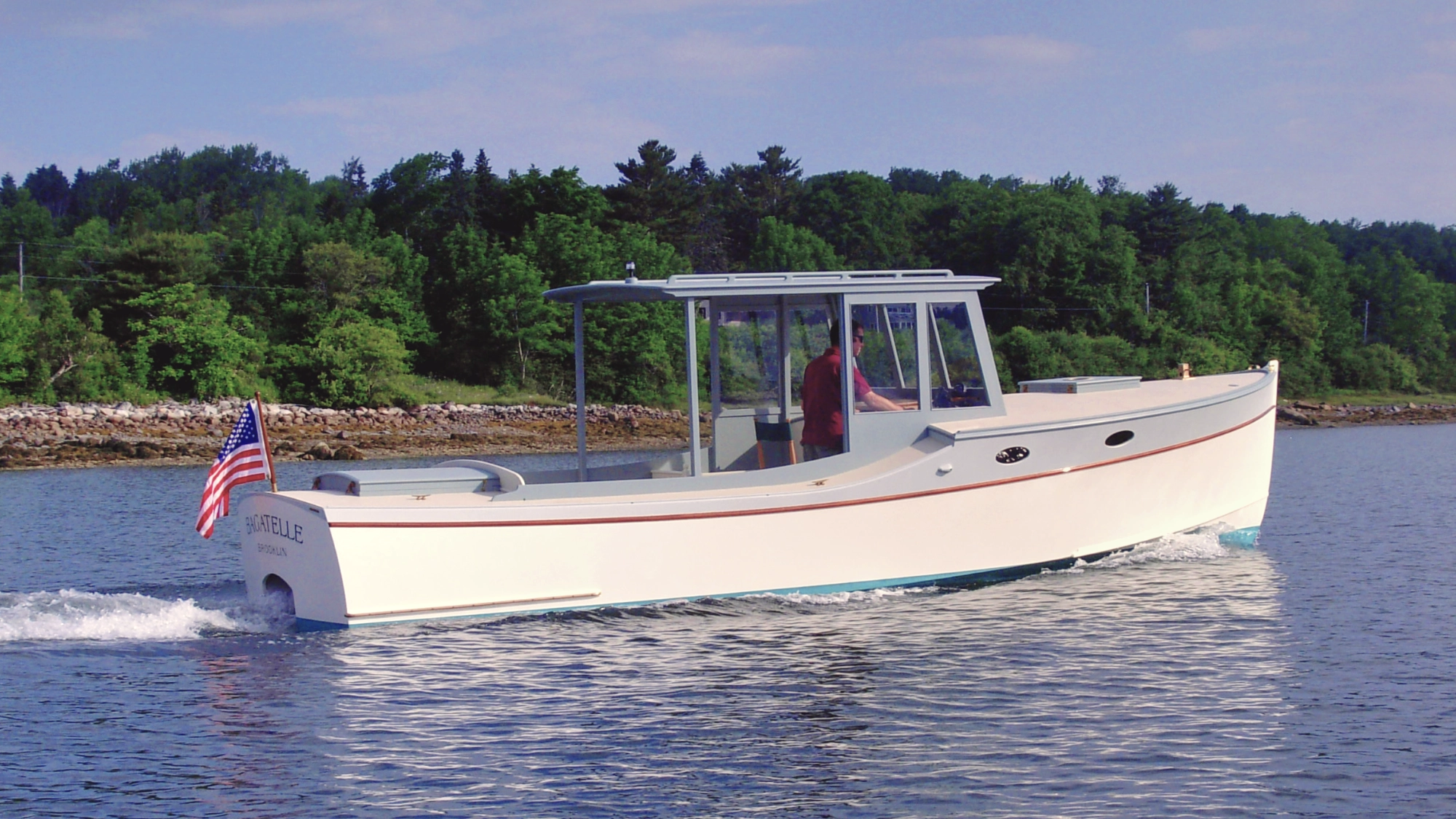
The new boat has a lot in common with Top Hat: a narrow twisting V-bottom with a fine entry and fairly flat run for good sea keeping, fuel efficiency and semi-planing speed; shapely topsides with flared bow sections transitioning gracefully to tumblehome at the quarters and a radiused transom; powered by an outboard in a well for quiet, fuel efficiency, economy and space saving.
There are plenty of differences too: The sheathed strip plank construction method allowed us to do away with the sawn frames which saved labor and space; a cored foredeck eliminates the need for deck beams providing more head room down below; the main bulkhead was moved aft allowing space for a toilet opposite a sink and cupboards aft of the V-berth; and of course the higher raised deck sheer with windshield and shelter top.
We’re excited about the looks and the capabilities of this little cruiser. From their home port in Brooklin, her owners will be a day’s cruise or less from countless friendly harbors, quiet coves, and islands to explore. They’ll cruise safely, quietly, and comfortably. They’ll get there in good time but they won’t break the bank on the fuel bill. And they’ll do it in style!
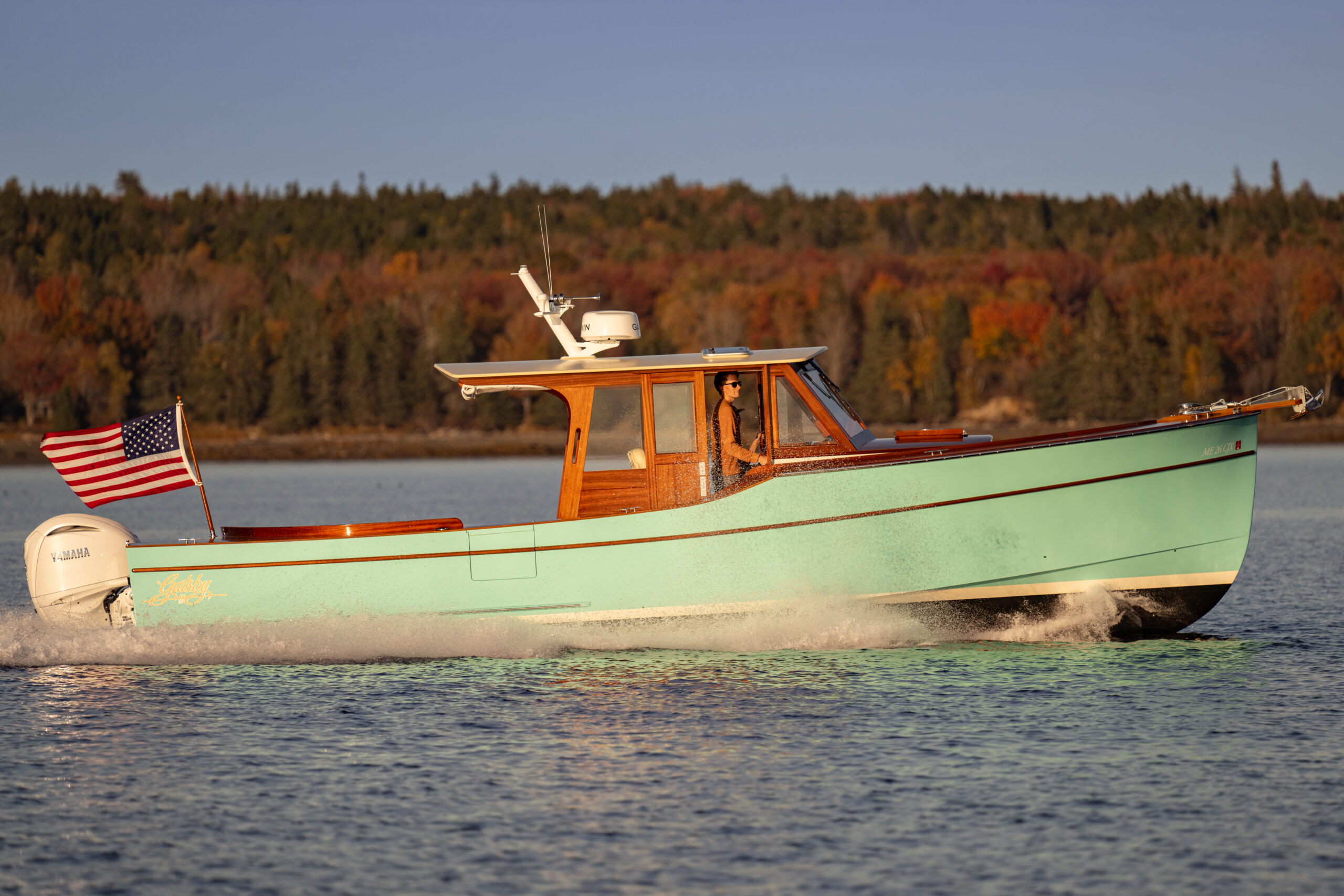
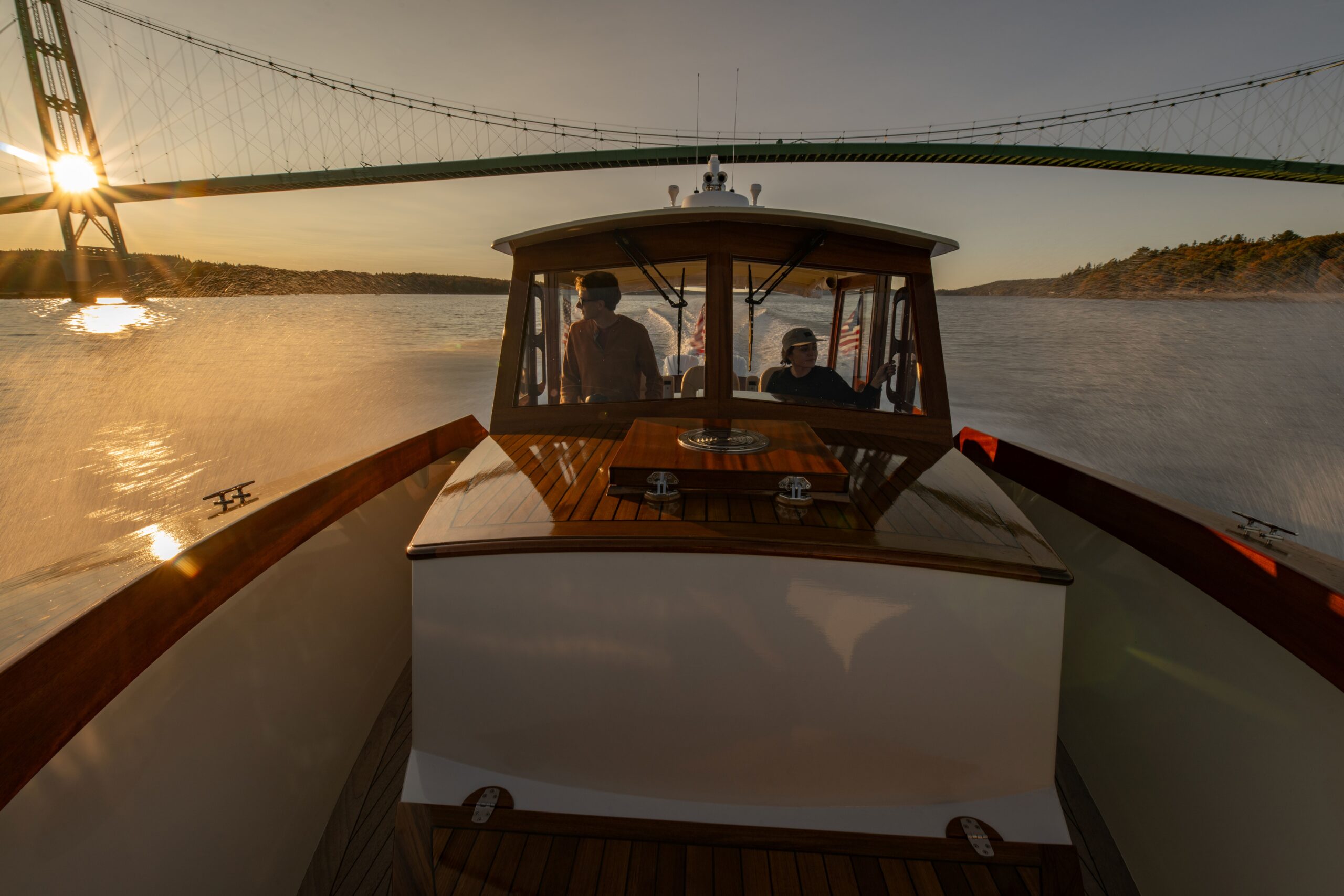
GATSBY’s hull is essentially the same as Doug’s Bowler and Top Hat designs. But each of the three designs has different sheer heights and main bulkhead locations. GATSBY’s sheer was lowered from Bowler’s to achieve a sleeker profile, and her main bulkhead is further forward to provide for an ample cockpit. With her raised foredeck, flaring bow, tumblehome stern and radiused transom, GATSBY’s topsides are a feast for the eyes.
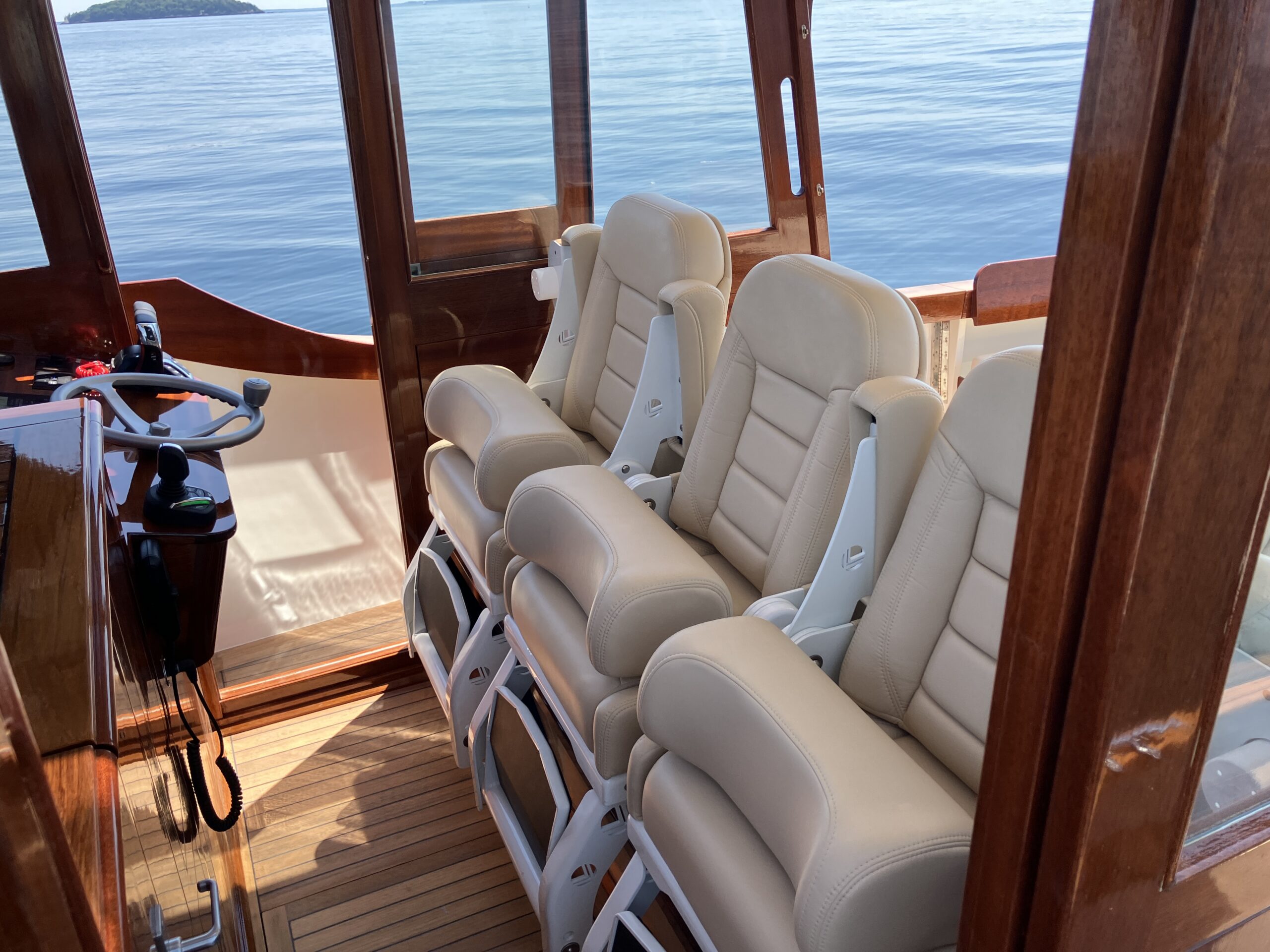
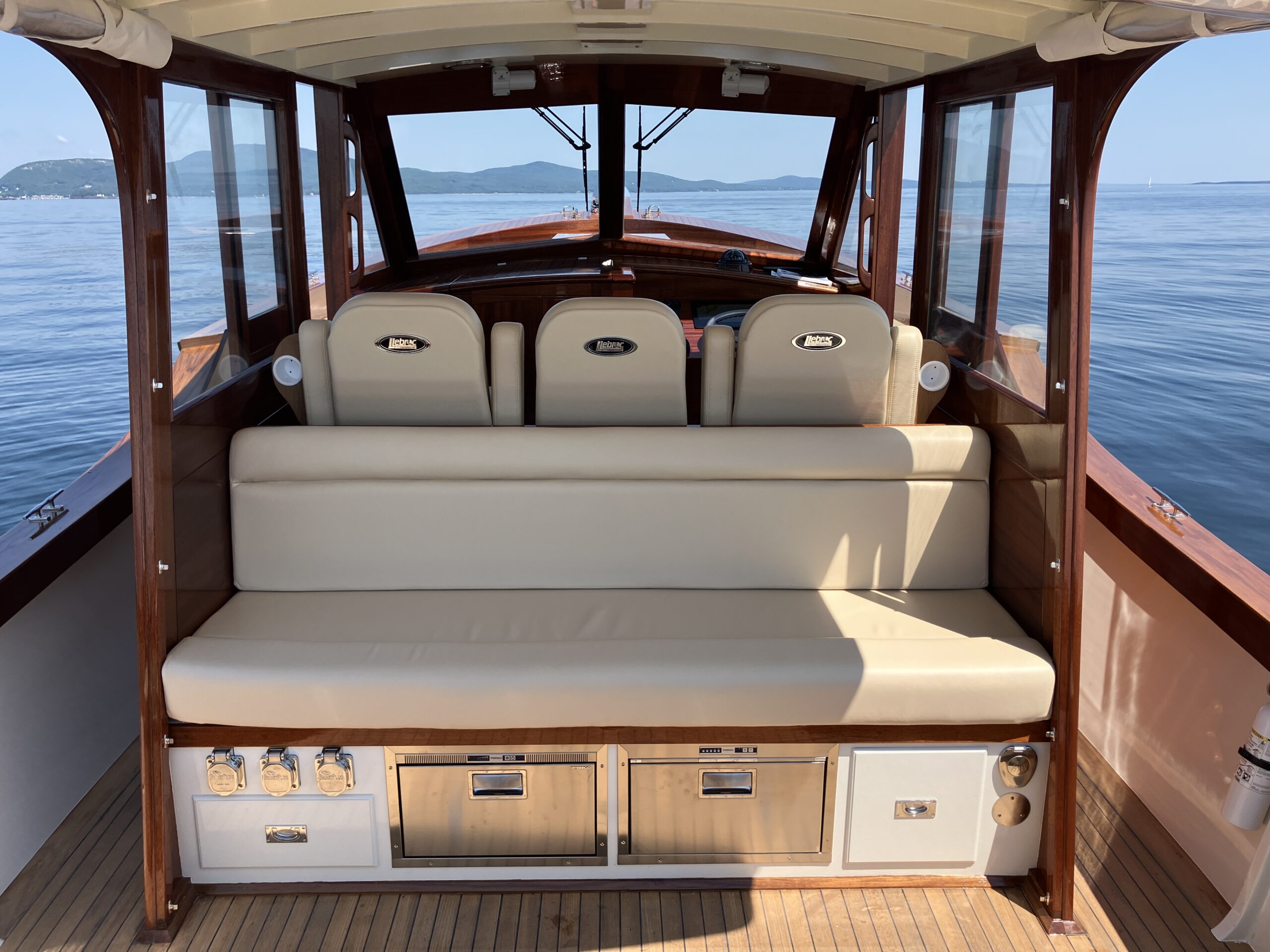
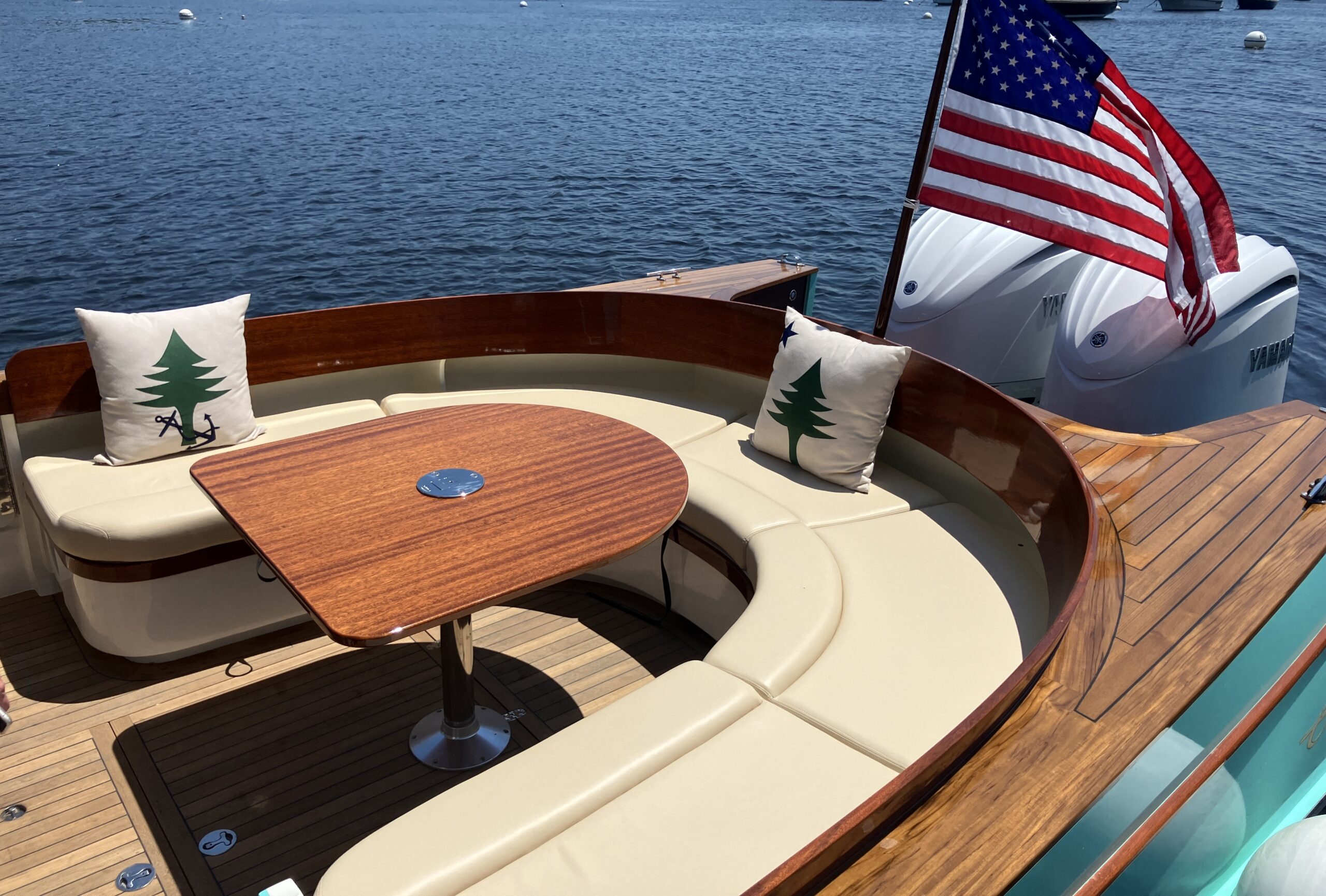
Forward of the windscreen and under the raised foredeck is a simple V-berth with plenty of storage beneath and a private head. A varnished mahogany windscreen fairs into a continuous coaming that establishes an inviting aft seating and social area. Along with the two fore and aft seat consoles further forward, GATSBY can comfortably seat as many as eight. A drop in mahogany table quickly converts the aft seating to a perfect space in which enjoy a chilled glass of wine, which is at the ready in the built-in refrigerator. The wonderfully curvaceous mahogany joinery is a joy to behold. Whether it’s in your gaze, under your hand, or against your back, the craftsmanship throughout is unmistakable. Topped off with custom colors and a brushed finish GATSBY cannot be missed!
Underwater the narrow twisting v-bottom transitions from a fine entry to a fairly flat run, resulting in a wholesome combination of good sea keeping, semi-planing speeds and fuel efficiency. A 115 HP Yamaha engine provides quiet and reliable propulsion at speeds up to 30 mph.
GATSBY was launched on July 2, 2018 in Hawkin’s Cove. Despite our best efforts to keep our launching plans under wraps, a small crowd of friends and family assembled to witness GATSBY’s first dip. It was all business as we checked bilges, scrutinized her trim, trialed systems and got underway for her first sea trial. But within 30 min we were already feeling really good about this boat and we were glad for the hugs and high fives that awaited us at the dock. As we have sorted out details and fine tuned her performance in the past few weeks, it has become clear to all of us involved that this is a special boat, and a shining example of how a collaborative process can really pay off.
GATBY’s owner is an experienced boater but new to Maine waters. An avid fisherman, his experience aboard a wide variety of sport fishing boats informed his decision making throughout the process. But from the start it was clear that this boat wasn’t about fishing, it was about family. There were conference calls involving multiple generations with a variety of opinions and perspectives, hundreds of drawings and photos exchanged covering everything from freeboard to color scheme, visits, lunch meetings, and a few last minute text messages. It all amounted to a very successful process and a vessel in which every one involved feels a great deal of pride.
We first met TOODLIN’s new owners when they visited the yard with one of our existing electric-boat clients. They joined us for a sea trial on the Benjamin River, and while they enjoyed the boat we were aboard, they were especially drawn to several other boats in the harbor. Fortunately, those boats were ours, too, and the conversation about building something together began there.
The Albury Runabout caught their eye for its handsome lines, practical size, and inviting layout. Their boat, however, would live on a Minnesota lake and be used mostly for swimming, relaxing, and “toodlin’” around. They envisioned a sleek, curvy runabout with lower freeboard, better suited to their protected waters. It would be powered by an electric motor, of course. They understood the benefits immediately: no vibration, no smelly exhaust, and no more lugging fuel containers down the steep steps to their dock.
Photo: Nick Parson
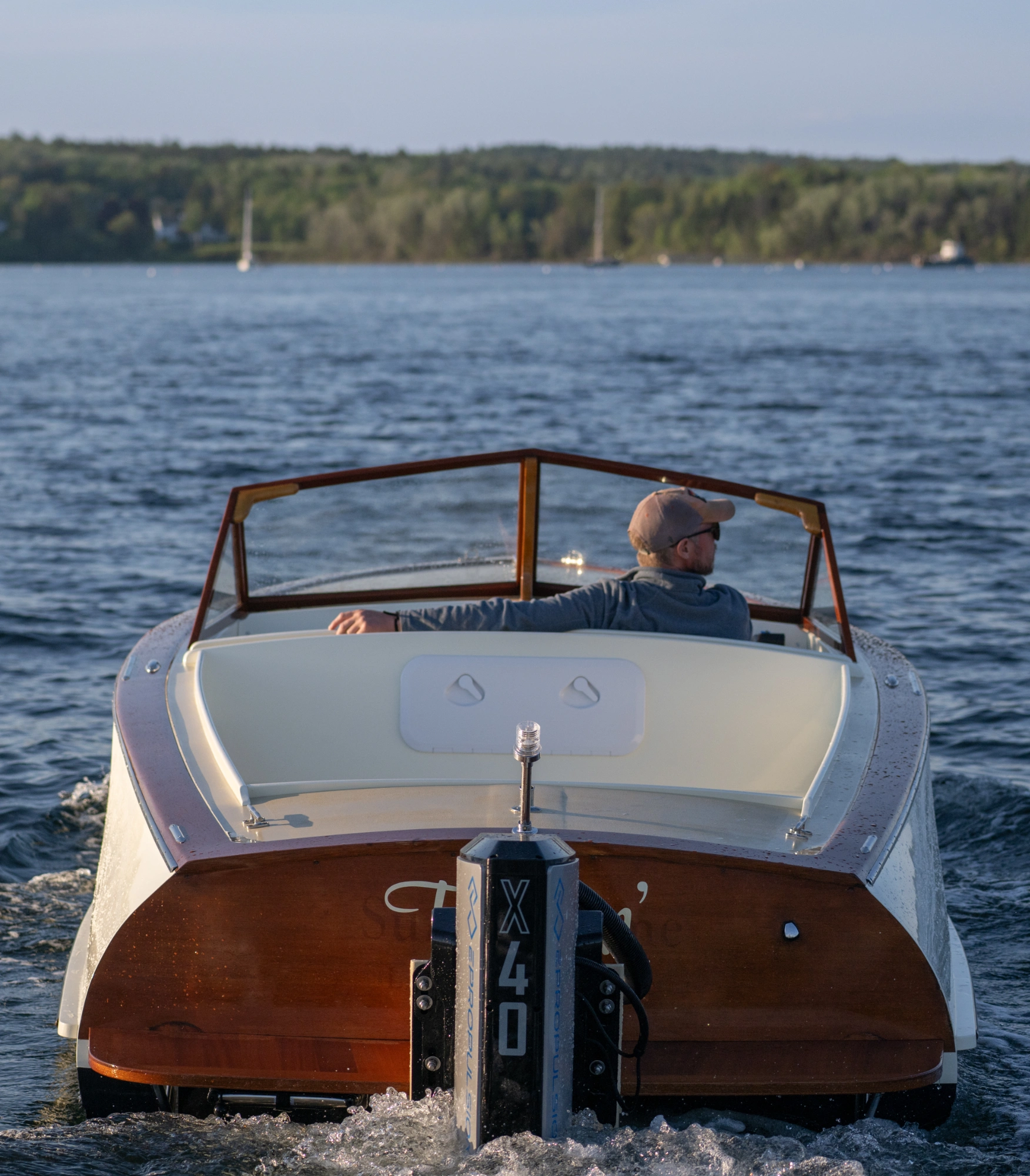
We found them a strong candidate for conversion: a 1999 Glen-L runabout. It was a home build, but capably done, with graceful topsides and a modified V-hull that could climb onto plane efficiently with modest power. The engine she came with was anything but modest: a 5.4L V8 inboard. Set amidships beneath a massive, varnished engine hatch, it dominated the boat and separated the two small cockpits.
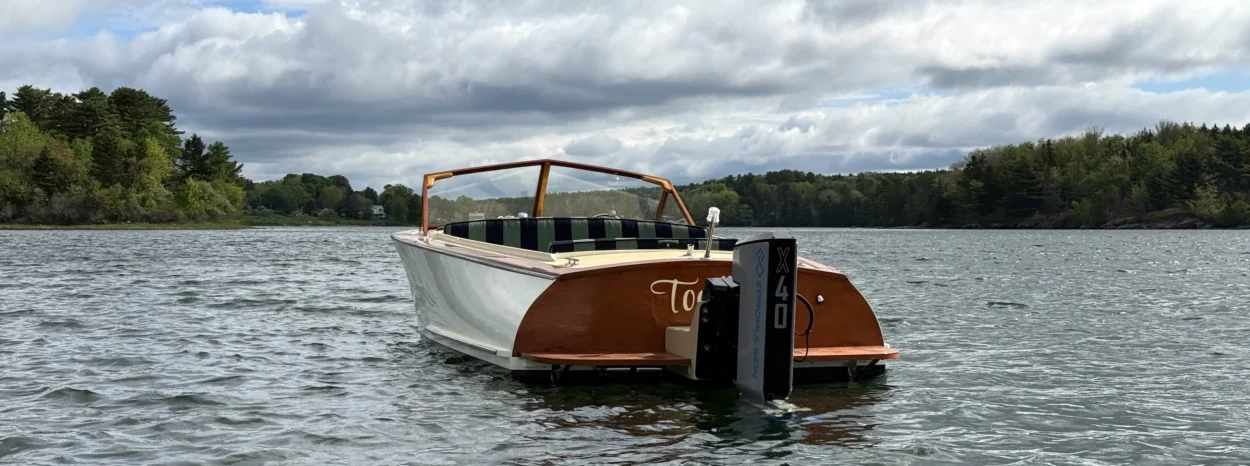
Together, we developed a plan to remove the inboard engine and open up the cockpit for more comfortable seating and lounging space. Power would come from an electric outboard mounted on an Armstrong bracket flanked by swim platforms – preserving as much usable interior space as possible, while keeping the eye-catching varnished transom intact.
Most of the owners’ time on the lake would be spent just toodlin’ around, but speed still mattered. Based on their performance goals, we selected ePropulsion’s X40 motor, powered by two of its large 96V G102-230 batteries. At 54 inches long and 400 pounds each, the batteries were a tight fit in a 19′ boat. Combined with a 220-pound motor mounted on a 20-inch offset bracket, the conversion demanded careful weight studies to ensure the boat would trim properly after such a significant reallocation of mass.
After a long road trip from Maine, she is now being enjoyed on a lake in Minnesota, where her wooden construction, hand-crafted detailing, and near-silent performance are attracting attention – and, we hope, winning a few more converts to electric power.
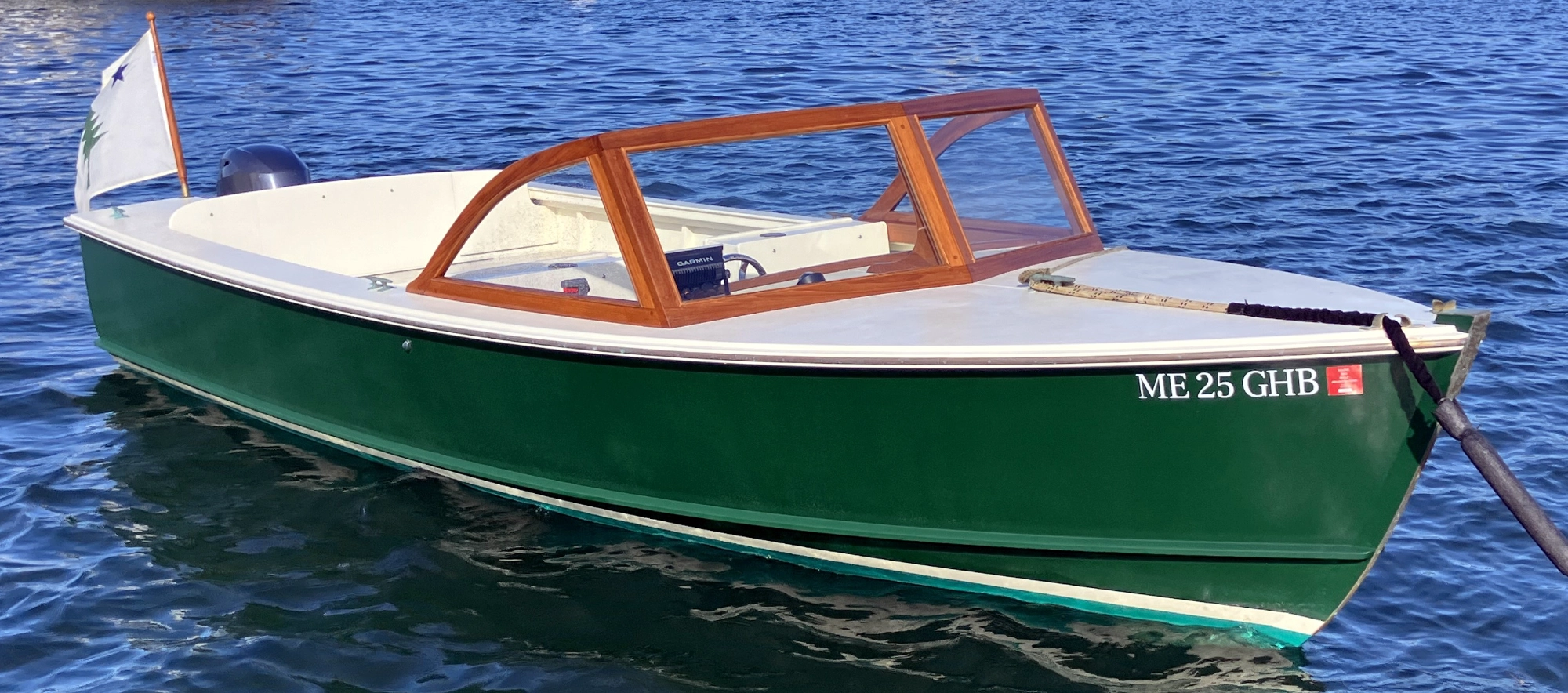
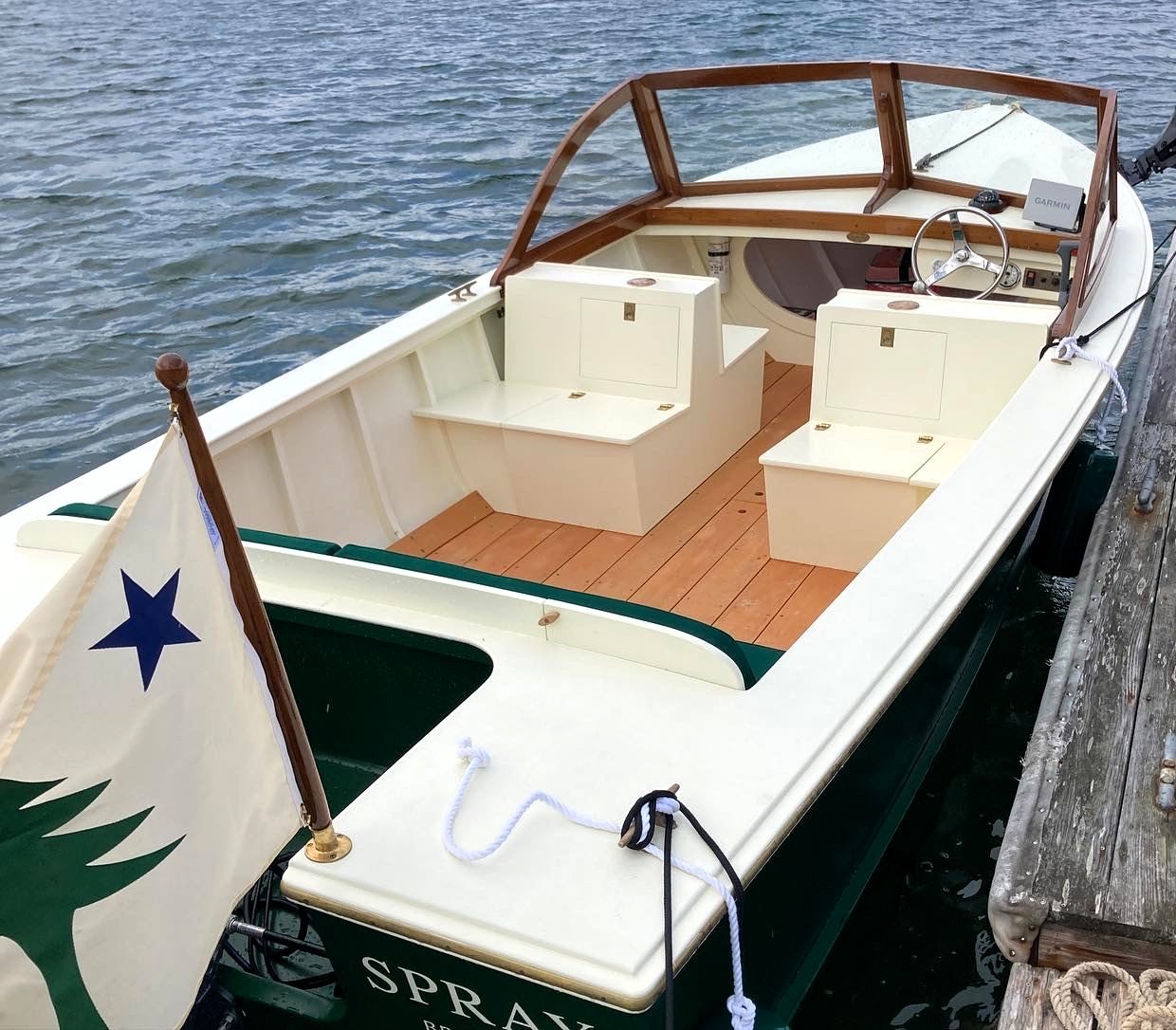
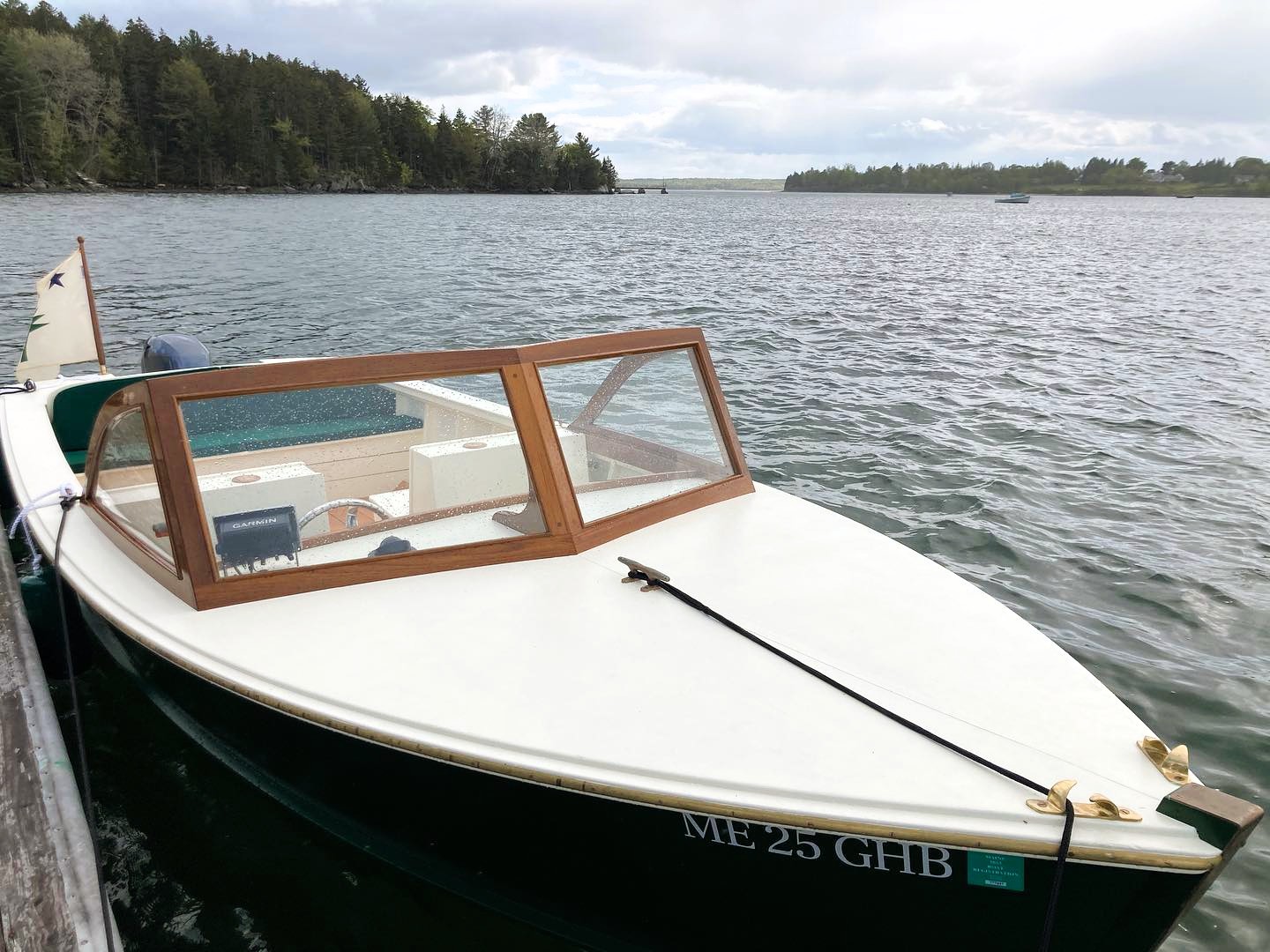
SPRAY is a new Albury Runabout, built to Doug’s plans for a Brooklin couple. Doug’s plans are based on lines taken from what Willard Albury considered his optimal boat.
This boat has already proven to be optimal in her home waters. Departing Benjamin River, she is rugged and capable enough for spur of the moment jaunts to Isle au Haut, Fox Island Thoroughfare, Swans Island, Stonington or any of the hundreds of hidden hike and picnic spots in between.
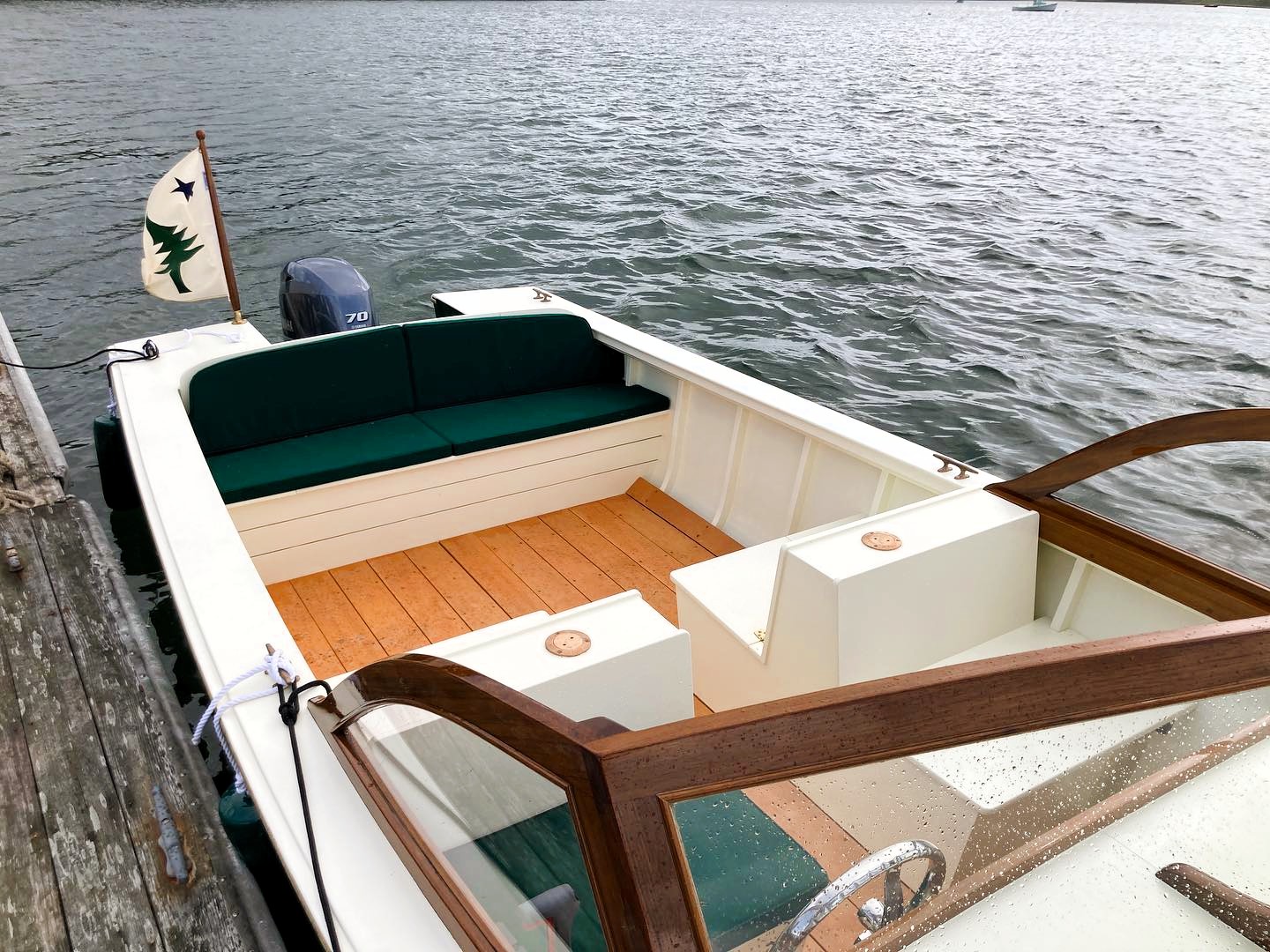
For this new Albury we added a pair of aft facing seats and a more comfortable aft bench seat with seat back.
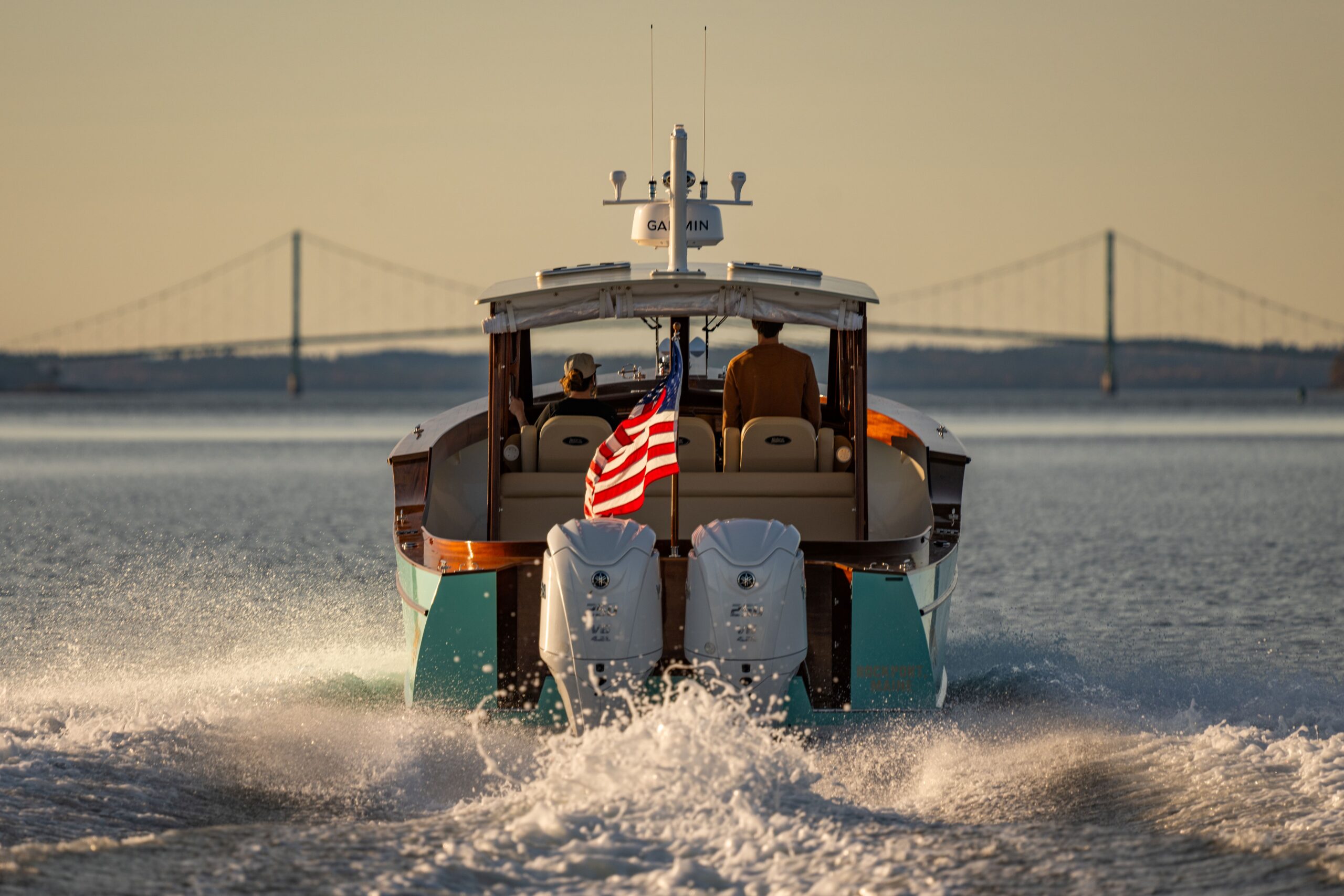
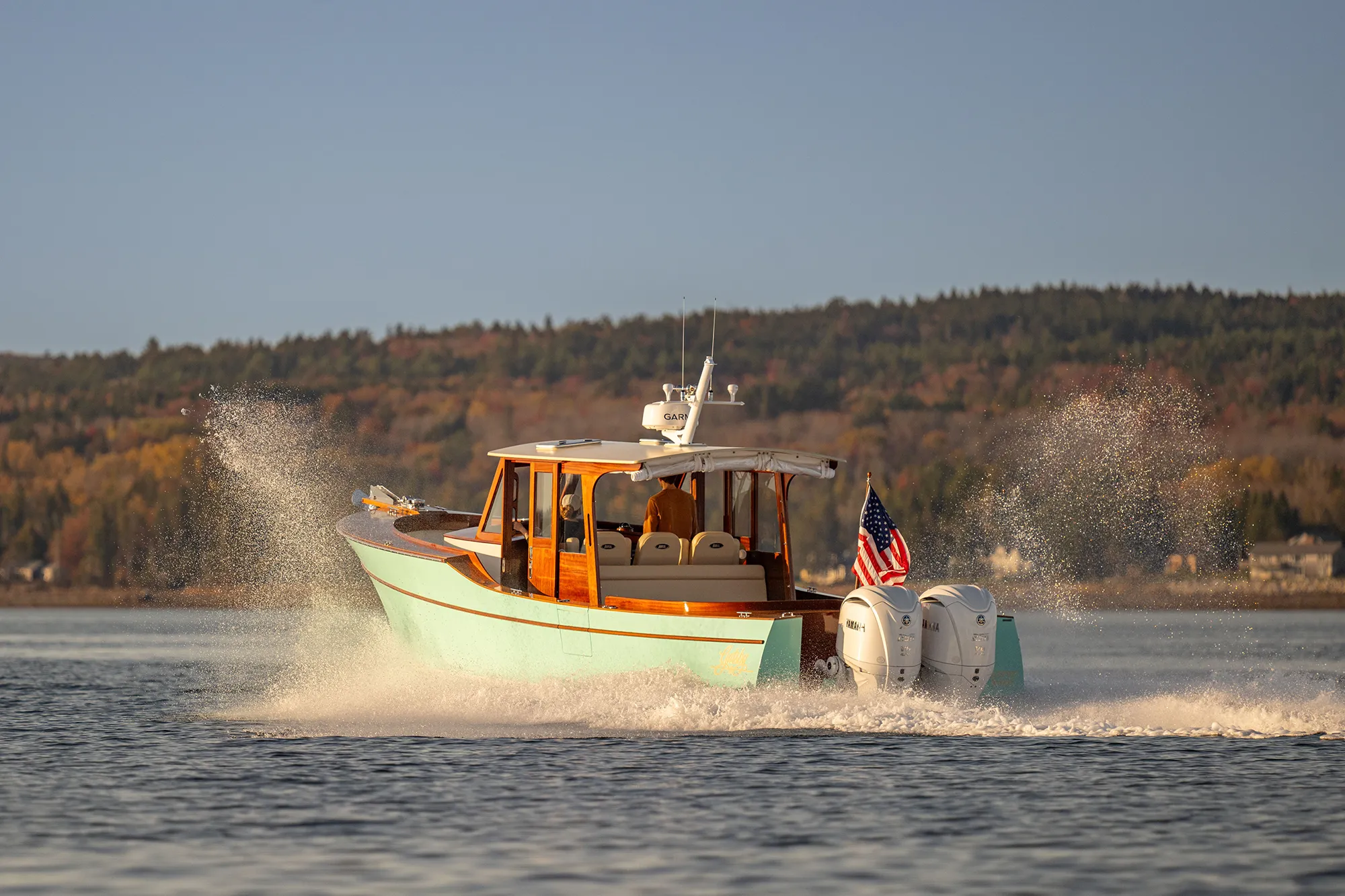
In 2018 we designed and built GATSBY for a family with a new summer home in Rockport Maine. Since then, they have loved her dearly and used her extensively for picnics and day trips around Penobscot Bay. As they discovered all the wonderful places to see and explore by boat, they began to realize they needed a boat with a bit more size, range, speed, capacity and comfort in a range of conditions.
A conversation began in 2021, and we brought in Matthew Smith, N.A. to develop the design. He worked closely with Ellery and the owners to ensure the new boat would build upon what they loved about GATSBY while also providing a whole new boating experience. Lead Builder Matthew Elwell and Designer/Systems Architect Ben Parson worked out the myriad details. Kit Macchi headed up hull and pilot house construction and Alina Johns worked tirelessly to make her shine!
Photo: Nick Parson
Photo: Nick Parson
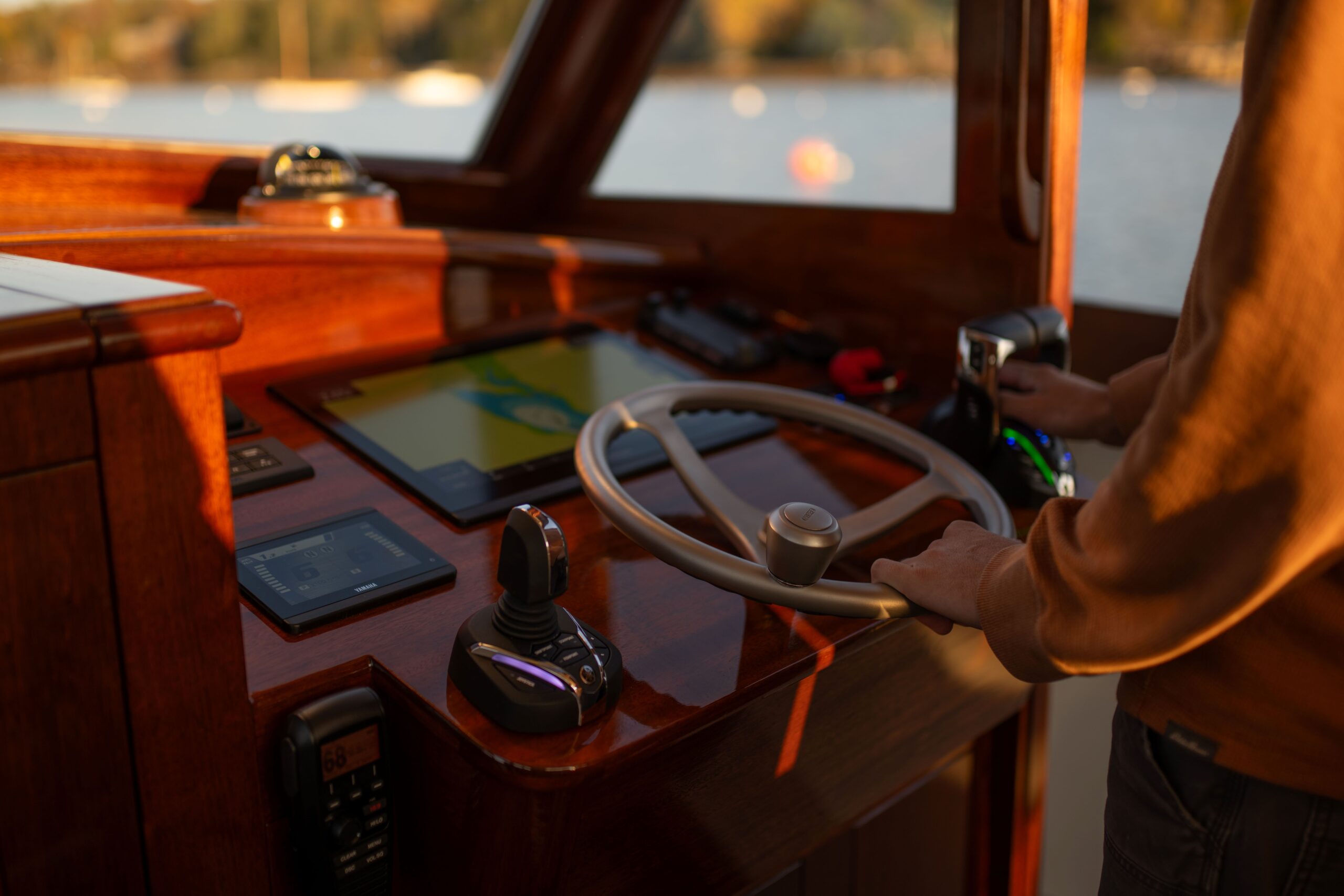
At 31′ 6″ on deck, with a 10′ 4″ beam, and displacing approximately 10,000 lbs, GATSBY II is nearly three times larger than GATSBY. But part of the challenge was to design a boat that was easier to use and handle in all ways, despite going up substantially in size. This was achieved with thoughtful design and well-placed technology: Hull doors and a “walk around” layout for moving in/out and around the boat with ease and safety; the latest technology from Yamaha provided joystick controls with bow thruster integration for effortless and intuitive docking and in-harbor handling; a SeaKeeper gyrostabilizer for comfort and stability at anchor and low speeds; a Zipwake dynamic trim control system for comfort and efficiency at speed; autopilot; electric windlass and much more.
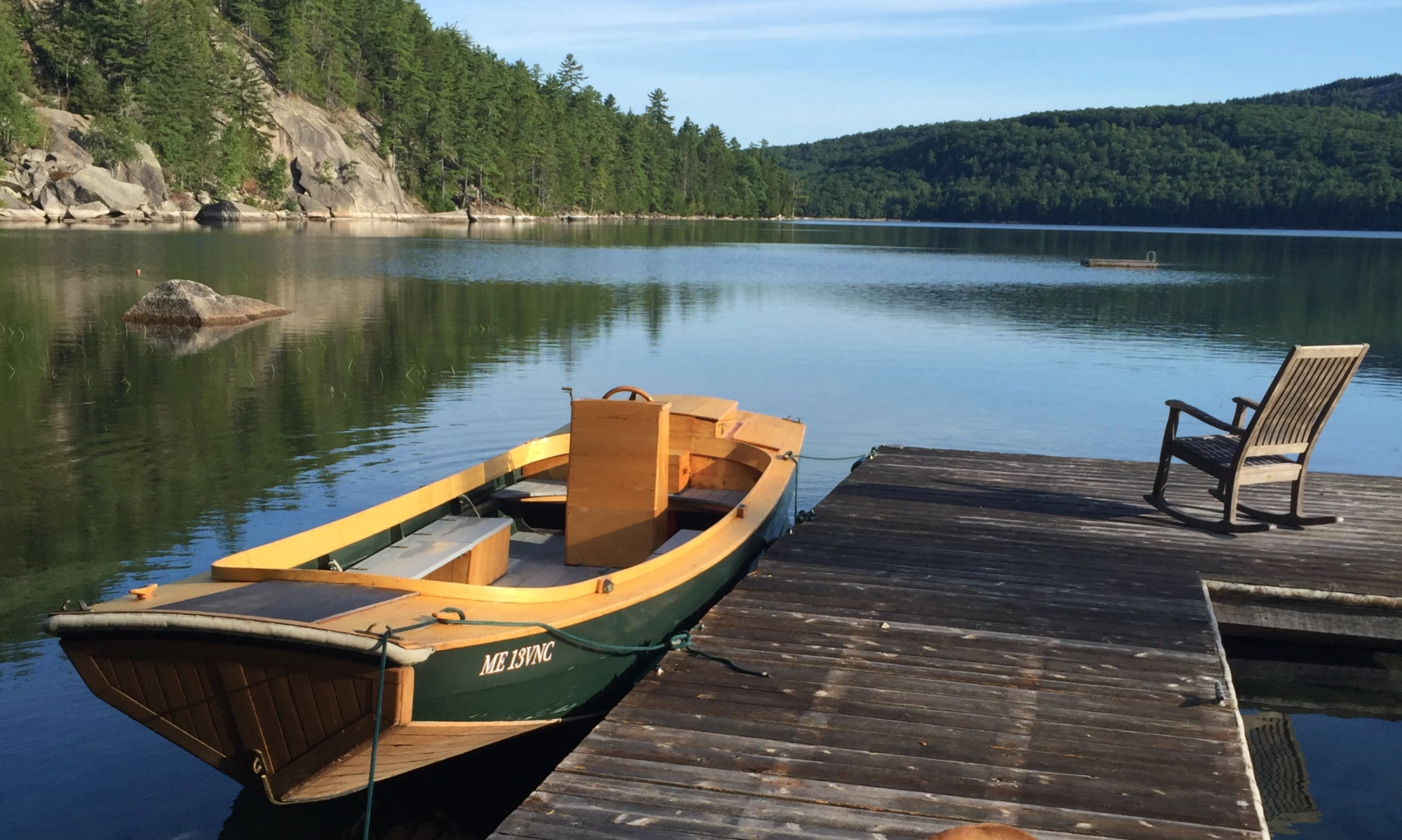
A pristine Maine pond + A cherished family cottage + a private floating dock in a quiet cove = a perfect opportunity to engage in low impact electric boating. More and more, we are encountering boaters for whom electric propulsion is the priority, not just a consideration. There are few existing production boat hulls that are suitable for maximizing the potential of electric propulsion, so there’s an opportunity for custom builders like us to design and build efficient displacement hulls to make the most of recent advancements in electric propulsion technology.
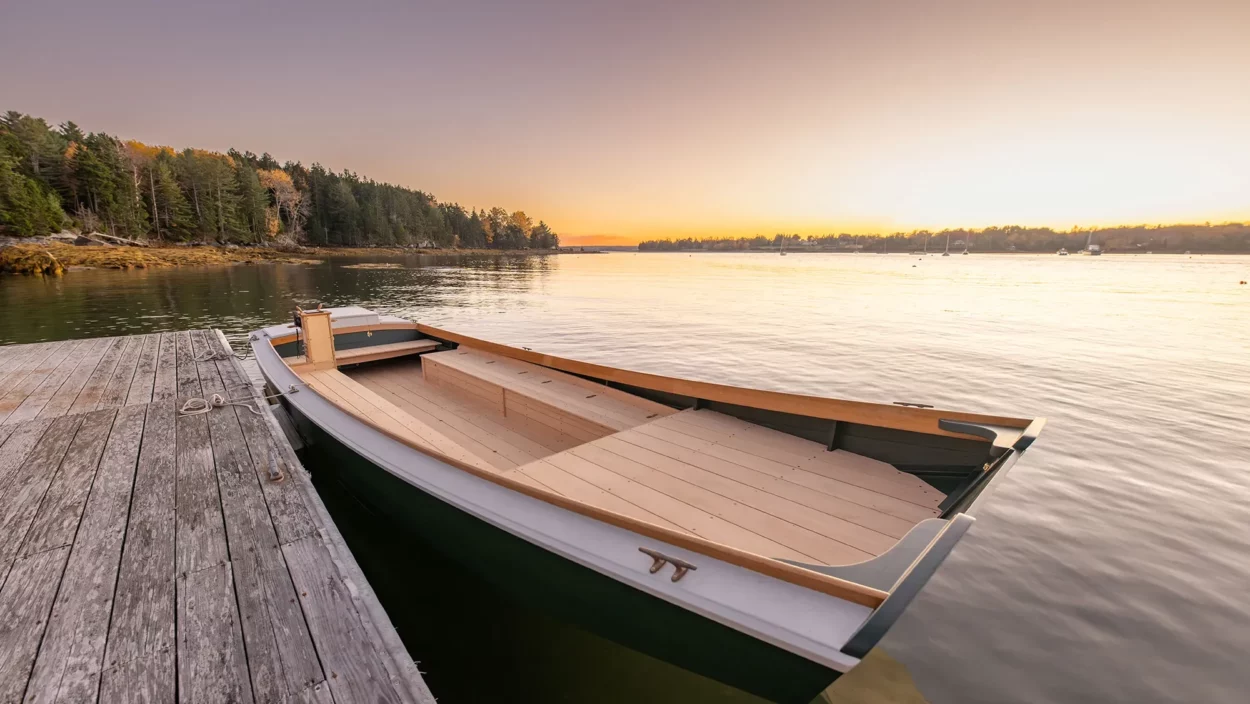
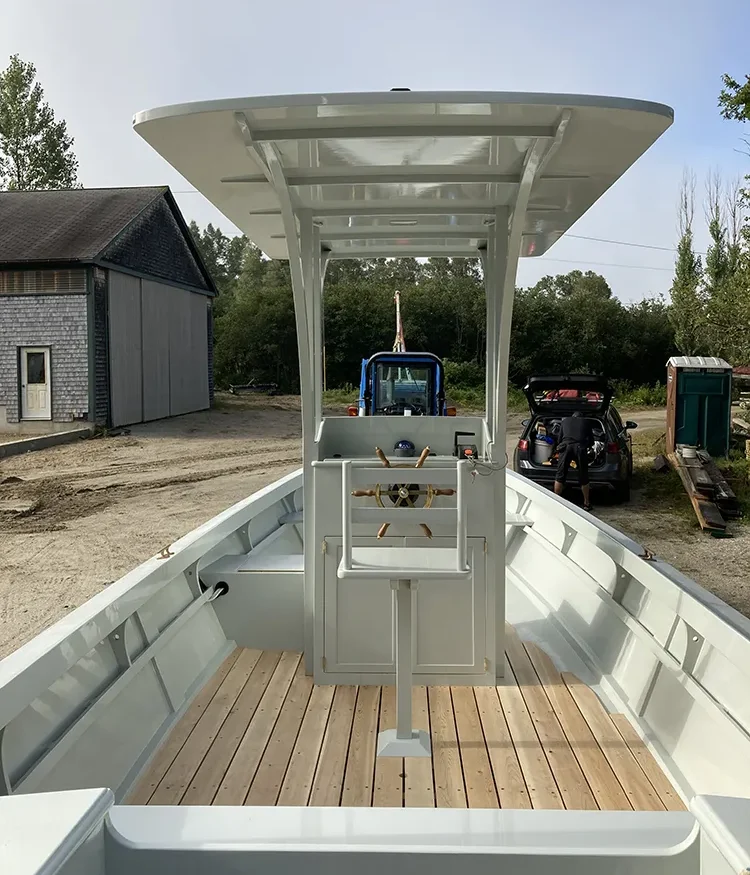
While we are designing and building you a boat that provides a noninvasive experience in a special place, we mustn’t pass up the opportunity to reference that place in the lines and details. Let’s draw from the natural environment with bare native cedar and dark green topsides. Let’s plan on at least three generations and guests and build in lots of seating. Let’s add a touch of elegance in a brass wheel and varnished coaming.
Photo: Nick Parson
Photo: Nick Parson @thesearesomephotos
In this busy bright buzzing world many of us are grasping for peace, quiet, immersion…authenticity. I can’t say a custom electric boat is the answer to anything, but it’s an opportunity to get closer to something we are yearning for.
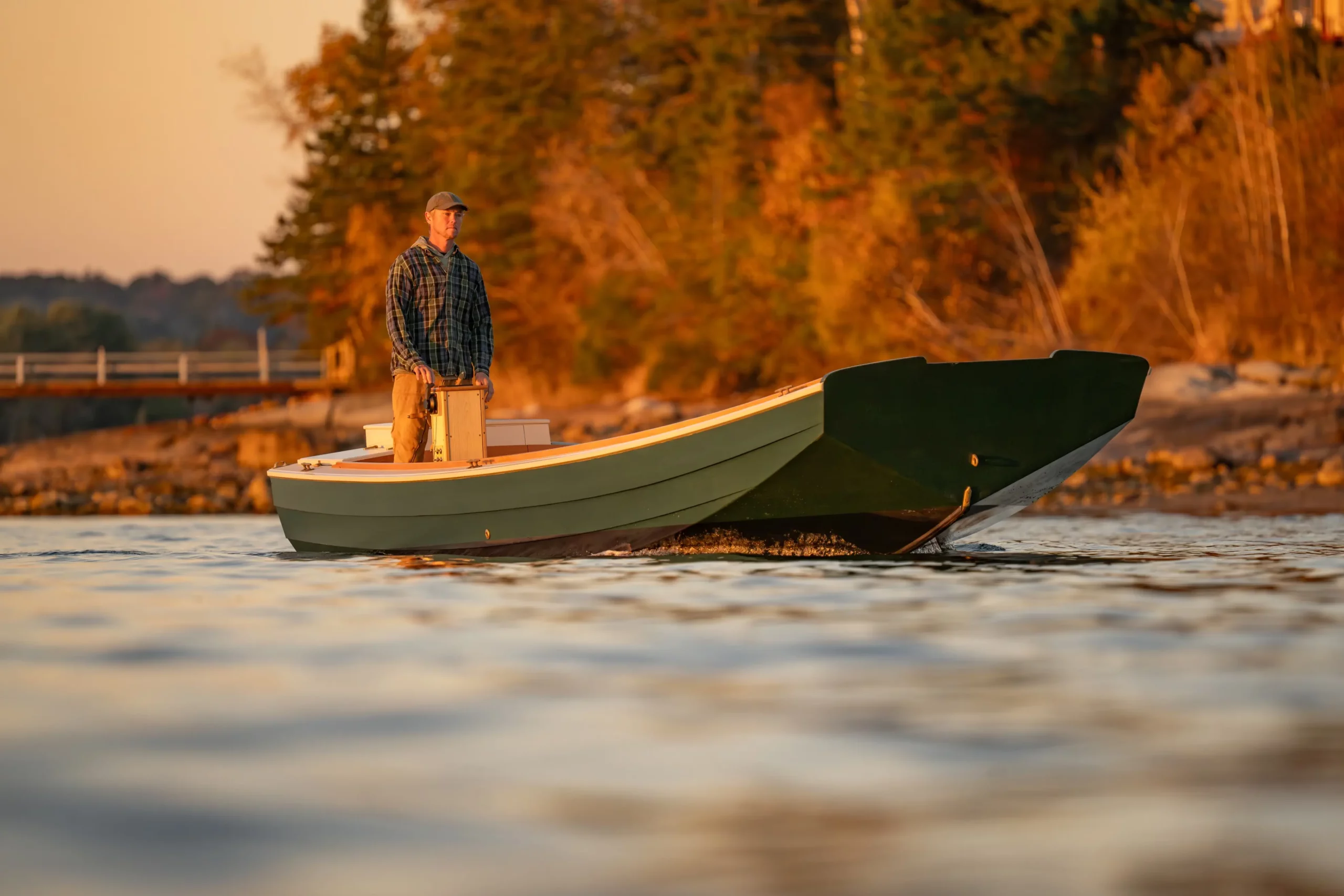
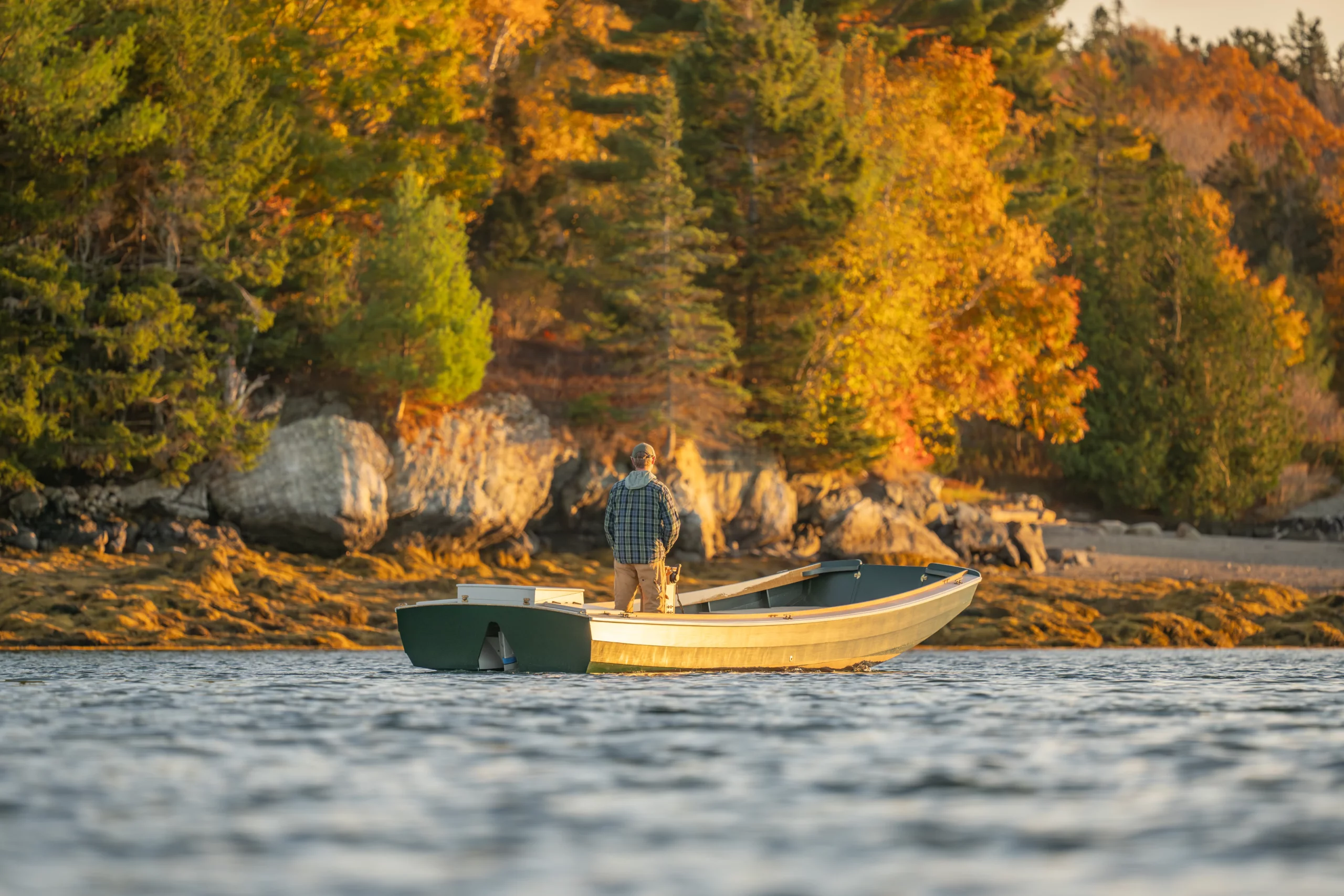
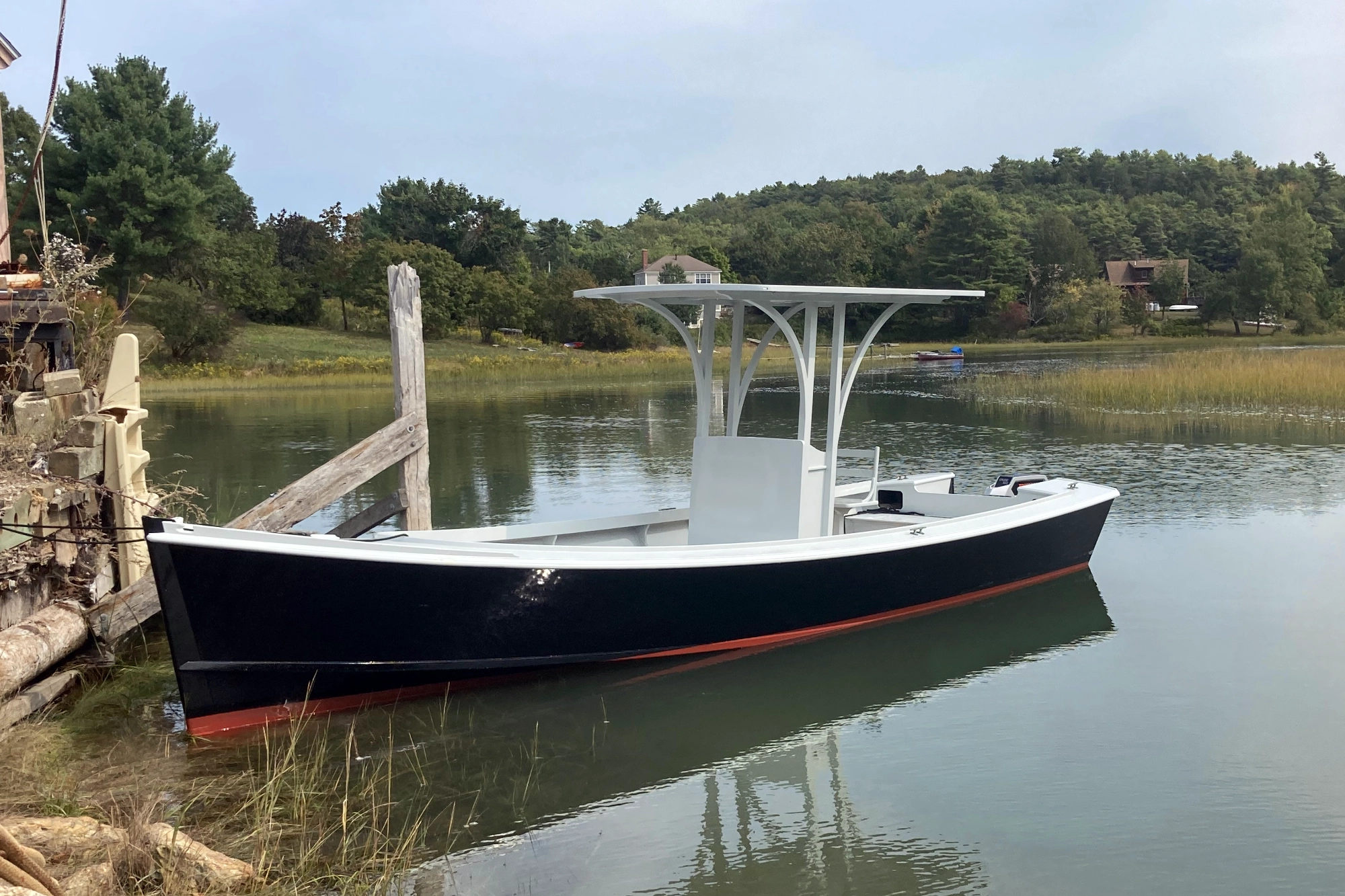
For our latest electric boat ANCHOVY we found an existing garvey design from Harry Bryan that was well suited to electric power and the pristine pond she will call home. Long, low and narrow with a non-immersed transom, the hull is inherently energy efficient. Those same qualities and her honest workboat origins make for a boat that is both wholesome and striking as she makes her way quietly across the pond.
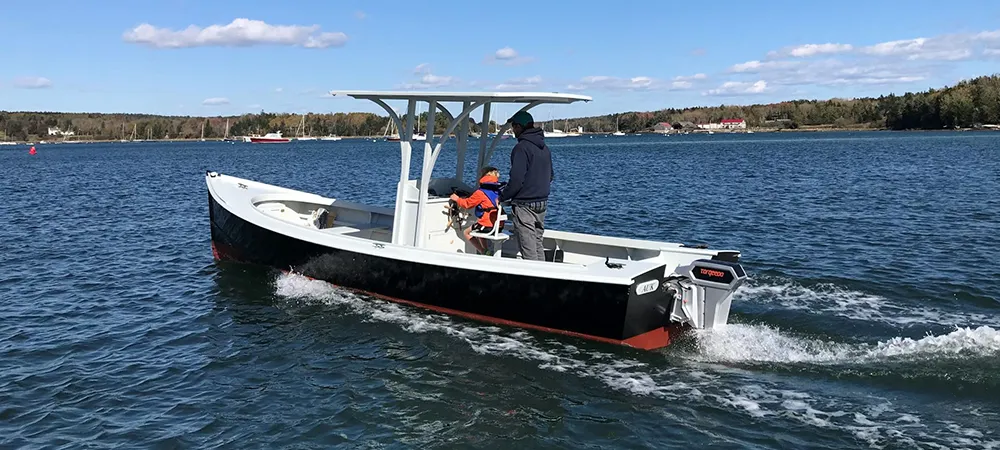
In early 2020 AUK’s owner asked us to propose an existing Hylan design that we felt would maximize the potential of the latest electric outboard technology. Doug offered his Point Comfort 23 as the best candidate, and with the help of Ocean Planet Energy we selected a Torqeedo Cruise 10.0 motor powered by a pair of their 48 V 5000 Wh batteries (later upgraded to a Cruise 12.0 and third battery). With access to 120 V service the batteries can be charged from flat in about 6 hours with the Torqeedo fast charger. For charging on the mooring and extending range, Ocean Planet Energy recommended (4) Solbian SR+ 116 panels.
As a platform for the latest electric propulsion system, AUK has lot to offer. With her plumb bow she has a long waterline for her size which makes for better performance at lower speeds. When speed is a must she planes easily with her shallow V back aft. In general the historically-inspired design represents a measure of balance that is often missing in the inefficient overpowered “Clorox bottles” that populate most of our harbors in 2020.
AUK’s aesthetic is also derived from a carefully struck balance. Her vernacular Chesapeake work boat roots mingle with a modern minimalism that modestly references the technology driving her. It is truly fun to watch her underway and consider how her far flung elements emulsify into something altogether new.
But the fun of watching her is nothing compared with the thrill of being aboard. As you cast off and navigate the harbor the silence slowly dawns on you. After a few minutes underway you will begin to understand that this isn’t just a new kind of boat, it’s a new kind of boating! One where we’ve regained our senses, where we can enjoy the moment not just the destination, where we can appreciate the world around us without actively degrading it. Here’s to the future of electric boating!